Nvidia just did something it has never done before—and the message is unmistakable. On Wednesday, the company issued its first-ever year-ahead revenue forecast, projecting a staggering 70% growth for fiscal 2028. The number implies revenue between $690 billion and $700 billion, a figure that blows past what Wall Street's most optimistic models had dared to predict.
The $100 Billion Gap That Shook the Market
Analysts had been modeling fiscal 2028 revenue at roughly $570 billion—a 44% growth rate from the current fiscal year. Nvidia's own projection lands more than $100 billion higher. That gap isn't a rounding error; it's a statement of intent.
For a company already valued as the poster child of the AI revolution, this forecast is a declaration that the boom is nowhere near its peak. The after-hours stock rally that followed suggests investors are inclined to believe it.
Why Jensen Huang Decided to Break With Tradition
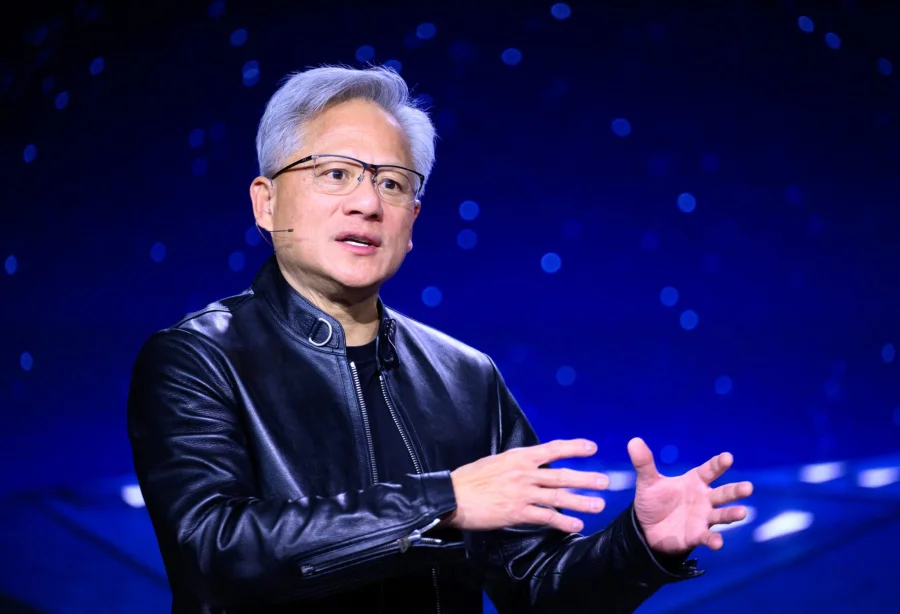
Nvidia has historically guided quarter by quarter, keeping its cards close. Wednesday's move changes that calculus. "We wanted to make sure that everybody has the same set of information," CEO Jensen Huang said on the conference call. "We've got a huge year coming up next year."
The subtext is hard to miss. By offering unprecedented forward visibility, Huang is daring skeptics to challenge the numbers. It's a confidence play from a CEO who sees demand growing at 100%—and wants the world to know it.
The AI Bubble Debate: What This Forecast Really Targets
For months, critics have warned that AI infrastructure spending resembles a bubble—and that "circular financing" among tech giants could be inflating demand artificially. The theory goes that companies are buying Nvidia chips partly because they're raising capital on the promise of AI, creating a feedback loop that could unwind.
Nvidia's 70% projection is a direct rebuttal. If demand were merely circular, the argument goes, it wouldn't be growing at 100%. Huang's message to doomsayers: the orders are real, the customers are real, and the growth is real.
What 70% Growth Actually Means for Real Businesses
Behind the billion-dollar figures are tangible consequences for companies building AI infrastructure. Cloud providers, enterprise software firms, and even government-backed AI initiatives are all competing for Nvidia's limited supply. A 70% growth forecast signals that Nvidia expects its customers to keep spending at unprecedented levels—and that supply constraints will persist.
For smaller AI startups, this could mean continued difficulty accessing cutting-edge chips. For hyperscalers like Microsoft, Amazon, and Google, it means their capital expenditure plans are validated. For the broader market, it's a signal that the AI buildout is accelerating, not cooling.
Wall Street's Reaction: Euphoria With a Side of Caution
The after-hours rally reflects genuine enthusiasm, but seasoned investors know that guidance is not delivery. Nvidia's forecast is preliminary, and fiscal 2028 is still two years away. Between now and then, macroeconomic conditions, export controls, and competitive pressures could all shift the picture.
Analysts who had modeled $570 billion will now scramble to revise their estimates upward. But the risk cuts both ways—if Nvidia fails to hit its own ambitious target, the credibility damage could be significant.
Confirmed Numbers vs. What Remains Unclear
What we know: Nvidia issued a preliminary expectation of 70% revenue growth for fiscal 2028, implying $690-700 billion. CEO Jensen Huang confirmed 100% demand growth for AI chips. The stock rose in after-hours trading.
What remains unclear: The exact breakdown of revenue by segment, whether export restrictions will impact the forecast, and how much of the projected growth depends on a handful of hyperscale customers. Nvidia has not yet provided detailed segment-level guidance for fiscal 2028.
Why Nvidia's Position Is Hard to Challenge Right Now
Nvidia's dominance isn't just about having the best chip—it's about the entire ecosystem built around it. The CUDA software platform, the networking infrastructure, the developer community, and the supply chain relationships create a moat that competitors like AMD and Intel have struggled to breach.
Even if a rival produces a comparable GPU, switching costs remain high. Enterprises have optimized their entire AI stacks around Nvidia's architecture. That lock-in effect is a key reason why Huang can project 70% growth with apparent confidence.
The Risks Behind the Optimism
No forecast exists in a vacuum. Export controls on advanced chips to China could constrain addressable markets. Geopolitical tensions could disrupt supply chains. And the circular financing concern—while dismissed by Nvidia—hasn't fully disappeared from the conversation.
There's also the question of concentration. If a significant portion of Nvidia's projected growth depends on a few hyperscalers, any pullback in their capital expenditure plans would hit Nvidia disproportionately. The company's own guidance acknowledges a "huge year" but doesn't detail the customer mix behind it.
The Bigger Pattern: AI Infrastructure Is Entering a New Phase
Nvidia's forecast is part of a broader trend: AI spending is shifting from experimentation to full-scale deployment. Companies are no longer testing AI capabilities—they're building production systems that require massive, sustained compute investment. This is the difference between a bubble and a buildout.
If Nvidia's numbers hold, it would mean the AI infrastructure market is growing faster than any major technology cycle in recent memory—faster than the internet boom, faster than cloud computing's early years.
What Investors and Businesses Should Watch Now
For investors, the key metric to track is not just Nvidia's revenue but its order backlog and customer concentration. Watch for quarterly commentary on whether demand is broadening beyond hyperscalers. For businesses planning AI investments, the forecast suggests that chip supply will remain tight—locking in partnerships early may be prudent.
For skeptics, the test will be whether Nvidia's customers can generate meaningful returns on their AI spending. If they can, the 70% forecast will look conservative in hindsight. If they can't, the circular financing argument gains new life.
What Happens Next: The Road to Fiscal 2028
Nvidia will need to deliver strong results through fiscal 2027 to build confidence in its 2028 projection. Each quarterly earnings report will be scrutinized for signs of momentum or cracks. The company's next major product cycles—including next-generation architectures—will be critical to sustaining the growth trajectory.
One thing is certain: Nvidia has raised the bar for itself. By issuing a year-ahead forecast, it has created a benchmark that investors will hold it to. The company has chosen transparency over caution—and now it has to deliver.
Our Take
Nvidia's first-ever year-ahead forecast is more than a financial update—it's a power move. By projecting 70% growth, Huang is telling the market that the AI revolution is real, durable, and still accelerating. The move also carries strategic weight: it forces competitors, customers, and critics to operate on Nvidia's terms.
But bold guidance cuts both ways. If Nvidia hits these numbers, it will cement its place as one of the most successful companies in business history. If it falls short, the backlash will be fierce. For now, the market is choosing to believe the vision—and the after-hours rally shows that confidence remains high.
Frequently Asked Questions
What is Nvidia's fiscal 2028 revenue forecast?
Nvidia projected 70% revenue growth for fiscal 2028, implying revenue in the range of $690 billion to $700 billion, based on expected fiscal 2027 revenue. This is significantly higher than analyst consensus of roughly $570 billion.
Why did Nvidia issue a year-ahead forecast for the first time?
CEO Jensen Huang said the company wanted to ensure "everybody has the same set of information" ahead of a major growth year. The move is widely seen as an attempt to address AI bubble concerns and provide transparency to investors.
What is the "circular financing" concern about Nvidia?
Critics have suggested that some AI companies are buying Nvidia chips using capital raised on AI promises, creating a feedback loop that could unwind. Nvidia's 70% growth forecast is a direct rebuttal, suggesting demand is genuine and growing at 100%.
How did the market react to Nvidia's forecast?
Nvidia's stock rallied in after-hours trading following the announcement, indicating that investors responded positively to the stronger-than-expected growth projection.