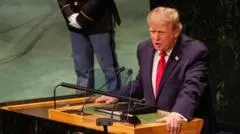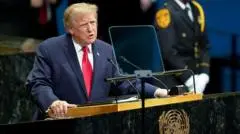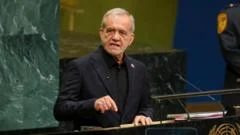
Iran's president walked to the UN podium with a message aimed squarely at Washington — and he did not soften it. Masoud Pezeshkian declared that Iran will never "bend the knee," a direct retort to President Donald Trump's threat to "annihilate" Iran if a peace deal is not agreed soon.
The moment crystallised a standoff that has been building for weeks: two leaders speaking past each other, each betting the other will blink first.
A Podium, A Warning, And A Line Drawn In Public
Pezeshkian's speech was less a diplomatic overture than a public refusal. By framing Iran's position as a matter of national dignity — never bending the knee — he signalled that pressure from Washington would not produce a quick concession.
The language matters. In UN diplomacy, leaders usually leave room for negotiation. Pezeshkian's phrasing closed some of that space, at least rhetorically.
Why Trump's "Annihilate" Threat Changed The Temperature
Trump's warning that Iran could be "annihilated" if no peace deal is reached soon set the terms of this exchange. It was a maximalist threat — the kind that forces a response.
For Pezeshkian, staying silent was not an option. For Washington, the threat was likely meant as leverage. But leverage only works if the other side believes backing down is survivable. Iran's president just told his audience it is not.
How The Two Leaders Reached This Point
The confrontation did not emerge overnight. It reflects a longer pattern of failed negotiations, sanctions, and mutual distrust between Washington and Tehran.
Trump's approach has leaned on pressure and deadlines. Iran's response, under Pezeshkian, has leaned on public defiance and refusal to appear coerced. Each side's strategy feeds the other's.
Who Feels This First — And Why It Matters Beyond The UN Hall
Ordinary Iranians have lived under sanctions, currency pressure, and uncertainty for years. A collapsed diplomatic track would likely mean more of the same — or worse.
For the wider region, the stakes are higher. Any escalation between the US and Iran ripples through oil markets, shipping routes, and the calculations of allies from Israel to the Gulf states.
What Officials And Analysts Are Saying
Pezeshkian's remarks were delivered publicly and on the record. Trump's threat was likewise public. Neither side has issued a formal walk-back.
Analysts caution that public rhetoric in UN settings often exceeds what happens in private channels. But when both sides escalate in the same week, the room for quiet diplomacy narrows.
Reading The Subtext: Dignity As Strategy
"Bend the knee" is not diplomatic language — it is cultural and historical. Pezeshkian is invoking a narrative of sovereignty that resonates at home, where any sign of capitulation to Washington would be politically costly.
That makes the speech as much about domestic credibility as about Trump. Iran's leadership needs to be seen as unbowed, especially after years of economic strain.
Confirmed Facts vs What Remains Unclear
Confirmed: Pezeshkian said Iran will never "bend the knee." Trump threatened to "annihilate" Iran absent a peace deal soon. Both statements were public.
Unclear: Whether any formal negotiations are underway, what terms either side would accept, and whether back-channel contacts continue. No verified deal framework has been disclosed.
Risks And The Case Against Optimism
The obvious risk is miscalculation. When leaders stake their credibility on not backing down, small incidents can spiral.
Critics of Trump's approach argue that threats of annihilation reduce the incentive for Tehran to negotiate at all. Critics of Iran's position argue that defiance without a diplomatic off-ramp leaves ordinary citizens bearing the cost.
Both critiques can be true at once.
A Wider Pattern: Pressure Versus Sovereignty
This exchange fits a broader trend in which major powers use public ultimatums, and smaller or sanctioned states respond with sovereignty narratives. The script is familiar — and rarely ends quickly.
It also reflects a shift in how diplomacy is conducted: less in closed rooms, more on stages and social platforms, where audiences are domestic as much as foreign.
What Readers Should Watch Next
Watch for three signals: any resumption of formal talks, any change in sanctions enforcement, and any third-party mediation — from Europe, the Gulf, or elsewhere.
Also watch the tone. If either side softens its public language, that is often the first sign of a real opening.
Future Outlook
Nothing in this exchange suggests an imminent breakthrough. The more likely near-term path is continued public posturing, with quiet contacts tested and abandoned depending on domestic pressures.
A deal remains possible — but not while both leaders are publicly committed to not being the one who blinks.
Our Take
This is a story about two leaders speaking to their own audiences first. Pezeshkian's "bend the knee" line was aimed at Iranians as much as at Trump. Trump's "annihilate" threat was aimed at his base as much as at Tehran.
That is why the rhetoric is so sharp — and why the diplomatic path is so narrow. The real question is not who is tougher. It is whether either side has left itself room to move.
Frequently Asked Questions
What did Iran's president say to Trump at the UN?
Masoud Pezeshkian said Iran will never "bend the knee," rejecting US pressure in his UN address.
What did Trump threaten to do to Iran?
Trump threatened to "annihilate" Iran if a peace deal is not agreed soon.
Is there a US-Iran peace deal in place?
No. No confirmed deal or formal framework has been announced.
Why does this matter for the region?
Escalation between the US and Iran can affect oil markets, shipping, and the security calculations of allies across the Middle East.