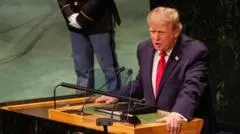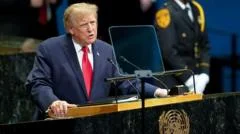
Donald Trump stood at the UN General Assembly podium and framed the future of US-Iran relations as a coin toss — a peace deal, or something far worse. In the same city, on the same day, officials from both countries sat down on the sidelines. That contradiction is the story.
What Trump Actually Said — And Why the Word 'Annihilate' Landed Hard
According to the original report, Trump used his address to ponder aloud whether a peace deal would be agreed, or whether he would have to take extreme action against Iran. The framing was deliberately binary: deal or destruction.
That word — "annihilate" — is not diplomatic language. It is pressure language. And in the theatre of the UN, where every phrase is calibrated, it was meant to be heard in Tehran as much as in the chamber.
Why a UN Speech About Iran Matters Beyond the Room
Iran sits at the centre of several fault lines at once: nuclear negotiations, regional proxy conflicts, Gulf security, and global oil supply. Any US president's words on Iran move markets, reassure or alarm allies, and shift the calculus in ongoing back-channel talks.
When the language is this extreme, the cost of misreading it is high — on all sides.
The Detail That Changes the Story: Officials Met on the Sidelines
The headline fact is not just the threat. It is that officials from both countries met on the sidelines of the same UN gathering. That is not how two countries on the brink of war usually behave.
Public threats and private meetings can coexist — and often do. But the gap between them is where the real negotiation lives.
Who Feels This First: The Human and Regional Cost
For ordinary Iranians, the threat of "annihilation" is not abstract. It is a reminder of sanctions, isolation, and the fear of escalation. For US allies in the Gulf, it is a signal to prepare for multiple scenarios. For global markets, it is a reason to watch the next headline closely.
Diplomacy rarely fails in a single moment. It fails when the public and private tracks stop talking to each other.
What Is Confirmed — And What Is Still Unclear
Confirmed: Trump made the remark in his UN address, weighing a peace deal against extreme action. Officials from both countries met on the sidelines, per the original report.
Unclear: What was discussed in that meeting. Whether Iran responded officially. Whether any framework exists. Whether the threat was rhetorical pressure or a policy signal. All of that remains unverified.
The Pattern Behind the Rhetoric
This is not the first time maximalist language has been paired with quiet diplomacy. Pressure and negotiation are often two hands of the same strategy — one to force movement, the other to catch it.
Whether that is what is happening here, or whether the two tracks are genuinely diverging, is the question analysts will be asking in the coming days.
Risks and the Balanced View
The risk of this approach is miscalculation. A threat this severe, delivered publicly, can corner the other side into a response it might not otherwise choose. It can also reassure hardliners at home while alarming allies abroad.
The counter-argument: without pressure, talks stall. Supporters of the approach would say the meeting on the sidelines only happened because the stakes were raised. Critics would say the same language makes a deal harder to sell in Tehran.
Both readings are plausible. Neither is confirmed.
What Readers Should Watch Next
Watch for any official Iranian response — or deliberate silence. Watch whether the sideline meeting produces a follow-up. Watch whether the rhetoric softens or hardens in the days after the UN gathering.
For now, the only honest position is this: the threat is real, the meeting is real, and the outcome is not yet written.
Future Outlook
If the private track holds, the speech may be remembered as pressure, not policy. If it collapses, the same words will be read as a warning that was ignored. Which version becomes history depends on what happens next — not on what was said at the podium.
Our Take
The most important line in this story is not the threat. It is the meeting. Two countries that are truly done talking do not sit down on the sidelines of the same summit. That does not mean peace is near — it means the door is not closed. And in US-Iran relations, an open door is never a small thing.
Frequently Asked Questions
What did Trump say about Iran at the UN?
In his UN General Assembly address, Trump said he was weighing whether a peace deal would be agreed with Iran or whether he would have to take extreme action against it — including the word "annihilate."
Did US and Iranian officials actually meet?
Yes, according to the original report, officials from both countries met on the sidelines of the UN gathering. The content of that meeting has not been confirmed.
Does this mean a US-Iran war is imminent?
No. The speech was a threat, not a declaration. The simultaneous sideline meeting suggests diplomacy is still active. The situation is fluid and unconfirmed.
Why does this matter for the rest of the world?
Iran is central to global oil supply, regional security, and nuclear negotiations. Any shift in US-Iran tension affects markets, allies, and the broader Middle East.