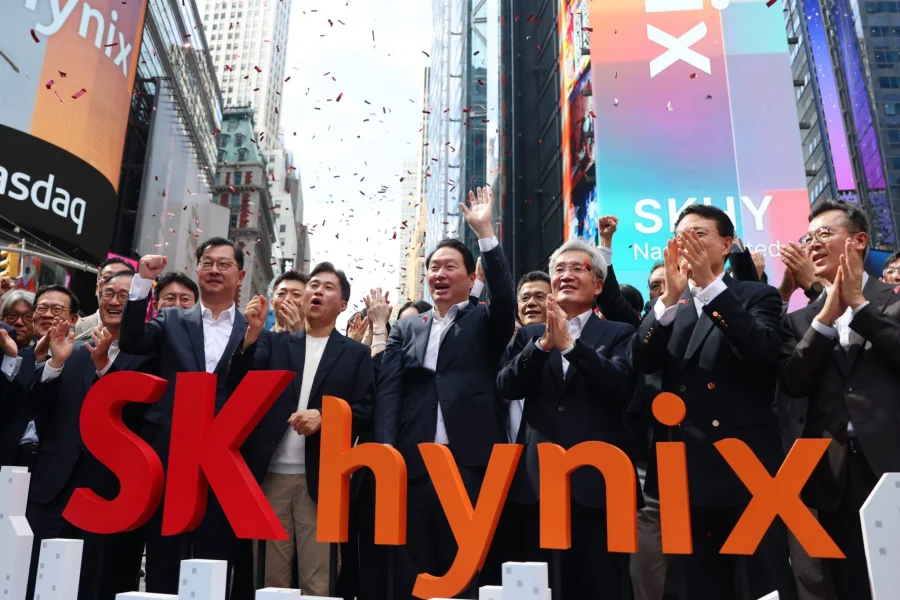
On Friday, a South Korean chipmaker that most Americans have never heard of quietly made history. SK Hynix, the world’s dominant producer of high-bandwidth memory (HBM), raised $26.5 billion in its Nasdaq debut — the largest U.S. listing ever by a foreign company and the second-largest share sale in American history, trailing only SpaceX’s $86 billion IPO last month. Shares surged 12.8% on day one.
But the real story isn’t the money. It’s what this listing reveals about the AI boom — and the invisible bottleneck that could define the next decade of computing.
The chip inside every Nvidia processor
SK Hynix doesn’t make the kind of chips most people recognize. It doesn’t design smartphone processors or laptop CPUs. Instead, it manufactures high-bandwidth memory (HBM) — a specialized type of memory that sits inside almost every Nvidia AI processor. These chips are critical because AI models need to move enormous amounts of data between memory and compute units at lightning speed. Without HBM, even the most powerful GPUs would stall.
And right now, there is a severe shortage of HBM. SK Hynix controls roughly 50% of the global HBM market, making it the single most important supplier for Nvidia’s AI infrastructure. Every major AI company — from OpenAI to Google to Meta — depends on Nvidia’s processors, which depend on SK Hynix’s memory.
Why demand is so intense — and why doubling production isn’t enough
SK Group Chair Chey Tae-won told CNBC on the day of the listing: “We’ve announced plans to double production capacity within five years, but every customer says, ‘That’s still not enough — we need more.’”
That single quote captures the scale of the AI boom. Data centers are being built at a pace never seen before. Cloud providers like Amazon, Microsoft, and Google are spending tens of billions of dollars on AI infrastructure. And every new server rack needs HBM chips that are increasingly difficult to manufacture at scale.
The shortage has driven prices for HBM to record highs, making SK Hynix extraordinarily profitable. The company’s revenue has more than doubled in the past year, and its operating margins have surged past 30%.
How SK Hynix became the quiet giant of the AI supply chain
SK Hynix’s rise didn’t happen overnight. The company has been manufacturing memory chips for decades, but its bet on HBM — a technology that stacks multiple layers of memory vertically to achieve higher bandwidth — began paying off around 2022, when AI workloads started demanding unprecedented memory performance.
While competitors like Samsung and Micron also produce HBM, SK Hynix was the first to mass-produce the latest generation (HBM3E), giving it a critical head start. Nvidia has publicly stated that it relies on SK Hynix as its primary HBM supplier, and the two companies have deepened their partnership over the past two years.
The Nasdaq listing gives U.S. investors direct exposure to this relationship. Previously, American investors could only buy SK Hynix shares through over-the-counter markets or via South Korea’s stock exchange. Now, it trades on the Nasdaq under a ticker symbol that is already being watched closely by AI-focused funds.
Who benefits — and who is left out
The biggest winners from this listing are SK Hynix’s existing shareholders, including SK Group and South Korean institutional investors, who now have access to deeper U.S. capital markets. But the listing also benefits Nvidia, which gains a more visible and financially stable supplier — reducing supply chain risk for its own investors.
For retail investors, the listing offers a rare chance to buy into the AI supply chain at a level that is usually reserved for institutional players. However, the stock’s 12.8% first-day pop means early buyers are already paying a premium.
For South Korea, the listing is a national milestone. SK Hynix is now one of the most valuable companies listed in the U.S., and its success reinforces South Korea’s position as a critical node in the global AI hardware ecosystem.
What officials and analysts are saying
Chey Tae-won’s CNBC interview was the most direct public statement from SK Group leadership. He emphasized that the company’s biggest challenge is not demand — it’s capacity. “Every customer says, ‘That’s still not enough — we need more,’” he repeated, underscoring the urgency.
Analysts at Morgan Stanley and Goldman Sachs, who underwrote the listing, have issued bullish notes on SK Hynix, citing the structural shortage of HBM and the company’s technological lead. However, some analysts have warned that the stock’s valuation is stretched, given that the company is already pricing in years of growth.
Why this listing matters beyond the numbers
The $26.5 billion figure is staggering, but it’s the context that matters. This is the second-largest U.S. share sale in history — behind only SpaceX, which is a private company with a cult-like following. That SK Hynix, a relatively unknown South Korean memory chipmaker, has achieved this scale tells you everything about how central hardware has become to the AI revolution.
It also signals a shift in where AI value is being captured. For years, the narrative was dominated by software companies — OpenAI, Anthropic, Google DeepMind. But the real money, increasingly, is in the physical infrastructure: the chips, the memory, the data centers, the power grids. SK Hynix’s listing is a bet that hardware scarcity will define the next phase of AI growth.
Confirmed facts vs what remains unclear
Confirmed: SK Hynix raised $26.5 billion in its Nasdaq listing. Shares rose 12.8% on day one. It is the largest U.S. listing by a foreign company and the second-largest U.S. share sale ever, behind SpaceX. Chey Tae-won confirmed plans to double production capacity within five years. SK Hynix is the primary HBM supplier for Nvidia.
Unclear: Whether SK Hynix can maintain its technological lead over Samsung and Micron, both of which are investing heavily in HBM production. The exact timeline for capacity expansion and whether it will be enough to meet demand remains uncertain. The long-term impact of potential U.S.-China trade restrictions on SK Hynix’s supply chain is also unclear.
SK Hynix’s moat: Why it’s hard to catch up
SK Hynix’s competitive advantage rests on three pillars: first-mover advantage in HBM3E, which gives it years of manufacturing experience that rivals cannot easily replicate; deep integration with Nvidia, which creates a switching cost for the chip giant; and scale economies that allow it to invest billions in next-generation fabrication facilities. The company also benefits from South Korea’s government support for semiconductor manufacturing, including tax incentives and infrastructure investments.
Risks and balanced view
No investment story is without risks. SK Hynix faces potential competition from Samsung and Micron, both of which are racing to close the HBM gap. Geopolitical risks are significant: any escalation in U.S.-China tensions could disrupt SK Hynix’s supply chains or limit its access to certain markets. The company also faces cyclical risk — memory chip prices have historically been volatile, and a sudden slowdown in AI spending could hit revenue hard.
Critics also point out that SK Hynix’s valuation already reflects high expectations. At current prices, the stock trades at a premium to historical averages, and any disappointment in earnings or capacity expansion could trigger a sharp correction.
The bigger picture: Hardware is the new software
SK Hynix’s listing is part of a broader trend: the AI boom is increasingly about physical infrastructure, not just algorithms. Companies like Nvidia, AMD, and now SK Hynix are becoming the gatekeepers of AI progress because they control the scarce resources — chips, memory, and interconnect — that make large-scale AI possible.
This shift has implications for investors, policymakers, and technologists. If hardware remains the bottleneck, then the companies that control it will capture disproportionate value. That is why SK Hynix’s $26.5 billion listing is not just a financial event — it is a signal about where the AI industry is heading.
What investors and readers should watch now
For investors: Watch SK Hynix’s quarterly earnings for updates on HBM pricing and capacity expansion. Pay attention to Nvidia’s earnings calls for any mention of supplier diversification. Monitor Samsung and Micron’s HBM roadmaps for signs of competitive pressure.
For readers: This story matters because it affects the cost and availability of AI services. If HBM remains scarce, AI companies will face higher costs, which could translate into higher prices for consumers or slower deployment of new AI features.
What happens next
SK Hynix will now focus on executing its capacity expansion plans. The company is building new fabrication facilities in South Korea and exploring potential sites in the United States, partly to align with the CHIPS Act incentives. Analysts expect the company to announce additional capacity investments within the next 12 months.
The bigger question is whether demand will continue to outstrip supply. If AI adoption accelerates — as many analysts expect — the HBM shortage could persist for years, keeping SK Hynix in a position of extraordinary pricing power. If AI spending slows, the company could face a painful inventory correction.
Either way, SK Hynix has just made history. And the world is now watching.
Our Take
SK Hynix’s Nasdaq debut is a reminder that the AI boom is not just about software breakthroughs — it is about the physical components that make those breakthroughs possible. The company’s dominance in HBM memory gives it a unique position in the AI supply chain, one that is unlikely to be challenged in the near term. But the risks — from competition, geopolitics, and cyclical demand — are real. Investors should approach with eyes open, but the story itself is one of the most important in technology today.
Frequently Asked Questions
What is SK Hynix and why is its Nasdaq listing important?
SK Hynix is a South Korean semiconductor company that is the world’s leading manufacturer of high-bandwidth memory (HBM) chips. Its Nasdaq listing raised $26.5 billion, making it the largest U.S. listing by a foreign company ever and the second-largest U.S. share sale in history. The listing gives U.S. investors direct access to a critical supplier for Nvidia’s AI processors.
How does SK Hynix’s HBM memory power AI?
High-bandwidth memory (HBM) is a specialized type of memory that stacks multiple layers vertically to achieve extremely high data transfer speeds. AI models need to move massive amounts of data between memory and compute units, and HBM is essential for preventing bottlenecks. SK Hynix’s HBM chips are used inside almost every Nvidia AI processor.
Why is there a shortage of HBM memory chips?
Demand for HBM has exploded because of the rapid growth of AI data centers. Every new AI server needs HBM chips, and manufacturing them at scale is technically challenging. SK Hynix, Samsung, and Micron are all expanding production, but supply has not kept pace with demand, leading to high prices and allocation constraints.
What are the risks of investing in SK Hynix?
Key risks include competition from Samsung and Micron, geopolitical tensions that could disrupt supply chains, cyclical volatility in memory chip prices, and a potential slowdown in AI spending. The stock’s valuation also reflects high growth expectations, leaving little room for disappointment.