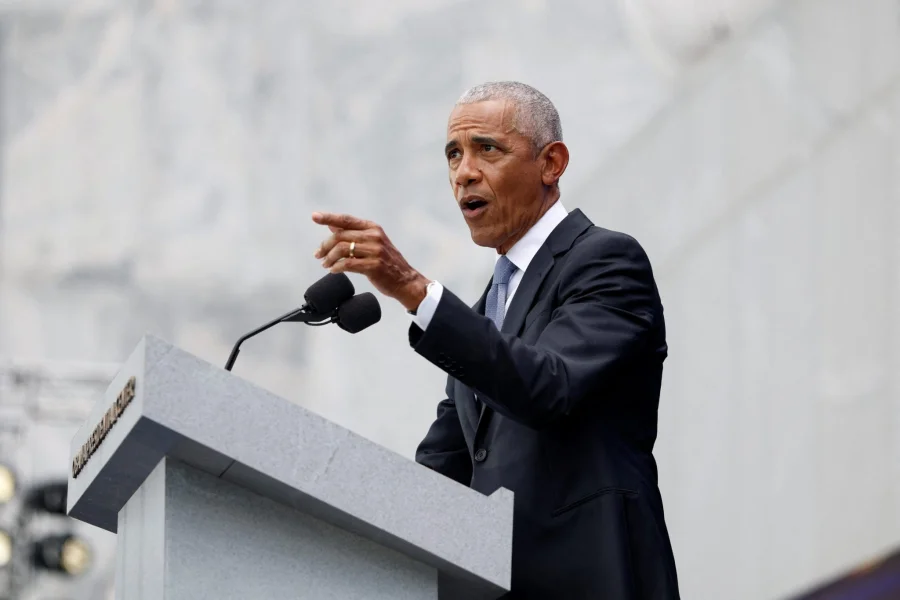
President Donald Trump on Sunday made his clearest case yet for why America should not slow down on artificial intelligence — and in doing so, handed Democrats a ready-made campaign issue that Barack Obama is already urging his party to seize.
Trump said he worried about losing the AI race to China, and argued that winning it would do more to address the technology's risks than any attempt to pump the brakes. He acknowledged some regulation might be needed but offered no specifics, and attributed warnings about unchecked AI development to "negative forces" he declined to identify.
Trump's Argument: Speed Is Safety in the AI Race
The president's position rests on a simple logic: if the United States falls behind China on artificial intelligence, the risks multiply rather than shrink. In his view, American leadership — not American restraint — is the real guardrail.
"We can put guardrails, we can do this and that," Trump said, before suggesting that many of the loudest warnings are coming from people who, in his words, "shouldn't be bringing it up."
It is a framing that prioritizes geopolitical competition over precautionary oversight, and it puts the White House at odds with a growing chorus of industry pioneers who have spent years warning that AI is advancing faster than anyone can safely manage.
Why Obama Is Telling Democrats to Run on AI
Obama's counter-move is equally deliberate. By pushing Democrats to make AI a campaign issue, he is betting that voters — particularly parents, workers, and young people — are more anxious about the technology than excited by it.
The former president's intervention signals that AI is no longer a niche policy debate confined to Silicon Valley and Washington think tanks. It is becoming a kitchen-table issue, and Democrats see an opening.
For a party still searching for a unifying message ahead of the 2026 midterms, AI offers something rare: a topic that touches jobs, education, privacy, misinformation, and national security all at once.
How We Got Here: From Bipartisan Concern to Partisan Divide
Only a few years ago, AI safety was one of the few issues with genuine cross-party agreement. Lawmakers on both sides expressed alarm about deepfakes, algorithmic bias, and the concentration of AI power in a handful of companies.
That consensus has frayed. Trump's remarks on Sunday did not create the divide, but they sharpened it — framing regulation as a drag on American competitiveness rather than a necessary shield.
Obama's response completes the split. What was once a shared concern is now a partisan battlefield, with each side accusing the other of either recklessness or overreach.
Who Actually Feels This Fight
The stakes are not abstract. Workers in industries from customer service to software development are already watching AI reshape their jobs. Parents are navigating AI tools their children use daily. Students are being told to learn with AI and beware of it at the same time.
For these groups, the question is not whether America beats China — it is whether anyone is looking out for them while the race is run.
Trump's answer is that winning the race is the protection. Obama's implied answer is that without rules, winning the race could still leave millions of people behind.
What the White House Has — and Hasn't — Said
Trump's comments were notable as much for what he left out as for what he said. He did not announce a task force, a legislative framework, an executive order, or a timeline. He did not name the "negative forces" he blamed for amplifying AI warnings.
That ambiguity leaves the administration's actual AI policy unclear. Acknowledging that regulation may be needed is not the same as proposing it, and the president offered no signal about what form it might take.
The Real Divide: Precaution vs. Primacy
Strip away the politics and the disagreement is fundamental. One side believes the safest path is to slow down, study, and regulate before deployment. The other believes the safest path is to move first, move fast, and let leadership itself become the safeguard.
Both positions carry real risks. Precaution can cede advantage to less cautious competitors. Primacy can unleash harms that no later regulation can undo.
Trump has now clearly chosen the second path. Obama is organizing his party around the first.
Confirmed Facts vs. What Remains Unclear
Confirmed: Trump made the remarks on Sunday, downplayed the need to slow AI development, cited China competition, acknowledged some regulation may be needed, and attributed warnings to unnamed "negative forces." Obama has urged Democrats to make AI a campaign issue.
Unclear: What specific regulations, if any, the administration might propose. Who Trump was referring to as "negative forces." Whether Obama's push will translate into concrete Democratic policy proposals or remain a rhetorical theme. No timeline has been set for any federal AI action.
Risks and the Case Against Both Positions
Critics of Trump's approach argue that treating AI as a race to be won ignores the possibility that the technology could cause serious harm long before any winner is declared. They point to warnings from industry pioneers — the very voices Trump appeared to dismiss — as evidence that the concerns are not political theater.
Critics of Obama's approach counter that campaign rhetoric about AI risks can easily become vague fearmongering that stalls American innovation without producing meaningful protections. Regulation, they note, is only as good as its specifics — and specifics are hard to campaign on.
Neither side has yet offered a detailed plan. That is the uncomfortable truth beneath the headlines.
A Pattern Beyond This Moment
This is not the first time American politics has wrestled with a transformative technology. The internet, social media, and crypto all followed a similar arc: early wonder, delayed concern, partisan division, and eventually — years too late — regulation.
AI is following the same curve, only faster. The difference is that the warnings are coming earlier and louder, and the two parties are already splitting along the same lines that defined every previous tech debate.
What This Means for Voters and Readers
If you are a voter, expect AI to show up in campaign ads, debates, and town halls over the next year — often in simplified, emotionally charged terms. Pay attention to whether candidates offer specifics or only slogans.
If you are a worker, student, or parent, the practical reality is that AI will continue to spread regardless of who wins this argument. The question is whether anyone sets rules along the way.
If you are an investor or business leader, the absence of clear federal guidance means uncertainty will persist — and uncertainty is its own kind of cost.
What Could Happen Next
Trump could follow his remarks with concrete proposals, or he could leave the issue as a rhetorical position. Obama's push could produce a Democratic AI platform, or it could fade into general campaign messaging.
What is nearly certain is that the debate will intensify. AI is too consequential — economically, militarily, and socially — to stay on the sidelines of a national election.
Our Take
Trump and Obama are not really arguing about AI. They are arguing about a deeper question: when a technology is this powerful, is the greater risk moving too fast or moving too slow?
Trump has bet on speed. Obama is betting that voters want someone to at least ask the question. Both are making a calculated political wager — and neither has yet shown the details that would make their position more than a slogan.
What is missing from both sides is the same thing: specifics. Until one of them offers a real plan, the American public is being asked to choose between two instincts rather than two policies.
Frequently Asked Questions
What did Trump say about AI regulation?
Trump said he worries about losing America's AI edge to China and downplayed the need to slow development. He acknowledged some regulation may be needed but gave no specifics, and attributed warnings about AI risks to unnamed "negative forces."
Why is Obama making AI a campaign issue?
Obama is urging Democrats to campaign on AI because the technology touches jobs, privacy, education, and national security — issues that resonate with voters. It also gives Democrats a unifying theme ahead of the 2026 midterms.
Is there any federal AI regulation in place right now?
Following Trump's remarks, no new federal AI legislation or executive action has been announced. The administration has not provided a timeline or framework, leaving the regulatory landscape unclear.
What does this mean for ordinary Americans?
AI will continue to spread regardless of the political debate. The practical impact depends on whether any rules are eventually set — covering areas like job displacement, data privacy, misinformation, and safety. For now, voters are being asked to weigh speed versus safety without detailed plans from either party.