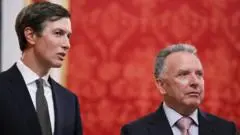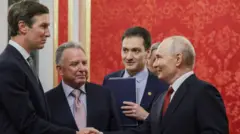
The diplomatic shuttle between Moscow and Kyiv is about to get its busiest week yet. Steve Witkoff and Jared Kushner, the two men President Donald Trump has tasked with ending the war in Ukraine, are now heading to the Ukrainian capital for their first official visit. The trip comes immediately after they sat down with Vladimir Putin in Russia — a meeting that has raised both hope and alarm across European capitals.
A Diplomatic First: Trump’s Negotiators Touch Down in Kyiv
For months, Witkoff and Kushner have operated largely in the background, holding quiet conversations with Russian officials and European intermediaries. This Kyiv visit changes that. It is the first time the pair will engage directly with Ukrainian leadership on the ground, signaling that Washington is moving from back-channel discussions to formal mediation.
The choice of Witkoff, a real estate investor with deep personal ties to Trump, and Kushner, the former president’s son-in-law, underscores the unconventional nature of this peace push. Neither man holds a traditional diplomatic title, yet both carry the president’s direct authority.
Why This Moscow-to-Kyiv Sequence Matters Now
The order of meetings matters. Going to Moscow first and Kyiv second sends a signal — intentional or not — about where Washington sees the primary obstacle to peace. Ukrainian officials have repeatedly insisted that any negotiation must begin with Russia’s withdrawal from occupied territories. Russian officials, by contrast, have demanded Ukraine accept territorial losses and abandon its NATO aspirations.
By meeting Putin before Zelensky, the envoys may be testing whether Moscow is willing to soften its maximalist demands. But the sequencing also risks alienating Kyiv, which has grown wary of any deal made over its head.
From Moscow Meeting to Kyiv Talks: The Road Behind
The Moscow meeting itself was not publicly announced in advance, a sign of how sensitive these discussions remain. According to the original report, the Putin meeting was described as substantive but inconclusive — a familiar pattern in this conflict, where both sides use talks to gauge red lines rather than to concede ground.
Witkoff and Kushner are not career diplomats. They are dealmakers. Their approach is likely to focus on incremental confidence-building measures — prisoner exchanges, ceasefire verification, humanitarian corridors — rather than a grand peace treaty. That pragmatic style may be exactly what this frozen conflict needs, or it may prove dangerously naive against hardened wartime positions.
What Kyiv Expects From the American Envoys
For ordinary Ukrainians, this visit carries heavy emotional weight. After nearly three years of full-scale war, there is exhaustion but also deep skepticism. Many Ukrainians fear that Trump’s team, eager for a quick win, may pressure Kyiv into accepting terms that reward Russian aggression.
The envoys will likely hear a consistent message from Ukrainian officials: security guarantees must come before any political settlement. Without binding security commitments from the West, Kyiv argues, any ceasefire is just a pause before the next Russian offensive.
Official Positions: What Washington, Moscow, and Kyiv Have Said
The White House has framed the envoys’ mission as an attempt to "stop the killing" and find a realistic path to peace. Russian officials have welcomed the direct line to Trump but have given no public indication of flexibility on core demands. Ukrainian officials have said they are open to talks but have repeatedly stressed that Ukraine's sovereignty and territorial integrity are non-negotiable.
Notably, no official readout of the Putin meeting has been released. That silence suggests the discussions were either highly productive or deeply frustrating — or possibly both.
Reading the Signals: What This Shuttle Diplomacy Really Means
This is not traditional diplomacy. Witkoff and Kushner operate with a businessman's urgency, focused on outcomes rather than process. Their presence in Kyiv signals that Trump wants a visible breakthrough — something he can point to as a foreign policy win.
But the gap between Russian and Ukrainian positions remains vast. Moscow wants recognition of its territorial gains and a guarantee that Ukraine will never join NATO. Kyiv wants its borders restored and ironclad Western security guarantees. These positions are not close, and no amount of shuttle diplomacy can erase that fundamental reality.
Confirmed Facts vs What Remains Unclear
Confirmed: Witkoff and Kushner met with Putin in Russia. They are now scheduled to visit Kyiv for talks. This will be their first trip to the Ukrainian capital.
Unclear: The specific agenda for the Kyiv meetings has not been disclosed. Which Ukrainian officials they will meet remains unknown. Whether the Putin meeting produced any concrete proposals is also unconfirmed.
Speculation: Analysts speculate that the envoys may carry a preliminary framework for a ceasefire, but this has not been verified by any official source.
Why Trump’s Chosen Negotiators Are Uniquely Positioned
Witkoff and Kushner bring something traditional diplomats lack: direct access to the president and a mandate to think outside bureaucratic constraints. Witkoff has longstanding business relationships in the region, while Kushner’s Middle East experience — particularly the Abraham Accords — gives him a track record of brokering deals between bitter adversaries.
Their weakness is equally clear: neither has deep expertise on Ukraine or Russia. They are learning on the job, in one of the most dangerous geopolitical conflicts of the century.
Risks and the Skeptics’ View
European allies have watched this process with unease. There is a persistent fear that Trump’s team, eager for a deal, may concede too much to Moscow. Baltic states and Poland have warned against any agreement that legitimizes Russian territorial conquest.
Domestically, critics in Washington argue that Kushner’s role creates conflicts of interest, given his family’s business interests and his previous White House role. Supporters counter that his dealmaking skills are exactly what this stalled process needs.
A Pattern of Personal Envoys in Trump’s Foreign Policy
This mission fits a broader pattern in Trump’s approach to foreign policy: bypassing traditional State Department structures in favor of trusted personal emissaries. From North Korea to the Middle East, Trump has preferred direct, personality-driven engagement over institutional diplomacy.
That approach has produced mixed results. The Abraham Accords were a genuine achievement. The Hanoi summit with Kim Jong-un collapsed without agreement. Whether Ukraine becomes an Abraham Accords-style success or a Hanoi-style failure remains an open question.
What Ukrainians and Global Markets Should Watch For
For Ukrainians, the key signals to watch are: whether the envoys meet with President Zelensky personally, whether they bring any concrete security guarantee proposals, and whether they publicly acknowledge Ukraine's territorial red lines.
For global markets and European security planners, the critical question is whether this shuttle diplomacy produces a ceasefire framework before winter. Energy prices, grain exports, and European defense spending all hinge on the trajectory of this conflict.
What Happens Next: Scenarios for the Coming Weeks
If the Kyiv talks go well, the next step could be a direct Trump-Putin summit, possibly followed by a Trump-Zelensky meeting. If they go poorly, the envoys may return to Washington with a clearer picture of just how intractable this conflict remains.
One thing is certain: the world will be watching Kyiv this week. The outcome of these talks will shape not just the future of Ukraine, but the credibility of Trump's personal diplomacy on the global stage.
Our Take
This is diplomacy by dealmaker, not by diplomat. That carries both promise and peril. The promise is that Witkoff and Kushner may find creative solutions that career diplomats have missed. The peril is that they may underestimate the depth of historical grievance and strategic interest that drives both Moscow and Kyiv.
The fact that they are going to Kyiv at all is a positive sign — it suggests Washington understands that no peace can be imposed without Ukrainian buy-in. But the road from Kyiv talks to a real peace agreement remains long, and the graveyard of failed ceasefires in this conflict is already full.
Frequently Asked Questions
Who are Steve Witkoff and Jared Kushner?
Steve Witkoff is a real estate investor and longtime associate of Donald Trump. Jared Kushner is Trump's son-in-law and former senior White House adviser. Both have been appointed as the president's top negotiators for the Russia-Ukraine conflict.
Why is the Kyiv visit significant?
It is the first time these envoys will meet Ukrainian officials directly on the ground. Previous discussions were reportedly held with Russian and European intermediaries. The visit signals a shift from back-channel talks to formal mediation.
What did the envoys discuss with Putin?
No official readout has been released. The meeting was described as substantive but inconclusive. Analysts speculate that ceasefire terms and prisoner exchanges were likely on the agenda, but this has not been confirmed.
Could this lead to a peace deal soon?
A full peace deal remains unlikely in the short term due to vast gaps between Russian and Ukrainian positions. However, the talks could produce incremental agreements on ceasefires, humanitarian corridors, or prisoner exchanges in the coming weeks.