President Trump has dismissed mounting concerns over artificial intelligence safety as a "hoax," rejecting calls for stricter safeguards — a remark that lands just as one of the world's leading AI developers warns that a mandatory "kill switch" may be necessary to prevent catastrophe.
Trump's Blunt Rejection of AI Safety Warnings
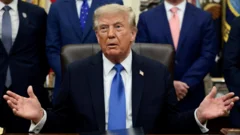
Speaking publicly, Trump characterized fears about AI risks as overblown, calling them a "hoax." His comments signal a clear preference for rapid innovation over precautionary regulation — a stance that could define US AI policy in the months ahead.
The president did not outline specific policy changes, but his rhetoric aligns with a broader push to keep America competitive in the global AI race, where speed is often prioritized over safety guardrails.
Why This Clash Matters Beyond Washington
AI is no longer a niche technology. It is embedded in healthcare, finance, education, and national security. How governments regulate — or refuse to regulate — it will affect billions of people.
Trump's dismissal of safety fears could embolden companies to move faster with fewer checks. For ordinary users, that means both faster innovation and greater uncertainty about how powerful AI systems are being controlled.
The Warning That Sparked the Debate
Trump's remarks came after Anthropic co-founder Jack Clark told the BBC that an AI "kill switch" — a mechanism to shut down dangerous AI systems — may need to be mandatory. Clark's warning reflects growing concern among AI researchers that advanced systems could soon outpace human oversight.
Anthropic, known for its safety-focused approach to AI development, has consistently argued that voluntary safeguards are not enough. Clark's comments added urgency to a debate that Trump has now publicly dismissed.
Who Is Affected by This Divide
Everyday users, developers, investors, and policymakers all have a stake. If the US leans toward deregulation, AI companies may accelerate deployment — but without uniform safety standards, risks could multiply.
For workers whose jobs are being reshaped by AI, and for citizens concerned about misinformation and autonomous systems, the absence of clear safeguards is not an abstract debate. It is a direct concern.
What Officials and Experts Are Saying
Trump's position is not universally shared. Many AI researchers, ethicists, and even some industry leaders have called for mandatory safety measures. Jack Clark's BBC interview is the latest high-profile example.
Officials within the AI safety community have warned that without binding rules, the race to build more powerful systems could outpace the ability to control them. Trump's comments suggest the White House is not currently aligned with that view.
Reading Between the Lines of Trump's Statement
Calling AI safety fears a "hoax" is a political signal as much as a policy one. It frames regulation as an obstacle to American leadership — a message aimed at voters and industry alike.
But the technical reality is more complex. AI systems are already capable of generating convincing disinformation, automating cyberattacks, and making decisions with real-world consequences. Dismissing those risks does not make them disappear.
Confirmed Facts vs What Remains Unclear
Confirmed: Trump called AI safety fears a "hoax" and rejected calls for greater safeguards. Jack Clark told the BBC a mandatory AI "kill switch" may be needed.
Unclear: Whether Trump's remarks will translate into formal policy. No specific executive orders or legislative proposals have been announced. It is also unclear how Congress or US agencies will respond.
The Broader Pattern: Innovation vs. Precaution
This is not an isolated moment. Globally, governments are split between those pushing for AI safety laws and those prioritizing speed. The EU has moved toward regulation; the US under Trump appears to be heading the other way.
That divergence could create a fragmented global landscape, where AI companies face different rules depending on where they operate — complicating safety efforts that require international coordination.
What This Means for Readers Right Now
If you use AI tools, follow AI news, or work in tech, expect more political rhetoric around AI safety. Do not assume that a lack of regulation means a lack of risk.
Stay informed about how AI systems are being deployed in areas that affect you — from hiring algorithms to content moderation. The debate in Washington is not just theoretical; it shapes the tools you use daily.
Where This Could Go Next
Trump's stance may energize AI companies that favor self-regulation. It could also galvanize safety advocates to push harder for voluntary industry standards or state-level rules.
If a major AI incident occurs — a harmful deployment, a security breach, or a public backlash — the political calculus could shift quickly. For now, the president's position is clear: he is not treating AI safety as an urgent threat.
Our Take
Trump's dismissal of AI safety fears as a "hoax" is a high-stakes bet. It assumes that innovation will outpace risk — and that the public will not demand safeguards until it is too late. History suggests that when powerful technologies arrive without guardrails, the consequences are rarely evenly distributed. This story is not just about one president's opinion. It is about whether the world's most powerful AI systems will be built with safety in mind — or whether that question will be answered only after something goes wrong.
Frequently Asked Questions
What did Trump say about AI safety?
Trump called AI safety fears a "hoax" and rejected calls for greater safeguards, signaling a preference for rapid innovation over precautionary regulation.
Who is Jack Clark and why does his warning matter?
Jack Clark is the co-founder of Anthropic, an AI safety-focused company. He told the BBC that a mandatory AI "kill switch" may be needed to shut down dangerous systems — a warning that directly contrasts with Trump's position.
Will Trump's comments change US AI policy?
No formal policy changes have been announced. However, his rhetoric could influence the direction of AI regulation, potentially slowing momentum for mandatory safety rules.
What is an AI "kill switch"?
An AI "kill switch" is a mechanism that allows developers or regulators to immediately shut down an AI system if it behaves dangerously or unpredictably. Clark suggested it may need to be mandatory.