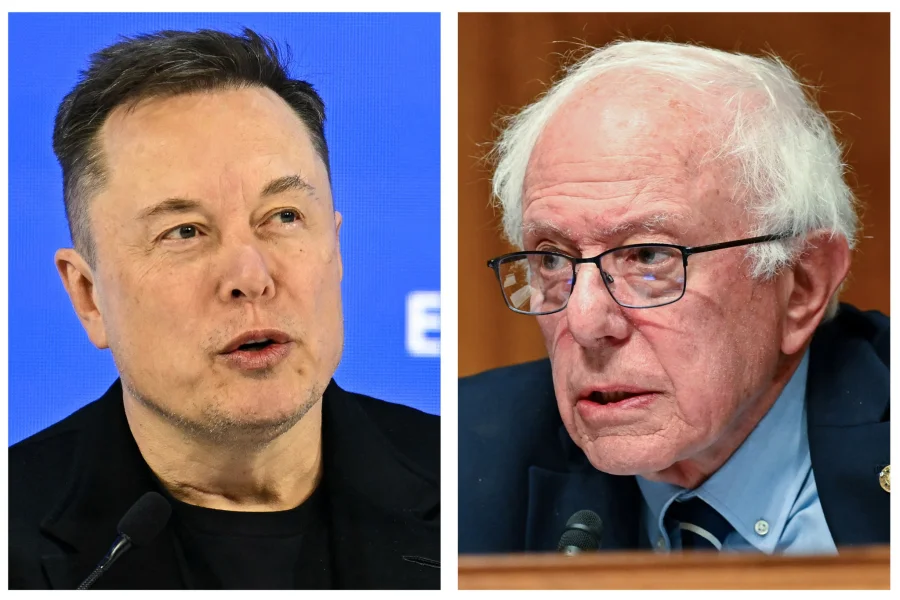
The richest man on Earth and the Senate's most vocal critic of billionaires rarely agree on anything. But this week, Elon Musk and Bernie Sanders found common ground — in the numbers, if not the conclusions.
Musk, the world's wealthiest person, made a blunt calculation: even if the government seized every penny from all 938 American billionaires, it wouldn't come close to wiping out the $40 trillion national debt. Sanders, the independent senator from Vermont, looked at the same figures and saw something else entirely — a chance to fund transformative social programs and put money directly into working families' pockets.
The Billionaire Tax Math That Sparked the Clash
Musk's argument is straightforward arithmetic. The combined net worth of America's billionaires, while staggering, is estimated in the range of $5 to $6 trillion. The national debt stands at roughly $40 trillion. Confiscating everything would cover only a fraction — perhaps 12 to 15 percent — of what the federal government owes.
"Even if you tax every billionaire in America at 100%, it barely makes a dent," Musk argued, framing the debt crisis as a spending problem rather than a revenue problem.
Why Sanders Sees the Same Numbers Differently
Sanders isn't proposing confiscation. His plan targets a 5% annual wealth tax on billionaires — a levy on net worth rather than income. Over time, that recurring tax could generate substantial revenue while leaving billionaires still extraordinarily wealthy.
The senator's pitch is simple: tax the ultrawealthy at a modest rate and send ordinary Americans a check. It's a redistribution argument rooted in the belief that concentrated wealth has outpaced wage growth for decades, and that the tax code currently favors those at the very top.
The Real Disagreement: Spending vs. Revenue
Beneath the competing calculations lies a fundamental philosophical divide. Musk sees the $40 trillion debt as evidence that government spending is the core problem — no tax increase, however aggressive, can solve a structural deficit. Sanders sees the debt as a policy choice, one that prioritizes tax cuts for the wealthy and corporations while underfunding social programs.
Both men are technically correct within their own frameworks. The question is which framework voters find more compelling.
What a 100% Tax Would Actually Mean
Even setting aside the math, a 100% wealth confiscation is practically impossible. Billionaires hold assets in stocks, real estate, and private companies — not cash in bank accounts. Forcing liquidation would crash markets, destroy enterprise value, and likely trigger capital flight before any law took effect.
Economists across the political spectrum generally agree that extreme confiscation is neither feasible nor desirable. The real policy debate centers on marginal tax rates, wealth taxes, and closing loopholes.
How a 5% Wealth Tax Could Work in Practice
Sanders' proposal faces its own challenges. Valuing illiquid assets like private companies or art collections is notoriously difficult. Billionaires can also relocate, renounce citizenship, or use legal structures to shield wealth. Countries like France and Sweden have tried wealth taxes and abandoned them due to capital flight and administrative complexity.
Supporters argue that modern data and international cooperation could overcome these hurdles. Critics counter that the tax would raise far less than projected once avoidance strategies are factored in.
Confirmed Facts vs. What Remains Unclear
Verified: The US national debt has surpassed $40 trillion. There are approximately 938 billionaires in America. Musk and Sanders have publicly debated the efficacy of taxing the ultrawealthy.
Unclear: The exact combined net worth of all 938 billionaires fluctuates daily with market movements. The precise revenue a 5% wealth tax would generate depends on valuation methods and avoidance behavior that cannot be predicted with certainty.
The Billionaire Tax Debate in a Broader Context
This exchange is part of a larger reckoning about inequality in America. The pandemic-era wealth surge, rising housing costs, and stagnant wages have intensified public scrutiny of the ultrawealthy. Polls consistently show majority support for higher taxes on billionaires, even among some Republican voters.
Yet the debt question complicates the narrative. If taxing billionaires fully wouldn't solve the debt, what would? That's the uncomfortable question neither Musk nor Sanders fully answers.
What This Means for Your Wallet
For ordinary Americans, this debate isn't abstract. Tax policy determines what you pay, what services you receive, and how the government manages its obligations. A wealth tax could fund education, healthcare, or infrastructure — or it could be absorbed by avoidance strategies and administrative costs.
The debt, meanwhile, affects interest rates, inflation, and the dollar's value. Every percentage point of debt service is money not spent on programs or returned as tax relief.
What Happens Next in the Tax Debate
Neither Musk's confiscation argument nor Sanders' wealth tax proposal is likely to become law in its current form. But the exchange frames the terms of a debate that will intensify as budget negotiations approach and the 2026 midterm elections draw nearer.
Expect to hear variations of these arguments in campaign ads, congressional hearings, and social media discourse. The underlying question — how should America tax its wealthiest citizens — is not going away.
Our Take
Both Musk and Sanders are using selective math to make political points. Musk is right that confiscation alone can't solve the debt. Sanders is right that a modest wealth tax could fund meaningful programs. The deeper truth is that America's fiscal challenges require both spending discipline and revenue reform — a compromise neither man is offering.
The billionaire tax debate is really a proxy for a larger question: what kind of society do Americans want to build? That's a conversation worth having, with better numbers and fewer soundbites.
Frequently Asked Questions
How many billionaires are there in America?
According to recent estimates, there are approximately 938 billionaires in the United States. Their combined net worth fluctuates with market conditions but is generally estimated in the range of $5 to $6 trillion.
Would taxing billionaires at 100% eliminate the national debt?
No. The national debt exceeds $40 trillion, while the combined wealth of all US billionaires is estimated at roughly $5 to $6 trillion. Even complete confiscation would cover only a fraction of the total debt.
What is Bernie Sanders' billionaire tax proposal?
Sanders has proposed a 5% annual wealth tax on billionaires — a levy on net worth rather than income. Revenue from this tax would be used to fund social programs and provide direct payments to American families.
Why is Elon Musk against taxing billionaires?
Musk argues that taxing billionaires at any rate won't meaningfully address the $40 trillion national debt. He frames the debt as a spending problem that requires cuts rather than a revenue problem that requires higher taxes.
Has any country successfully implemented a wealth tax?
Several European countries including France, Sweden, and Norway have tried wealth taxes. Many have scaled back or abandoned them due to capital flight, administrative complexity, and lower-than-projected revenue. Some economists argue modern data systems could make them more effective today.