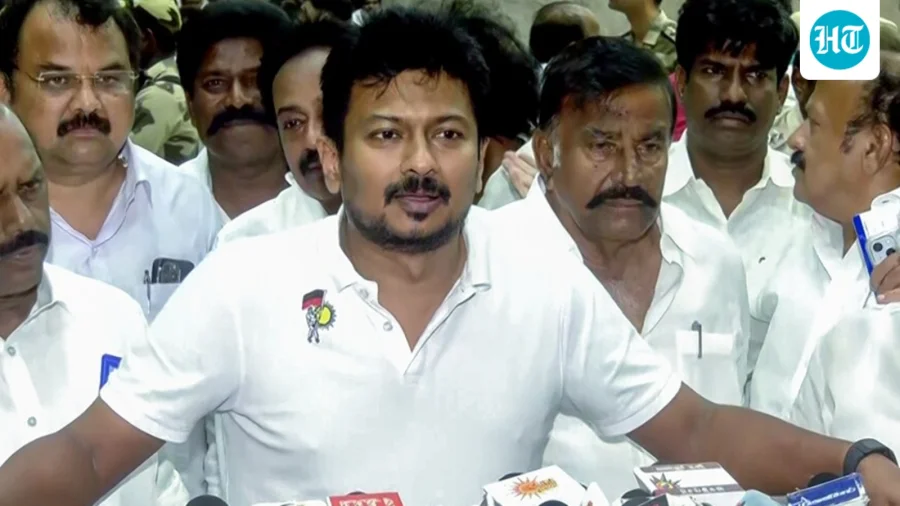
Tamil Nadu's political temperature rose sharply on Wednesday as Deputy Chief Minister Udhayanidhi Stalin pushed back against allegations that his recent remarks were aimed at actor Trisha. In a pointed response, the DMK leader insisted his words carried "only one meaning" and dismissed actor-politician Vijay's Tamizhaga Vetri Kazhagam (TVK) as a "circus."
DMK leader's sharp rebuttal to TVK's allegations
Udhayanidhi Stalin's response came after TVK leaders accused him of making derogatory remarks about Trisha during a public meeting. The Deputy CM denied the charge outright, asserting that his statement was being deliberately misrepresented by political opponents.
"My words had only one meaning. Those who are twisting it are doing so for their own political gains," Udhayanidhi Stalin said, according to reports. He did not elaborate on what that meaning was, but insisted the controversy was manufactured.
Why the Cauvery issue is at the heart of this clash
Beyond the personal denial, Udhayanidhi Stalin made a more significant political accusation. He alleged that Vijay's TVK had edited his speech to divert public attention from the Cauvery water-sharing dispute — a long-standing and emotionally charged issue in Tamil Nadu.
The Cauvery issue has historically been a rallying point for Tamil political parties, and any perceived dilution of focus on it can carry political costs. By linking the Trisha controversy to the Cauvery matter, the DMK leader is framing the dispute as a distraction from a far more consequential state issue.
How the controversy unfolded
The row began after Udhayanidhi Stalin made remarks during a public address that were interpreted by some as a reference to Trisha. TVK functionaries quickly seized on the comments, accusing the Deputy CM of disrespecting the actress.
Vijay's entry into full-fledged politics with TVK has already reshaped Tamil Nadu's political landscape. The party has positioned itself as a fresh alternative to the Dravidian majors, and its leadership has been aggressive in attacking the DMK on multiple fronts.
What this means for Tamil Nadu's political battlefield
The exchange is not merely personal — it reflects the intensifying contest for political space in Tamil Nadu ahead of the 2026 Assembly elections. The DMK, which leads the ruling alliance, faces a new challenger in TVK, which has been drawing crowds and attention with Vijay's star power.
For Udhayanidhi Stalin, who is widely seen as the DMK's future face, responding firmly to TVK's attacks is part of establishing his political authority. For Vijay, taking on the Deputy CM directly helps TVK shed its image as a celebrity-driven outfit and project itself as a serious political force.
Official response and political reactions
Neither Udhayanidhi Stalin's office nor TVK's leadership has issued an official statement beyond the public remarks reported in the media. However, the exchange has triggered reactions across the political spectrum, with allies of both sides weighing in on social media and in statements to the press.
Political analysts note that the timing of the controversy — coinciding with renewed focus on the Cauvery issue — is significant. The water-sharing dispute with Karnataka remains unresolved, and any party seen as softening its stance risks public backlash.
Reading between the lines of the 'circus' remark
Udhayanidhi Stalin's choice of the word "circus" to describe TVK is telling. It suggests the DMK establishment views Vijay's political foray as lacking ideological substance — a charge TVK has repeatedly denied.
By dismissing TVK as a "circus," the Deputy CM is attempting to frame the actor-led party as entertainment rather than governance. This is a common tactic used by established parties against celebrity entrants, but it also risks underestimating TVK's growing appeal among younger voters.
Confirmed facts vs what remains unclear
What is confirmed: Udhayanidhi Stalin has publicly denied that his remarks targeted Trisha. He has also called TVK a "circus" and alleged that his speech was edited to divert attention from the Cauvery issue.
What remains unclear: The exact nature of the original remarks and whether they were indeed aimed at Trisha. The extent of any editing of the speech has not been independently verified. Both claims and counter-claims are currently based on public statements and media reports.
Why TVK's rise matters beyond this spat
Vijay's TVK has brought a new dynamic to Tamil Nadu politics. With a massive fan following and significant financial backing, the party has the potential to disrupt the traditional DMK-AIADMK bipolarity. Its performance in the 2026 elections will be closely watched as an indicator of whether celebrity-led politics can translate into electoral success.
The party's ability to attract crowds at rallies and its aggressive social media presence have already made it a force to reckon with. However, translating that enthusiasm into seats remains an unproven challenge.
Risks and balanced view
For the DMK, dismissing TVK as a "circus" carries risks. If Vijay's party continues to gain traction, such remarks could be seen as arrogance from an entrenched establishment. For TVK, focusing on personal attacks against Udhayanidhi Stalin could backfire if voters perceive it as avoiding substantive issues like the Cauvery dispute.
Supporters of both sides have valid points. DMK backers argue that TVK is a superficial political project built on celebrity worship. TVK supporters counter that the party represents a genuine demand for change after decades of Dravidian politics.
The broader pattern of celebrity politics in India
Vijay's political entry is part of a wider trend of film stars transitioning to politics in India. From M.G. Ramachandran and N.T. Rama Rao in the past to actors like Pawan Kalyan in Andhra Pradesh today, cinema has often served as a launchpad for political careers in southern India.
The success of such transitions has been mixed. While some actors have become chief ministers, others have faded quickly. TVK's trajectory will add another data point to this ongoing experiment.
What readers should watch for next
For those following Tamil Nadu politics, the key developments to track are: whether TVK releases the alleged unedited version of Udhayanidhi Stalin's speech, how the DMK responds to any further attacks, and whether the Cauvery issue regains centre stage in public discourse.
Voters should also pay attention to how both parties address substantive governance issues — water sharing, employment, education, and infrastructure — rather than getting drawn into personal spats.
Future outlook
The immediate future is likely to see more heated exchanges between the DMK and TVK as both sides test their messaging ahead of elections. The Cauvery issue, meanwhile, remains a live political flashpoint that could resurface at any time depending on the Supreme Court's proceedings and Karnataka's stance.
Whether this controversy fades quickly or escalates further will depend on how both leaders choose to play their next moves. Political observers suggest that Udhayanidhi Stalin's firm response indicates the DMK does not intend to cede ground to TVK easily.
Our Take
This spat is more than political theatre — it reveals the anxieties of an established party facing a new challenger with significant cultural capital. Udhayanidhi Stalin's dismissal of TVK as a "circus" may resonate with the DMK's core base, but it also signals that the party takes Vijay's political ambitions seriously enough to respond personally.
The Cauvery angle adds a layer of complexity. By linking the controversy to the water-sharing issue, the Deputy CM is attempting to position the DMK as the true guardian of Tamil Nadu's interests while painting TVK as a distraction. Whether that framing sticks will depend on how voters perceive both parties' sincerity on the issue.
For now, the ball is in TVK's court. If Vijay's party can produce evidence of speech editing, it could turn the tables. If not, the "circus" label may stick — at least for a while.
Frequently Asked Questions
What did Udhayanidhi Stalin say about Trisha?
Udhayanidhi Stalin has denied making any remarks targeting actor Trisha. He said his words had "only one meaning" and that his speech was being misrepresented by political opponents to create controversy.
Why did Udhayanidhi Stalin call Vijay's TVK a 'circus'?
The Deputy CM used the term while responding to TVK's allegations about his remarks. He accused the party of editing his speech to divert attention from the Cauvery water-sharing issue, dismissing their political tactics as unserious.
What is the Cauvery issue in this context?
The Cauvery water-sharing dispute is a long-standing conflict between Tamil Nadu and Karnataka over river water allocation. Udhayanidhi Stalin alleged that TVK was using the Trisha controversy to shift focus away from this important state issue.
How has Vijay's TVK responded to these allegations?
TVK leaders have accused Udhayanidhi Stalin of making derogatory remarks about Trisha. The party has not yet released any unedited version of the speech, and the full details of their response remain limited to public statements reported in the media.