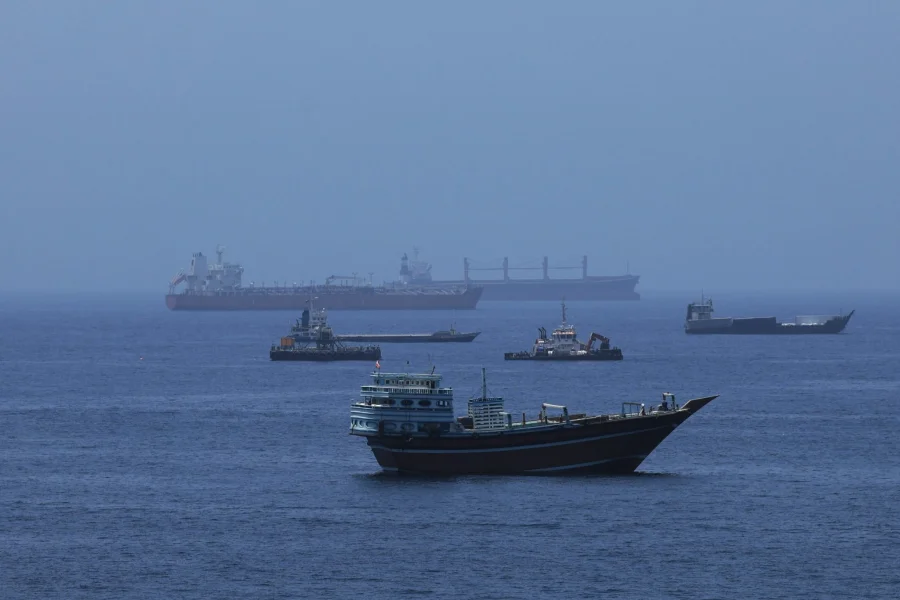
The Strait of Hormuz, the world's most critical oil chokepoint, is not fully closed. A maritime advisory group confirmed on Sunday that the southern route along the Omani coastline remains open for shipping, even as Iran's Revolutionary Guard declared the waterway shut. The announcement offers a sliver of stability for global energy markets, but the threat level remains "severe," and the situation is far from resolved.
Southern route operational, but threat level remains 'severe'
The Joint Maritime Information Center (JMIC), a key advisory body for the shipping industry, issued a note stating that the path along the Omani coast is still available for transit. However, the group described the threat-level in the strait as "severe." It told mariners to expect radio communications with naval forces and be aware of a danger from mines, a stark reminder of the risks vessels face.
Why this matters for global oil and your wallet
The Strait of Hormuz is a narrow waterway through which about 20% of the world's oil passes. Any sustained closure would send oil prices soaring, impacting fuel costs for millions of people in India and around the world. For now, the open southern route provides a critical safety valve, but the "severe" threat level means insurance premiums for tankers are likely to spike, adding to global shipping costs.
Timeline of a rapidly escalating crisis
The latest development follows a dramatic escalation in US-Iran hostilities. Iran's Islamic Revolutionary Guard Corps (IRGC) announced earlier Sunday that it would not allow any vessels to pass the strait until "foreign interference" ends, accusing the US of seeking to create disruptions. This declaration came after American forces struck Iran for a third time in a week overnight, following an attack on a Cyprus-flagged vessel. The tit-for-tat attacks have pushed the region to the brink of a major conflict.
Who is affected: From oil tankers to everyday consumers
The immediate impact is on commercial shipping, particularly oil tankers and cargo vessels transiting the Gulf. But the ripple effects will be felt globally. For Indian consumers, a prolonged disruption could mean higher petrol and diesel prices, as India imports a significant portion of its crude oil from the Gulf region. The uncertainty also threatens supply chains for goods ranging from electronics to food.
Official response: Maritime group's warning and Iran's stance
The JMIC's note is the most authoritative assessment of the situation on the water. It directly contradicts the IRGC's sweeping declaration, suggesting that Iran's ability to enforce a total closure is limited, at least for now. The IRGC, however, has a history of using asymmetric tactics, including mine-laying and speedboat swarms, to disrupt shipping. The US has not officially commented on the JMIC's assessment but has previously warned that any Iranian closure of the strait would be a "red line."
Analysis: A partial closure and a dangerous game of brinkmanship
The fact that the southern route remains open is significant. It suggests that Iran's declaration may be more of a political statement than a fully operational reality. However, the "severe" threat level indicates that the risk of an incident is extremely high. The IRGC may be attempting to create a climate of fear that drives up insurance costs and deters shipping, effectively achieving a partial closure without a full naval blockade. This is a dangerous game of brinkmanship that could easily spiral out of control.
Confirmed facts vs what remains unclear
Confirmed: The southern route of the Strait of Hormuz is open for transit. The JMIC has issued a "severe" threat warning. Iran's IRGC has declared the waterway closed. US forces have conducted a third round of strikes in a week.
Unclear: The exact extent of Iran's ability to enforce its closure. Whether the IRGC has laid mines in the northern route. The specific targets of the latest US strikes. The status of the Cyprus-flagged vessel that was reportedly attacked. The timeline for any potential diplomatic resolution.
Risks and a balanced view of the situation
The primary risk is a miscalculation that leads to a direct military confrontation between the US and Iran, which could shut the strait entirely. Critics of the US strikes argue they are escalating the conflict without a clear strategy. Supporters say they are a necessary response to Iranian aggression. For the shipping industry, the risk is not just a full closure but a series of incidents that make transit prohibitively expensive and dangerous.
The wider pattern: A region on the edge
This crisis is the latest chapter in a long history of tensions in the Persian Gulf. The Strait of Hormuz has been a flashpoint for decades, with Iran repeatedly threatening to close it during periods of heightened conflict. The current escalation, however, is one of the most serious since the Iran-Iraq war in the 1980s, which saw the "Tanker War" that targeted oil shipping. The involvement of the US and the IRGC's direct declaration marks a significant escalation.
Practical guidance for readers and investors
For the average person, the immediate impact may be limited if the southern route remains open. However, it is wise to monitor fuel prices in the coming weeks. For investors, the situation increases volatility in oil markets. Energy stocks may see short-term gains, but the broader market could be affected by uncertainty. For those in the shipping or logistics industry, it is crucial to stay in close contact with maritime advisory groups like the JMIC and review insurance and contingency plans.
Future outlook: What could happen next
The situation is highly fluid. The most likely near-term scenario is a continuation of the current state: the southern route remains open but under a "severe" threat, with periodic incidents and further US-Iran strikes. A full closure is possible if the conflict escalates further, but it would be a drastic step with severe global consequences. Diplomatic efforts, likely through Oman or other regional mediators, may be underway but have not been publicly confirmed. The coming days will be critical in determining whether this crisis de-escalates or spirals into a wider war.
Our take
The Strait of Hormuz is not closed, but it is not safe. The JMIC's confirmation that the southern route is open is a crucial fact that prevents panic, but the "severe" threat level is a clear warning that the situation is extremely dangerous. This is not a story of a crisis averted; it is a story of a crisis contained, for now. The world is watching a high-stakes game of brinkmanship where a single miscalculation could have catastrophic consequences for the global economy. The focus must remain on de-escalation, but the path to that outcome is far from clear.
Frequently Asked Questions
Is the Strait of Hormuz completely closed?
No. The southern route along the Omani coastline remains open for shipping, according to the Joint Maritime Information Center (JMIC). However, the threat level is "severe."
Why did Iran declare the Strait of Hormuz closed?
Iran's Islamic Revolutionary Guard Corps (IRGC) declared the waterway closed in response to US military strikes, accusing the US of seeking to create disruptions. The declaration is seen as a political statement and a threat, but its full enforcement is unclear.
How will this affect oil prices and fuel costs in India?
If the southern route remains open, the immediate impact on oil prices may be limited. However, the "severe" threat level and potential for further escalation could cause prices to rise. India, which imports a large portion of its crude oil from the Gulf, would be vulnerable to any sustained disruption.
What should ships do when transiting the Strait of Hormuz now?
The JMIC advises mariners to expect radio communications with naval forces and be aware of a danger from mines. Ships should stay on the southern route and follow all instructions from naval authorities. Insurance and security protocols should be reviewed.