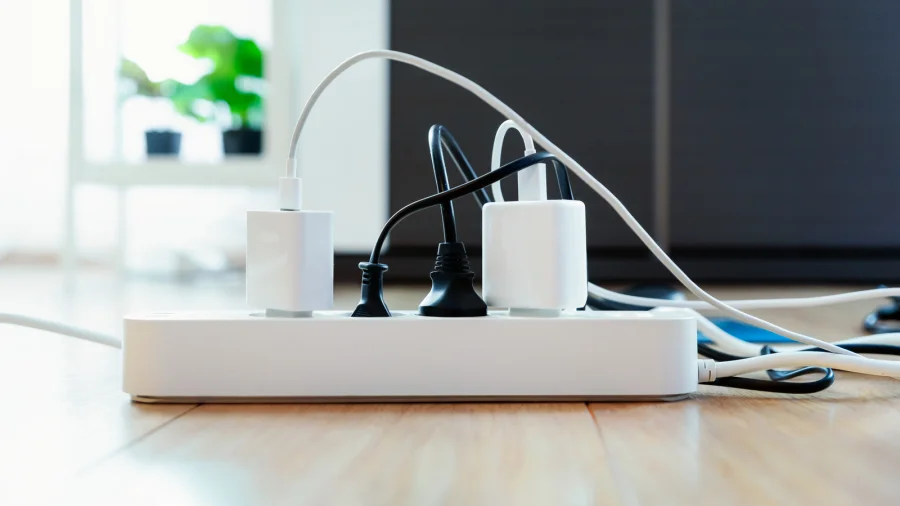
It sits behind your desk, under the television, or beside the router — a quiet strip of plastic and copper you haven't thought about in years. It still powers everything. The lights still come on. So it must still be working, right?
Not necessarily. A surge protector can lose its ability to protect long before it stops delivering electricity. And that gap — between looking fine and actually working — is where expensive electronics quietly die.
The Slow Death Inside a Surge Protector
Inside every surge protector sits a component called a metal oxide varistor, or MOV. Its job is simple: when voltage spikes, the MOV absorbs the excess energy and diverts it away from your devices.
But each absorption takes a small toll. Over months and years, the MOV degrades. It doesn't break dramatically. It just gets weaker — until one day it can no longer absorb anything at all.
Why a Dead Surge Protector Still Looks Alive
This is the part most people miss. A surge protector that has exhausted its protection often continues to function as an ordinary extension cord. Your laptop charges. Your TV turns on. Nothing seems wrong.
The danger is psychological as much as electrical. You believe you're protected. You plug in a new television or a gaming console without a second thought. Then a routine spike arrives — and there's nothing left to stop it.
What Actually Ages a Surge Protector
Time alone is a factor. The MOV components degrade gradually even without major events. But the real accelerant is spikes themselves — the small, frequent surges caused by appliances cycling on and off, air conditioners kicking in, or fluctuations in the local power supply.
In areas with unstable voltage, a surge protector can burn through its capacity far faster than its owner expects. A unit rated for years of protection in one home may be spent within months in another.
Who Should Be Paying Attention
Anyone with a surge protector older than a few years should treat this as a genuine question, not a hypothetical one. That includes households running home offices, gaming setups, or expensive entertainment systems.
It matters most for people who have never replaced a surge protector — because they are the ones most likely to assume protection they no longer have.
What Manufacturers and Electricians Actually Say
Most surge protector manufacturers include an indicator light designed to show whether protection is still active. When that light dims or goes out, the unit is no longer doing its job — even if it still powers your devices.
Electricians and safety guidance consistently point to the same principle: surge protectors are consumable items, not permanent fixtures. They are designed to be replaced.
Why This Isn't Just About One Device
The cost of a surge protector is trivial compared to what it protects. A single unprotected spike can destroy a laptop, a television, or a refrigerator's control board — repairs that run into thousands.
Replacing a surge protector is one of the cheapest forms of insurance a household can buy. Ignoring it is one of the easiest ways to lose that insurance without noticing.
Confirmed Facts vs What Remains Unclear
Confirmed: Surge protectors use MOV components that degrade with use and time. Many include indicator lights to signal when protection has ended. Units can continue supplying power after protection is gone.
Unclear: There is no universal expiry date. Lifespan depends on the quality of the unit, the stability of local power, and the number of surges absorbed. No single rule tells you exactly when yours will fail.
What Makes a Surge Protector Worth Trusting
Not all surge protectors are built the same. Higher joule ratings generally indicate greater capacity to absorb energy before failing. Units with clear, working indicator lights give users a way to know when protection has ended.
Some higher-end models include thermal fuses that cut power entirely once the MOV is spent — a feature that prevents the false sense of security altogether.
The Risks of Ignoring Replacement
The obvious risk is unprotected electronics. The less obvious one is complacency. A surge protector that has silently failed gives no warning, and the failure only becomes visible when something expensive breaks.
There is also a safety dimension. A degraded surge protector that overheats or fails internally can, in rare cases, become a fire risk — another reason not to treat these devices as permanent.
A Pattern Most Households Share
Surge protectors are bought once and forgotten. They are rarely included in any maintenance routine, unlike smoke detector batteries or water filters. This story is less about a single product and more about a blind spot in how homes manage electrical safety.
What You Should Do Now
Check the indicator light on every surge protector in your home. If it's dim or off, replace the unit. If there's no indicator light at all, and the unit is several years old, consider replacing it anyway.
For high-value electronics — computers, televisions, gaming consoles — it's worth upgrading to a unit with a clear protection indicator and a higher joule rating.
What Comes Next
As homes add more sensitive electronics, the case for treating surge protectors as replaceable rather than permanent will only grow stronger. For now, the responsibility sits with the user — because nothing inside the device will tell you when it's done.
Our Take
This isn't a dramatic story. There's no recall, no scandal, no urgent advisory. But that's exactly why it matters. The most dangerous failures are the quiet ones — the ones that leave everything looking normal until the moment it isn't.
A surge protector is one of the few devices in your home designed to sacrifice itself for something else. The least we can do is notice when it has.
Frequently Asked Questions
How often should I replace a surge protector?
There's no fixed rule, but most guidance suggests replacing surge protectors every two to three years, or sooner if the indicator light shows protection has ended or if the unit has absorbed a major spike.
How do I know if my surge protector is still working?
Check the indicator light. If it's lit, protection is likely active. If it's dim, off, or the unit has no indicator at all and is several years old, it may no longer be protecting your devices.
Can a surge protector still work after it stops protecting?
Yes. Many surge protectors continue to supply power even after their protection components have failed. This is why they can appear functional while offering no surge defence.
Is it worth replacing a surge protector instead of just buying a new one?
Surge protectors are not repairable. Replacement is the only option once protection has degraded. Given their low cost relative to the devices they protect, replacement is almost always the sensible choice.