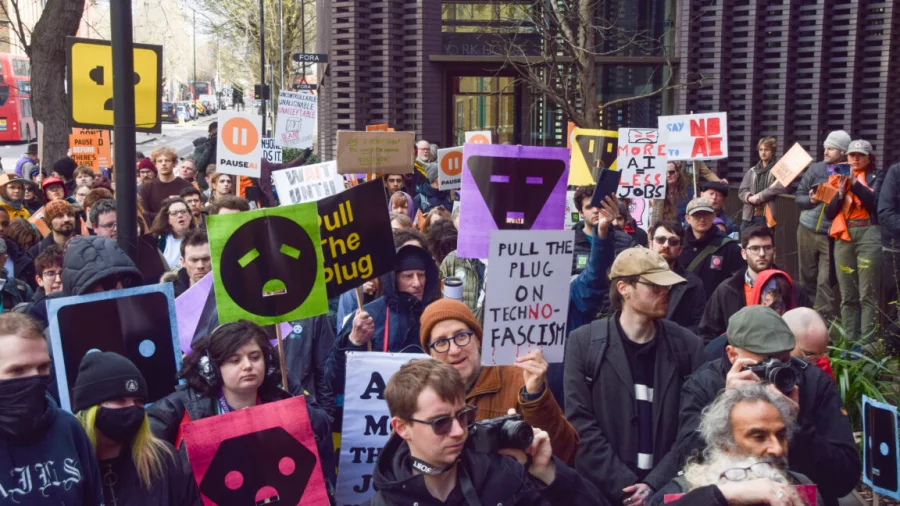
It started with attacks on CEOs. Then came nationwide protests outside data centers. And as millions of Americans stew over the very real fear that AI will take their jobs, federal law enforcement is now watching a new kind of domestic threat: people who simply hate technology.
More than 1,000 pages of unpublished reports from the Department of Homeland Security, FBI, and fusion centers—obtained exclusively by WIRED—reveal a quiet but significant shift in how the US government is categorizing and surveilling its own citizens. The new label? "Anti-technology extremism."
And it's a category so broad that critics say it could target anyone from a peaceful protester to a concerned parent.
What Is 'Anti-Tech Extremism' and Why Is the Government Watching It Now?
According to the intelligence documents, "anti-tech extremism" refers to individuals or groups who oppose the expansion of technology—particularly artificial intelligence, data centers, and automation—through actions that authorities deem threatening or disruptive.
This isn't just about hackers or cyberattacks. The reports describe a growing movement fueled by anger over AI-driven job displacement, privacy violations, and the environmental impact of massive data centers. In recent months, that anger has spilled into real-world protests, vandalism, and even violence against tech executives.
The government's response has been swift. Federal fusion centers—information-sharing hubs that connect local, state, and federal law enforcement—are now actively tracking this category as an emerging domestic threat.
Why This Matters Right Now
This matters because the definition of "anti-tech extremism" is dangerously vague. Under the current framework, someone who organizes a peaceful protest outside a data center could be lumped into the same category as someone who commits violence.
It also matters because this surveillance shift comes directly on the heels of President Donald Trump's National Security Presidential Memo 7, which instructs the Department of Justice to target anyone holding "anti-American," "anti-Christian," and "anti-capitalism" beliefs. The memo creates a legal and ideological framework where opposition to corporate tech expansion can be framed as unpatriotic.
For millions of Americans who are already anxious about AI replacing their jobs, this feels like the government is watching them for simply being afraid.
How the Surveillance Shift Unfolded
The timeline of this shift is telling. It began with a series of high-profile attacks on tech CEOs, which sparked a national conversation about the growing hostility toward the tech industry. Then, in early 2026, coordinated protests erupted at data center construction sites across multiple states, with demonstrators citing AI job loss, energy consumption, and data privacy as their core grievances.
In response, the DHS and FBI began circulating internal reports that reframed these protests not as labor or privacy activism, but as a potential extremist movement. The reports, obtained by WIRED, show that fusion centers in at least 12 states have been instructed to monitor "anti-tech" rhetoric and activities.
The documents also reference the need to track "anti-capitalism" beliefs as part of this threat assessment, directly linking economic dissent to national security concerns.
Who Is Affected and What Officials Are Saying
The immediate impact falls on activists, labor organizers, privacy advocates, and even journalists who cover tech criticism. Anyone who publicly opposes AI expansion or data center construction could find themselves under surveillance.
Officials from the DHS have not publicly commented on the reports, but internal documents suggest the agency views anti-tech sentiment as a "potential vector for domestic violence." The FBI has declined to confirm or deny the existence of a specific "anti-tech extremism" designation.
However, critics argue that the government is conflating legitimate political dissent with criminal intent. "This is a chilling development," said one civil liberties expert who spoke on condition of anonymity. "It creates a framework where criticizing the tech industry can be treated as a threat to national security."
What We Know So Far — and What Remains Unclear
What we know:
- More than 1,000 pages of unpublished reports from DHS, FBI, and fusion centers focus on "anti-tech extremism."
- The surveillance effort is nationwide and involves at least 12 fusion centers.
- The effort follows President Trump's National Security Presidential Memo 7, which targets "anti-American," "anti-Christian," and "anti-capitalism" beliefs.
- Recent attacks on CEOs and data center protests triggered the shift.
What remains unclear:
- The exact legal definition of "anti-tech extremism" and how it will be applied.
- Whether peaceful protesters will be treated differently from violent actors.
- The full scope of surveillance methods being used (e.g., social media monitoring, informants, etc.).
- How this will interact with existing First Amendment protections for free speech.
Risks, Concerns, and the Balanced View
The government's perspective: Officials argue that the rise in violence against tech executives and infrastructure requires a proactive response. They point to real attacks—including arson at data centers and physical assaults on CEOs—as evidence that the threat is genuine. From this view, monitoring anti-tech rhetoric is a necessary step to prevent future violence.
The critics' perspective: Civil liberties groups warn that the broad definition of "anti-tech extremism" could be used to suppress dissent. They note that many of the protests are non-violent and focused on legitimate concerns like job loss, privacy, and environmental harm. Labeling such activism as extremism, they argue, is a dangerous overreach that chills free speech.
The balanced view: The real risk lies in the ambiguity. If the government can prove that it is only targeting individuals who incite or commit violence, the surveillance may be defensible. But the inclusion of "anti-capitalism" beliefs in the threat assessment suggests a much broader ideological net. The line between protecting public safety and policing political thought is dangerously thin.
Why Similar Trends Are Growing
This isn't happening in a vacuum. Across the world, governments are grappling with the social fallout of rapid AI adoption. In Europe, labor unions have staged massive strikes over automation. In India, protests have erupted over AI-driven job losses in the IT sector. And in the US, the anxiety is palpable.
A recent Pew Research survey found that 72% of Americans are worried about AI taking their jobs. That fear is not irrational—studies show that generative AI alone could displace up to 300 million jobs globally by 2030.
When people feel their livelihoods are threatened, they react. And when those reactions are met with surveillance rather than dialogue, the cycle of distrust deepens.
"Anti-tech extremism is a label that could be used to criminalize the very real economic anxiety that millions of Americans are feeling." — Civil liberties expert
What Readers, Users, or Investors Should Know Now
If you are an activist, journalist, or even a concerned citizen who speaks out against AI or data centers, be aware that your activities may be monitored. This doesn't mean you should stop speaking out—but it does mean you should understand the legal landscape.
For investors and tech executives, this development signals a new era of risk. Companies that aggressively push AI automation without addressing worker displacement may find themselves facing not just public backlash, but also government scrutiny of the protesters.
For the average person, the takeaway is simple: the debate over AI is no longer just about technology—it's about freedom, surveillance, and who gets to define what counts as a threat.
What Could Happen Next
Legal challenges are almost certain. Civil liberties organizations are already preparing to challenge the surveillance framework on First Amendment grounds. If the courts rule that the definition of "anti-tech extremism" is too broad, the government may be forced to narrow its focus.
Meanwhile, the protests are unlikely to stop. As AI continues to displace jobs and data centers continue to consume massive amounts of energy, public anger will only grow. The question is whether the government will respond with dialogue or with more surveillance.
There is also the possibility that this surveillance framework could be expanded to include other forms of dissent—such as opposition to government AI contracts or criticism of tech industry lobbying.
Our Take: Why This Story Matters Beyond One Incident
This is not just a story about a new government report. It is a story about how a society on the brink of a technological revolution is choosing to handle the fear and anger that comes with it.
By labeling legitimate economic anxiety as "extremism," the government risks alienating the very people it should be listening to. The protests outside data centers are not just about data—they are about jobs, about dignity, about a future that feels increasingly uncertain.
Surveillance may stop a few bad actors, but it will not solve the underlying problem. Until the tech industry and the government address the real human cost of AI, the anger will keep growing—and so will the watchlists.
FAQs
What is anti-tech extremism according to US law enforcement?
According to internal reports from DHS and FBI, anti-tech extremism refers to individuals or groups who oppose technology expansion—especially AI and data centers—through actions deemed threatening or disruptive. The definition is broad and includes both violent and non-violent activities.
Is it illegal to protest against AI or data centers now?
Not inherently. Peaceful protest is protected by the First Amendment. However, the new surveillance framework means that such protests may be monitored and categorized as potential extremist activity. The legal line between protected speech and monitored activity is still unclear.
How does this relate to President Trump's National Security Memo 7?
National Security Presidential Memo 7 instructs the DOJ to target individuals with "anti-American," "anti-Christian," and "anti-capitalism" beliefs. The new anti-tech extremism category appears to operationalize that memo by linking opposition to tech expansion with anti-capitalist sentiment.
What should I do if I'm concerned about being monitored for my tech criticism?
Stay informed about your rights. Document any interactions with law enforcement. Consider using encrypted communications if you are organizing protests. And most importantly, continue to speak out—but understand that the government is watching more closely than before.