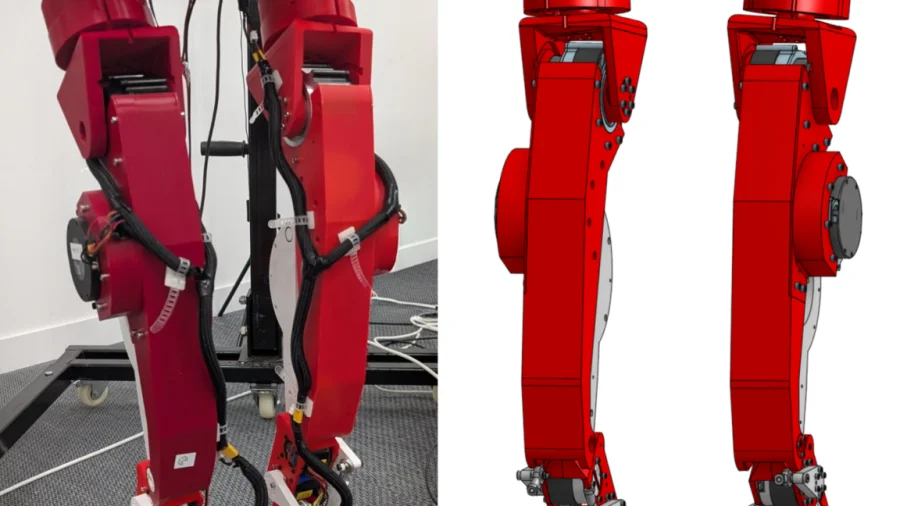
For years, the dream of building a humanoid robot that can walk, run, and learn like a human has been locked behind a wall of six-figure price tags and proprietary hardware. But a new project from Hugging Face is about to smash that wall down. A pair of 3D-printable humanoid legs, built for just $2,500, is now available to anyone with a 3D printer and a willingness to tinker. This isn't about creating the next marathon champion—it's about giving researchers a cheap, open platform to let their AI experiments run wild in a real, physical body.
Hugging Face’s LeRobot Humanoid: A Full-Stack Robotics Breakthrough
The newly released LeRobot Humanoid project from Hugging Face is more than just a set of legs. It's a complete, open-source package designed to democratize robotics research. The release includes a detailed bill of materials, files for all 3D-printable parts, wiring documentation, and step-by-step physical assembly instructions. But the hardware is only half the story. The project also comes with software tools for calibrating and controlling the robot, both in its physical form and in a simulated environment. This full-stack approach means researchers can spend less time building and more time experimenting.
Why This Matters Right Now
The high cost of humanoid robots has been a major bottleneck for AI and robotics research. Most advanced platforms cost tens or even hundreds of thousands of dollars, putting them out of reach for smaller labs, universities, and independent researchers. The LeRobot Humanoid project changes that equation. By using off-the-shelf components and 3D-printed parts, it slashes the entry price to just $2,500. This could lead to a surge in real-world AI experiments, accelerating progress in areas like locomotion, balance, and human-robot interaction. For students, startups, and researchers in developing countries, this is a game-changer.
How the LeRobot Humanoid Project Unfolded
Hugging Face, best known for its machine learning and AI development platform, has been quietly expanding into robotics. The LeRobot project is their open-source robotics initiative, and the humanoid legs are its most ambitious release yet. The project builds on years of work in the open-source hardware community, combining 3D printing with readily available motors, sensors, and controllers. The goal is not to create a polished consumer product, but to provide a flexible, modifiable platform that researchers can adapt to their specific needs. The legs are designed to be sturdy enough for basic walking and balancing tasks, but they are not intended for high-speed or heavy-duty applications.
Who Is Affected and What Officials Are Saying
The primary beneficiaries are researchers in AI, robotics, and related fields. For them, the LeRobot Humanoid represents a low-risk, high-reward platform for testing new algorithms. "If you are looking for the most advanced humanoid robot, this is not it," a Hugging Face spokesperson said. "But if you want a platform that lets you iterate quickly and test your software in a real body, this is a powerful tool." The project also has implications for educators, who can now give students hands-on experience with humanoid robotics without breaking the budget. Hobbyists and makers are also expected to embrace the open-source design.
What We Know So Far — and What Remains Unclear
What we know: The LeRobot Humanoid legs cost around $2,500 to build. The project is fully open-source, with all files and instructions available online. The legs can walk and balance, but are not designed for speed or complex terrain. The software includes both real-world and simulation control. What remains unclear: How durable the 3D-printed parts will be under repeated use. How easy it is for a non-expert to assemble and calibrate the robot. And whether the platform will attract a large enough community to sustain long-term development and support.
Risks, Concerns, and the Balanced View
While the LeRobot Humanoid is a promising development, it is not without risks. The use of 3D-printed parts raises questions about durability and reliability, especially for long-term experiments. The off-the-shelf components may not offer the precision or power of custom-built parts found in expensive robots. There is also the risk of fragmentation, as different researchers modify the design in incompatible ways. Critics argue that the platform is too limited for serious research, and that the time spent assembling and troubleshooting could be better spent on more advanced systems. However, proponents counter that the low cost and open nature of the project outweigh these limitations, especially for exploratory research and education.
Why Open-Source Robotics Trends Are Growing
The LeRobot Humanoid is part of a larger trend toward open-source hardware in robotics. Projects like the Berkeley Humanoid Lite and various open-source robotic arms have shown that democratizing access to hardware can accelerate innovation. By lowering the barrier to entry, these projects enable a wider range of researchers to contribute to the field. This trend is also being driven by advances in 3D printing and low-cost electronics, which make it possible to build functional robots for a fraction of the traditional cost. The result is a more diverse and dynamic research ecosystem.
- The LeRobot Humanoid uses 3D-printed parts and off-the-shelf components to keep costs low.
- The project includes both hardware and software, making it a complete platform for research.
- Hugging Face is known for its AI and machine learning tools, and this project extends their reach into robotics.
"If you are looking for the most advanced humanoid robot, this is not it. But if you want a platform that lets you iterate quickly and test your software in a real body, this is a powerful tool." — Hugging Face Spokesperson
What Researchers and Builders Should Know Now
For those interested in building the LeRobot Humanoid, the first step is to visit the Hugging Face LeRobot repository. The bill of materials lists all the required components, many of which are available from online retailers. A 3D printer is essential for creating the structural parts. The assembly process is documented in detail, but some experience with electronics and robotics is recommended. The software tools are designed to be user-friendly, but familiarity with Python and ROS (Robot Operating System) will be helpful. Researchers should also consider starting with the simulation environment before moving to the physical robot.
What Could Happen Next
The immediate future of the LeRobot Humanoid depends on community adoption. If a large number of researchers and hobbyists build and modify the platform, it could lead to a rich ecosystem of shared designs, software improvements, and experimental results. Hugging Face may also release additional components, such as arms or a torso, to create a full humanoid body. In the longer term, the project could inspire similar open-source initiatives from other companies and institutions, further democratizing robotics research. The ultimate goal is to accelerate the development of AI that can interact with the physical world in a meaningful way.
Our Take: Why This Story Matters Beyond One Project
The LeRobot Humanoid is more than just a cheap pair of robot legs. It represents a fundamental shift in how robotics research is conducted. By making hardware accessible and open, Hugging Face is challenging the traditional model of expensive, proprietary platforms. This could lead to a wave of innovation from researchers who were previously excluded from the field. While the current platform has limitations, its potential to democratize robotics research is immense. This story matters because it shows that the future of robotics is not just about building better machines—it's about making those machines available to everyone.
FAQs
What is the LeRobot Humanoid project?
The LeRobot Humanoid is an open-source project from Hugging Face that provides plans and software for building a pair of 3D-printable humanoid robot legs for about $2,500. It is designed to help researchers test AI in a physical body.
How much does it cost to build the 3D-printable humanoid legs?
The total cost for the components is approximately $2,500. This includes the 3D-printed parts, motors, sensors, controllers, and other off-the-shelf items. A 3D printer is also required to create the structural parts.
Who is the LeRobot Humanoid for?
The project is primarily aimed at AI and robotics researchers, educators, and students. It is also suitable for hobbyists and makers with experience in electronics and 3D printing. The low cost makes it accessible to smaller labs and institutions.
Can the LeRobot Humanoid legs run or walk on complex terrain?
No, the legs are designed for basic walking and balancing tasks. They are not intended for high-speed running or navigating complex terrain. The focus is on providing a platform for testing AI algorithms, not on high-performance locomotion.