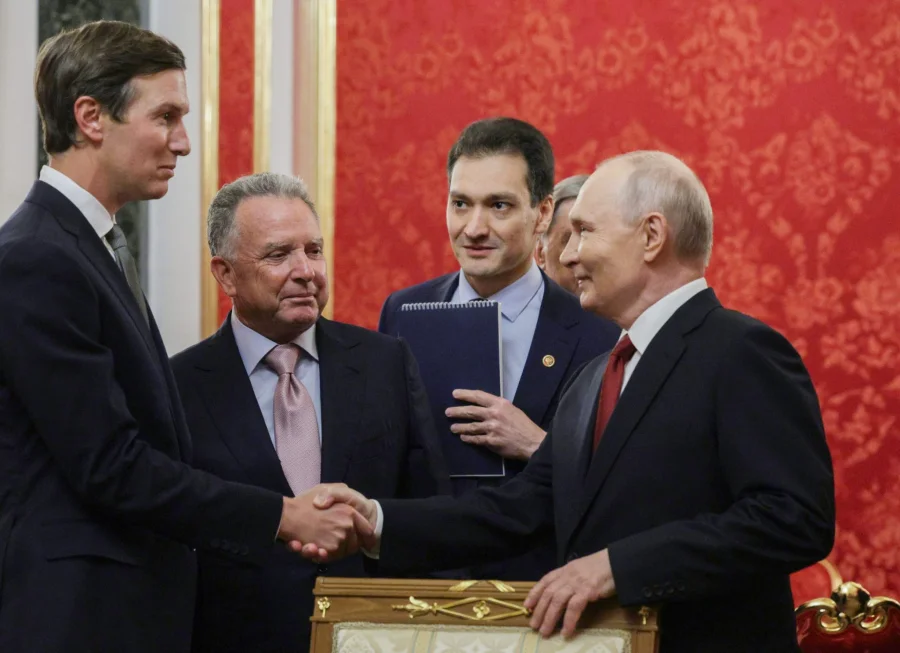
The Kremlin gates opened again for two familiar American visitors on Saturday, but the stakes behind this meeting felt heavier than the last. Steve Witkoff and Jared Kushner, President Donald Trump's hand-picked envoys, sat down with Vladimir Putin to try to breathe life into a peace process that has been drifting for months. The conversation in Moscow was always going to be difficult. What makes this round different is where the two Americans are headed next: Kyiv, for the first time ever.
A Diplomatic Double-Header That Carries Real Weight
The Moscow meeting alone would have been notable — it is the second Kremlin visit for Witkoff and Kushner, following their January talks with Putin. But the planned stop in Ukraine transforms this from a routine check-in into a genuine shuttle mission. The envoys are now positioned as the connective tissue between two capitals that have spent years speaking only through artillery fire.
This is the kind of high-wire diplomacy that rarely produces quick results, yet the very structure of the visit signals something important: Washington is trying to restart a conversation that had gone quiet.
Why This Peace Push Lost Its Momentum
The Russia-Ukraine war has not stopped, but America's attention had wandered. For the past six months, the White House's focus has been consumed by the Iran conflict, leaving the Ukraine file in a kind of diplomatic limbo. Witkoff and Kushner's January visit to Moscow now looks like a distant memory rather than a stepping stone.
That gap matters. In peace negotiations, momentum is everything. When talks stall, the front lines harden, and the political space for compromise shrinks. Saturday's Kremlin meeting is an attempt to reclaim lost ground — but the envoys will need more than a handshake in Moscow to make real progress.
The Unspoken Agreement: A Pause on Capital Strikes
One detail stands out from the talks: Putin and Ukrainian President Volodymyr Zelenskyy both agreed to pause strikes on each other's capitals while the negotiations took place. This is not a ceasefire — it is a temporary, tactical restraint. But in a war defined by escalation, even a limited pause carries symbolic weight.
The fact that both sides accepted this arrangement suggests a shared understanding that the talks matter, at least for now. Whether that restraint holds after the envoys leave remains an open question.
What a First Kyiv Visit Means for the Negotiating Table
For Witkoff and Kushner, the trip to Ukraine is uncharted territory. Meeting Putin in Moscow gives them Russia's perspective directly. Visiting Kyiv will give them the other side of the equation — the view from a nation that has been fighting for its survival.
This dual-track approach is classic shuttle diplomacy: hear both sides, find the overlap, and build from there. But the gap between Russian and Ukrainian positions remains enormous. The envoys are not walking into a breakthrough; they are walking into a minefield of competing demands, red lines, and deep mutual distrust.
Inside the Kremlin Meeting: What We Know and What We Don't
Details of Saturday's talks have not been fully disclosed. What is clear is that the meeting happened, that it lasted long enough to be meaningful, and that the envoys left with a scheduled stop in Kyiv. The substance of the conversation — whether Putin signaled flexibility or held firm — remains behind closed doors.
This is where honest reporting requires a pause. We do not know what was said. We do not know if progress was made. What we know is that the diplomatic machinery is moving again, and that alone is newsworthy after months of stagnation.
Confirmed Facts vs What Remains Unclear
Confirmed: Putin met Witkoff and Kushner at the Kremlin on Saturday. Both sides agreed to pause strikes on capitals during the talks. The envoys will visit Kyiv for the first time. This is their second Moscow visit, following January talks.
Unclear: The specific content of the negotiations. Whether Putin offered any new concessions. Whether the Kyiv visit will produce a concrete proposal. Whether the pause on capital strikes will hold beyond the diplomatic window.
All speculation beyond these points should be treated as exactly that — speculation.
The Escalation Paradox: Talks and Attacks Happening at Once
Saturday's diplomacy unfolded against a backdrop of intensified aerial attacks from both sides. This is the uncomfortable reality of the Russia-Ukraine war: negotiations and violence often run in parallel. The pause on capital strikes is an exception, not the rule.
This paradox shapes everything the envoys are trying to do. Every hour spent at the negotiating table is matched by hours of combat operations. The question is whether the diplomatic track can outpace the military one.
Why Washington's Attention Shifted — and Why It's Back
The six-month gap between the envoys' January visit and Saturday's meeting was not accidental. The Iran war consumed the White House's bandwidth, pushing Ukraine down the priority list. That shift had consequences: the peace process stalled, and both Moscow and Kyiv adjusted their strategies accordingly.
Now, with attention returning to Europe, the envoys are trying to rebuild what was lost. But time has passed, positions have hardened, and the window for compromise may have narrowed. The diplomatic clock is ticking.
What Ukrainians and Russians Stand to Gain or Lose
For ordinary Ukrainians, this diplomatic push carries both hope and skepticism. Hope that the war could end sooner. Skepticism born from years of broken promises and shifting red lines. For Russians, the talks represent a potential path to relief from sanctions and international isolation — but also uncertainty about what concessions might be required.
The human cost of this war is measured in lives, not just territory. Every round of talks carries the weight of families waiting for loved ones to return, cities waiting to rebuild, and a generation waiting for something resembling normalcy.
Risks and the Hard Road Ahead
It would be easy to frame this visit as a positive step, and in some ways it is. But the risks are substantial. The envoys are walking into a negotiation where the two sides' positions remain fundamentally opposed. Russia's territorial gains and Ukraine's demand for sovereignty are not easily reconciled.
Critics of the Trump administration's approach have questioned whether the U.S. is pushing Ukraine toward unfavorable terms. Supporters argue that only direct engagement can break the stalemate. Both perspectives deserve consideration as the diplomatic process unfolds.
A Pattern of On-Again, Off-Again Diplomacy
This is not the first time the U.S. has tried to mediate between Moscow and Kyiv, and it likely will not be the last. The pattern is familiar: a push for talks, a period of optimism, a breakdown, and a return to the table. Whether this round breaks that cycle remains to be seen.
What is different this time is the direct involvement of Trump's inner circle. Witkoff and Kushner are not career diplomats — they are personal emissaries with direct access to the President. That gives them a degree of authority that traditional negotiators often lack.
What to Watch For in the Coming Days
The Kyiv visit will be the next test. Watch for signals from the Ukrainian side about whether they see the envoys as honest brokers or as agents of American pressure. Watch for any public statements from Moscow about the tone of Saturday's talks. And watch the front lines — if the pause on capital strikes holds, it could indicate genuine commitment to the process.
For now, the diplomatic door is open. Whether anyone walks through it remains the defining question.
Future Outlook: Three Possible Paths
The coming weeks could follow several trajectories. A best-case scenario sees the envoys emerging from Kyiv with a framework for further talks. A middle path involves continued dialogue without concrete breakthroughs. A worst-case scenario sees the process collapse again, with both sides returning to full escalation.
None of these outcomes is predetermined. The envoys' success will depend on factors beyond their control: the situation on the ground, the willingness of both leaders to compromise, and the durability of Washington's renewed attention.
Our Take
This is diplomacy happening in real time, with all its messiness and uncertainty. The Witkoff-Kushner mission is significant not because it guarantees peace, but because it represents a choice to keep trying. After months of drift, the U.S. is signaling that the Russia-Ukraine war matters again.
Whether that signal translates into progress is another matter entirely. The gap between Moscow and Kyiv remains vast, and no single meeting — or even a shuttle between two capitals — can close it overnight. But the alternative to trying is a frozen conflict that continues to claim lives. For that reason alone, this diplomatic push deserves attention.
Frequently Asked Questions
Why are Witkoff and Kushner meeting Putin again?
The U.S. envoys are trying to revive stalled peace talks between Russia and Ukraine. Their Saturday meeting at the Kremlin follows a January visit and comes as Washington shifts focus back from the Iran conflict to the Russia-Ukraine war.
What is significant about the envoys' planned visit to Kyiv?
It will be Witkoff and Kushner's first-ever trip to Ukraine. Visiting both Moscow and Kyiv allows them to hear both sides' positions directly, a key element of shuttle diplomacy in peace negotiations.
Did Russia and Ukraine agree to any ceasefire during the talks?
Both sides agreed to pause strikes on each other's capitals while the talks took place. This is a temporary, tactical restraint rather than a full ceasefire, and it is unclear whether it will hold beyond the diplomatic window.
Why did the peace process lose momentum earlier?
Washington's attention was focused on the Iran war for the past six months, which pushed the Russia-Ukraine peace effort down the priority list. The envoys' January visit to Moscow was their last known trip before Saturday's meeting.