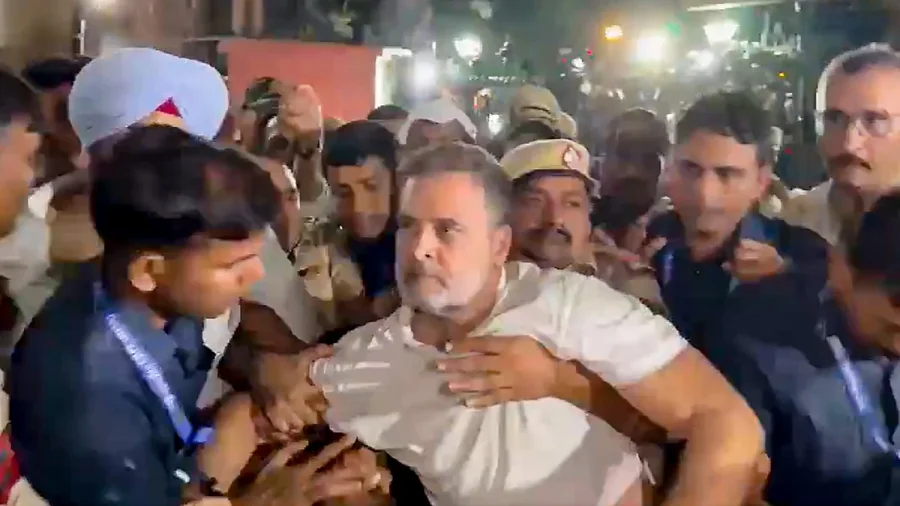
For nearly nine hours, Rahul Gandhi sat on the road at Parliament Street. By the time it ended, he was not walking away — he was being taken away. The Leader of Opposition was detained by Delhi Police on Tuesday, 6 October, after a sit-in that turned one of Delhi's most symbolic stretches into the epicentre of opposition politics.
What began as a planned INDIA bloc march to the Election Commission office at 10:30 a.m. ended with the forcible removal of Rahul Gandhi, Priyanka Gandhi Vadra, K.C. Venugopal, and several other Congress leaders from the Akashvani Bhavan premises. Their demand: the resignation of Chief Election Commissioner Gyanesh Kumar.
A March That Never Reached Its Destination
The opposition's plan was straightforward — march from Parliament Street to the Election Commission office nearby. The route was short. The political distance, however, proved impossible to cover.
Delhi Police stopped the MPs before they could proceed, triggering the sit-in. What followed was a standoff that lasted nearly nine hours, with Rahul Gandhi at its centre — not as a participant, but as the face of the protest.
Why Parliament Street Became the Battleground
Parliament Street is not just a location. It is where India's political power converges — Parliament, key ministries, and the offices that shape national decisions. A lockdown here is not routine. It is a signal.
For the INDIA bloc, the choice of venue was deliberate. The proximity to the Election Commission office meant the protest was not just symbolic — it was aimed directly at the institution they are challenging. The message was clear: the opposition wanted to be heard at the doorstep of the body it accuses of failing its mandate.
How the Day Unfolded
The protest began with the planned march at 10:30 a.m. When police blocked the route, opposition leaders sat down at the Akashvani Bhavan premises. Rahul Gandhi, Priyanka Gandhi Vadra, and K.C. Venugopal were among those who refused to move.
As the hours passed, the sit-in transformed from a planned demonstration into a test of endurance. By evening, Delhi Police moved in to detain the leaders. The protest ended — but the political confrontation did not.
Who This Affects Beyond the Leaders
For the Congress and its allies, the detention of Rahul Gandhi is not just a legal event. It is a political one. The images of a Leader of Opposition being removed by police will be used to frame a narrative of resistance — one that the party hopes will resonate with voters who see the Election Commission as compromised.
For the public, the lockdown of Parliament Street disrupted daily movement and drew attention to a demand that has been building for weeks. For the Election Commission, the protest is a direct challenge to its credibility at a time when trust in institutional neutrality is already under strain.
What the Opposition Is Saying
The INDIA bloc's demand is specific: Chief Election Commissioner Gyanesh Kumar must resign. The opposition has not detailed the full scope of its allegations in this protest, but the sit-in was framed as a response to what it calls a failure of the Commission to uphold its constitutional role.
Congress leaders have consistently argued that the protest is not about one individual but about the integrity of the electoral process. The detention of Rahul Gandhi, they say, is an attempt to suppress legitimate dissent.
What Delhi Police Has Said
Delhi Police detained the leaders after they refused to vacate the premises. The force has not issued a detailed statement on the specific charges, but the detentions were carried out after the protest was declared unlawful.
Officials said the lockdown was necessary to maintain order, though the opposition disputes this characterization. The police action has been described by Congress as disproportionate and politically motivated.
Confirmed Facts vs What Remains Unclear
Confirmed: Rahul Gandhi, Priyanka Gandhi Vadra, K.C. Venugopal, and other Congress leaders were detained by Delhi Police on Tuesday, 6 October. The sit-in lasted nearly nine hours. The protest was part of an INDIA bloc march demanding CEC Gyanesh Kumar's resignation.
Unclear: The specific legal grounds for the detentions have not been fully detailed. It is not yet known whether the leaders will face formal charges or be released without FIRs. The next phase of the opposition's protest strategy has not been announced.
The Political Moat Rahul Gandhi Is Building
Rahul Gandhi's willingness to sit on the road for nine hours is not a random act. It is part of a broader strategy to position himself as the opposition's most visible street fighter — a leader who does not just speak in Parliament but stands with protesters.
This approach has been building since the Bharat Jodo Yatra. The sit-in at Parliament Street is another brick in that wall. It creates a visual contrast: the Leader of Opposition on the ground, versus the government and institutions he accuses of avoiding accountability.
Risks and the Balanced View
The protest carries risks for the opposition. Detentions can generate sympathy, but they can also be framed as a disregard for law and order. The government has not yet responded in detail, but the BJP is likely to argue that the protest was an attempt to pressure a constitutional body.
There is also the question of public fatigue. Street protests can energize a base, but they can also be seen as political theatre if they do not lead to concrete outcomes. The demand for the CEC's resignation is unlikely to be met through a sit-in alone.
A Pattern of Institutional Confrontation
This is not an isolated event. The opposition has been increasingly willing to take its battles to the street, especially on issues related to electoral integrity. The INDIA bloc's decision to march to the Election Commission office reflects a broader trend: political disputes are moving from Parliament to public spaces.
That shift has consequences. It raises the stakes for institutions, increases the risk of confrontations, and tests the limits of protest in the capital. Parliament Street, once a backdrop, is now a stage.
What Readers Should Watch For
For those following the story, the key questions are: Will the detained leaders be formally charged? Will the INDIA bloc escalate its protest? And will the Election Commission respond to the demand for the CEC's resignation?
For voters, the larger question is whether this confrontation changes the political narrative ahead of upcoming elections. Street protests rarely shift policy on their own, but they can shift perception — and perception is what elections are made of.
What Could Happen Next
The opposition is unlikely to back down. The detention of Rahul Gandhi gives the INDIA bloc a fresh rallying point. More protests, more marches, and more confrontations are possible in the coming days.
The government, for its part, will likely maintain that the law will take its course. The Election Commission has not commented on the demand for the CEC's resignation. Whether this remains a street battle or moves to a larger political stage depends on how both sides choose to play the next move.
Our Take
The sit-in at Parliament Street was not just a protest. It was a statement about where the opposition believes the fight for electoral integrity must be fought — not in committee rooms, but on the streets. Rahul Gandhi's nine-hour stand forced a lockdown, drew national attention, and ended in detention. Whether it changes anything depends on what comes next. But for one day, the centre of Indian politics was not Parliament — it was the road outside it.
Frequently Asked Questions
Why was Rahul Gandhi detained?
Rahul Gandhi was detained by Delhi Police after he refused to vacate the Akashvani Bhavan premises during a sit-in protest. The protest was part of an INDIA bloc march demanding Chief Election Commissioner Gyanesh Kumar's resignation. Police said the protest was unlawful and blocked the planned route.
What is the INDIA bloc demanding?
The INDIA bloc is demanding the resignation of Chief Election Commissioner Gyanesh Kumar, alleging a failure to uphold the integrity of the electoral process. The demand was the central focus of the Parliament Street protest.
How long did the protest last?
The sit-in lasted nearly nine hours, beginning after the planned march was stopped at 10:30 a.m. and ending with the detention of opposition leaders in the evening.
Will the detained leaders face charges?
It is not yet clear whether the detained leaders will face formal charges. Delhi Police has not detailed the specific legal grounds for the detentions. The situation remains developing.