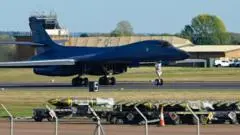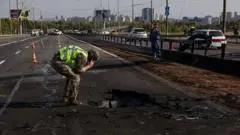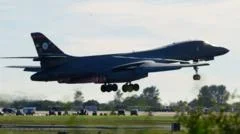
RAF Fairford's aprons are quieter this week. The US bombers that had been stationed at the Gloucestershire base were pulled out on Sunday, and Downing Street is now telling the public the base itself is safe.
The withdrawal was first reported by US media, which said a new threat prompted the decision. It came days after an incident near the base — an event that has not been fully described in public.
What Downing Street Actually Said — and What It Didn't
No10's message is narrow: RAF Fairford is safe. That is a statement about the base's security posture, not about the threat that reportedly triggered the US withdrawal.
Officials have not confirmed the nature of the threat, who made it, or whether it was directed at the base, the aircraft, or personnel. The distinction matters. A base can be secure while a specific deployment decision is still made as a precaution.
Why Fairford Matters More Than Its Runway Suggests
RAF Fairford is not an ordinary airfield. It is a US forward-operating base hosted on British soil, long used for bomber deployments and as a staging point for long-range missions.
When aircraft leave a base like this, the signal travels further than the flight path. Allies read it. Adversaries read it. And so do the communities living around the perimeter fence.
How the Week Unfolded
The sequence, based on what has been reported so far, is short. An incident occurred near the base last week. Then, on Sunday, US media reported a new threat and the bombers were withdrawn.
What has not been established publicly is whether the two events are directly connected, or whether the withdrawal was a routine repositioning that coincided with heightened reporting.
The People Who Live Beside the Fence
For residents around Fairford, the base is both an economic anchor and a permanent low-level hum of uncertainty. Aircraft movements are noticed. So are their absences.
A withdrawal without a clear public explanation feeds speculation locally — about safety, about what the base is being used for, and about whether they would be told if something were genuinely wrong.
What Has Been Confirmed — and What Hasn't
Confirmed: The bombers have been withdrawn. No10 says the base is safe. The withdrawal followed an incident near the base last week.
Not confirmed: The specific nature of the reported threat. Whether the incident and the withdrawal are linked. Whether the aircraft will return, and on what timeline. Whether any other US assets in the UK have been affected.
Anything beyond this is speculation and should be treated as such.
The Security Arrangement Behind the Headlines
Fairford operates under a longstanding UK-US arrangement in which the host nation provides the ground environment and the US controls its own assets and personnel protection.
That split is why statements from London and Washington can sound different without contradicting each other. No10 can vouch for the base. The US can still decide its aircraft are better placed elsewhere for a period.
Risks and the Case for Caution
The reassuring reading is straightforward: a precautionary move, a base that remains secure, and a threat that was managed quietly.
The less comfortable reading is that a threat serious enough to move strategic aircraft was serious enough to warrant more public explanation than has been offered. Neither reading has been ruled out by anything said so far.
A Pattern Worth Watching
Force protection decisions at overseas bases have become more frequent and less explained in recent years. Movements that once would have gone unnoticed are now reported within hours.
That transparency is useful. It also means partial information circulates faster than full context — which is exactly the gap No10's statement is trying to fill.
What Readers Should Take From This
Treat the withdrawal as a confirmed fact and the reasoning as unconfirmed. Avoid drawing conclusions about base safety from aircraft movements alone — deployments and force protection are different questions.
If you live near Fairford or have family stationed there, the practical position is unchanged: no public advisory has been issued, and no evacuation or lockdown has been reported.
What Happens Next
The clearest signals to watch are the return of aircraft, any joint UK-US statement, and whether the incident near the base is ever described in detail.
Silence on all three would suggest a precautionary episode now closed. Movement on any of them would suggest something more.
Our Take
This is a story about the gap between reassurance and explanation. No10 has answered the question it was asked — is the base safe — but not the question people are actually asking: what happened, and why did it require moving bombers out?
That gap is not evidence of a cover-up. It is normal in force protection matters. But it is also why the story will not close on its own.
Frequently Asked Questions
Is RAF Fairford safe right now?
Downing Street has publicly stated that RAF Fairford is safe. No public advisory, evacuation, or lockdown has been reported at the base.
Why did the US withdraw its bombers from RAF Fairford?
US media reported that a new threat led to the withdrawal on Sunday. The specific nature of that threat has not been publicly detailed by either the UK or US governments.
What was the incident near RAF Fairford last week?
An incident near the base was reported last week, preceding the withdrawal. Officials have not publicly described what occurred or confirmed whether it is linked to the bombers leaving.
Will the US bombers return to RAF Fairford?
No timeline has been announced. The base remains operational, and no statement has ruled out a future return of US aircraft.