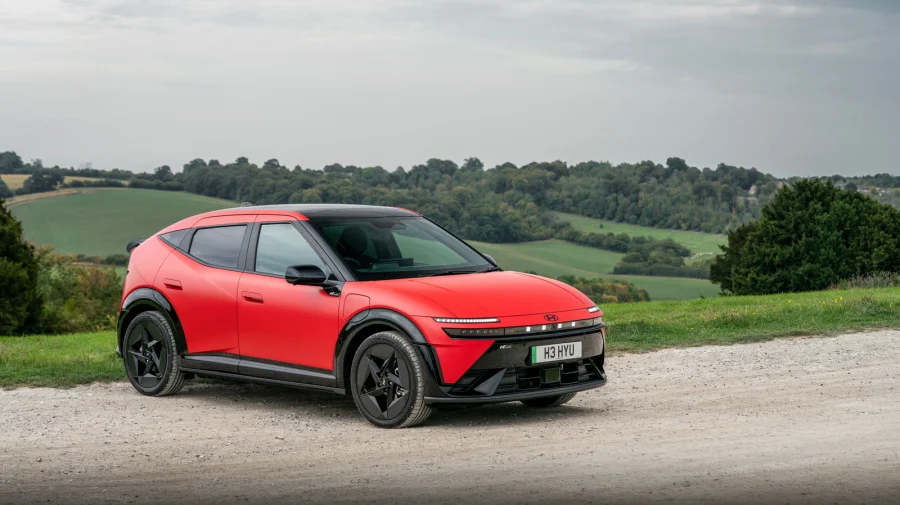
For years, the affordable hot hatch has been quietly disappearing from showrooms — priced out by emissions rules, electrification costs, and a market that rewards bigger, more expensive cars. Hyundai has just made a counter-argument, and it's on sale in Britain right now.
The Korean automaker's all-electric hot hatch has gone on sale in the UK, starting at around $25,000. It's a rare thing in 2025: a small, quick, electric car that doesn't ask buyers to stretch into premium territory. And in a detail that will frustrate American enthusiasts, Hyundai has no plans to bring it to the US.
A hot hatch price tag that actually looks like one
The roughly $25,000 starting figure puts this car in territory that has become almost empty in the EV market. Most electric vehicles with any performance intent now start well above $35,000, and genuinely quick ones sit far higher.
For UK buyers, that price point matters more than it might elsewhere. Britain's EV market is crowded at the top and thin at the bottom — plenty of expensive electric crossovers, very few attainable electric cars with any character.
Why the UK gets it and the US doesn't
Hyundai's decision to keep this model out of the US is the part of the story American readers will notice first. The company has made clear it has no plans to bring the car stateside.
The reasons aren't spelled out in detail, but the pattern is familiar. Small cars sell poorly in America, where buyers overwhelmingly choose SUVs and trucks. A compact electric hot hatch would likely struggle to find volume in a market that has spent two decades abandoning the segment.
That's a commercial calculation, not a statement about the car. It also means US buyers watching Europe's cheaper EV options will keep watching from a distance.
What "hot hatch" means in an electric era
The term once described cheap, light, front-wheel-drive cars with just enough power to be fun — Golf GTIs, Peugeot 205 GTIs, early Civic Type Rs. Electrification changed the physics: instant torque, low centre of gravity, and no gearbox to work through.
Hyundai's entry leans into that formula rather than fighting it. The result is a car positioned as fun-first and budget-conscious, rather than a stripped-out economy model with a sporty badge.
The buyers this actually reaches
The people most affected by this launch aren't collectors or enthusiasts with a second car in the garage. They're younger drivers, city dwellers, and second-car households in the UK who want something electric, quick enough to enjoy, and cheap enough to insure and finance.
That's a group the EV industry has repeatedly promised to serve and repeatedly priced out. Whether Hyundai actually reaches them depends on finance rates, insurance groups, and real-world running costs — not just the headline figure.
Where Hyundai's advantage sits
Hyundai's edge in electric cars isn't a single breakthrough — it's accumulated scale. The company has spent years building a dedicated EV platform family, refining battery supply chains, and spreading development costs across multiple models.
That matters here. A $25,000 electric hot hatch is only possible if the underlying platform, battery, and motor are already amortised across a wider range. Hyundai has that range. Many rivals chasing the same price point do not.
Confirmed facts, and what's still unclear
Confirmed: The car is on sale in the UK, priced from around $25,000, and Hyundai has no plans to bring it to the US.
Unclear: Exact UK trim pricing, battery options, performance figures, delivery timelines, and whether Hyundai will extend the model to other markets. Those details are not established by the available information and should not be assumed.
The risks Hyundai is taking
Cheap performance cars are historically low-margin. Building one at $25,000 in an era of expensive batteries means Hyundai is likely accepting thin returns in exchange for volume, brand building, and regulatory compliance in Europe.
There's also a demand question. UK EV incentives have shifted repeatedly, charging infrastructure outside major cities remains uneven, and buyers in this price bracket are the most sensitive to running-cost changes. A good car at a good price can still stall if the ownership experience doesn't add up.
The wider pattern this fits into
Europe is quietly becoming the test market for affordable EVs. Chinese manufacturers have pushed prices down aggressively, European brands have responded with smaller models, and Korean automakers are now competing directly on value rather than prestige.
The US, meanwhile, has moved the other way — larger vehicles, higher prices, and a market where a $25,000 electric car is increasingly an anomaly rather than a category.
What UK buyers should do now
If you're in the UK and interested, the headline price is only the starting point. Check insurance groupings before committing — small performance EVs can be expensive to cover. Confirm real-world range for your commute rather than the quoted figure. And compare finance offers across dealers, since monthly cost, not sticker price, is what most buyers actually pay.
What happens next
UK sales performance will effectively decide whether this model travels. If it finds buyers, Hyundai has a template it can scale into other European markets. If it doesn't, the affordable electric hot hatch may remain a British curiosity rather than a global one.
For US readers, the near-term answer is straightforward: this one isn't coming. Whether that changes depends on a market shift that hasn't happened yet.
Our Take
The interesting thing here isn't the car itself — it's the geography. Hyundai is betting that a cheap, fun electric car can work in Britain while being commercially pointless in America. That says less about the vehicle and more about how differently the two markets now think about size, price, and what a car is for.
If the UK experiment works, it becomes evidence that affordable EVs aren't dead — they're just being sold in the wrong places.
Frequently Asked Questions
How much does the Hyundai electric hot hatch cost in the UK?
It starts at around $25,000, making it one of the more affordable performance-styled electric cars on sale in Britain.
Will Hyundai sell this electric hot hatch in the US?
No. Hyundai has stated it has no plans to bring the model to the US market, where small cars and hot hatches sell in low volumes.
Why is Hyundai only selling it in the UK and Europe?
Small, affordable cars have far stronger demand in Europe than in the US, where buyers overwhelmingly choose larger SUVs and trucks. The decision is commercial rather than technical.
Is an electric hot hatch actually fun to drive?
Electric drivetrains offer instant torque and a low centre of gravity, which suits the hot hatch formula well. Whether a specific model delivers on that depends on tuning, weight, and chassis setup.