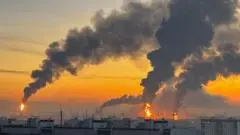
Air-defence fire lit up the sky over Moscow overnight as hundreds of drones flew toward the Russian capital in what the city's mayor called the largest attack on Moscow of the war. Two people were killed, and the mayor said 450 drones were downed.
The numbers alone mark a shift. A single overnight barrage of this size is unlike anything Moscow has reported since Russia's full-scale invasion of Ukraine began.
What Moscow's Mayor Said About the Overnight Barrage
Moscow's mayor said 450 drones were downed during the attack and confirmed that two people died. The figure covers drones intercepted over and around the capital, according to the mayor's statement.
No independent confirmation of the 450 figure was immediately available. Casualty and damage details were still being reported as the morning progressed.
Why a 450-Drone Night Changes the War's Geography
For most of the war, large-scale drone exchanges were concentrated near the front line. Strikes reaching Moscow in these numbers push the conflict's reach deep into Russia's interior.
That matters for ordinary residents. Airports, schools and workplaces in and around the capital can be disrupted for hours after a night like this, even when most drones are intercepted.
How the Attack Unfolded Overnight
The barrage came in waves during the night, with air defences active over the city. The mayor's office reported the interception total and the two deaths after the attack subsided.
This is not the first drone incident over Moscow, but officials described the scale as unprecedented. Earlier strikes had involved far smaller numbers.
Who Is Affected — and What Residents Faced
The two people killed are the most direct human cost. Beyond them, the attack affects millions who live under Moscow's air-defence umbrella.
Overnight drone alerts typically mean disrupted sleep, closed airspace and emergency crews on standby. For families in the affected areas, the war arrived at their doorstep in a way it rarely has before.
What Russian Authorities Have Confirmed So Far
The interception count and the death toll come from Moscow's mayor. Russian officials have not yet released a fuller account of damage or the targets involved.
Independent monitors and Ukrainian officials have not publicly confirmed the same figures. As with most wartime claims, the numbers should be treated as official statements rather than independently verified facts.
Reading the Numbers Carefully
Wartime interception figures are difficult to verify in real time. Both sides have incentives to emphasise success — Russia in showing its defences held, Ukraine in showing its reach.
What is clearer is the trend: long-range drone attacks are growing in size and ambition, and Moscow is no longer a peripheral target.
Confirmed Facts vs What Remains Unclear
Confirmed by Moscow's mayor: 450 drones downed, two people killed, and the description of the attack as the largest on the capital.
Not yet independently verified: the exact number of drones launched, the specific targets, the extent of damage, and whether any drones reached their intended objectives.
Unclear: how Russia will respond, and whether this becomes a new baseline for future strikes.
The Wider Pattern Behind the Escalation
Drone warfare has become the defining feature of this conflict — cheap, deniable and capable of reaching far behind the front line. Each side has scaled up production and range.
Attacks of this size suggest Ukraine is testing whether it can overwhelm Russian air defences through sheer volume. That is a strategy with real limits, but also real psychological weight.
What This Means for People Watching the War
For readers following the conflict, the key takeaway is scale, not just spectacle. A 450-drone night signals that long-range strikes are becoming routine rather than exceptional.
For anyone with ties to the region, travel plans and local safety advisories around Moscow are worth checking in the coming days.
What Could Happen Next
Russia is likely to respond, though the form and timing are unknown. Further large drone exchanges should be expected on both sides.
Whether this becomes a turning point or a single dramatic night depends on what follows — and on how both governments choose to frame it.
Our Take
The headline number — 450 drones — will dominate coverage, but the more important story is what it represents: a war that keeps expanding its reach. Moscow residents now share a reality that front-line communities have lived with for years.
That shift deserves attention beyond the casualty count, because it changes what the war feels like for millions of people far from the battlefield.
Frequently Asked Questions
How many drones were downed over Moscow?
Moscow's mayor said 450 drones were downed during the overnight attack. The figure has not been independently verified.
How many people died in the Moscow drone attack?
Two people were killed, according to the mayor's statement.
Was this the largest attack on Moscow of the war?
Yes — the mayor described it as the largest attack on the Russian capital since the war began.
Who launched the drones?
The attack is attributed to Ukraine, in line with the original report. Ukrainian officials have not publicly confirmed the specific figures cited by Moscow.