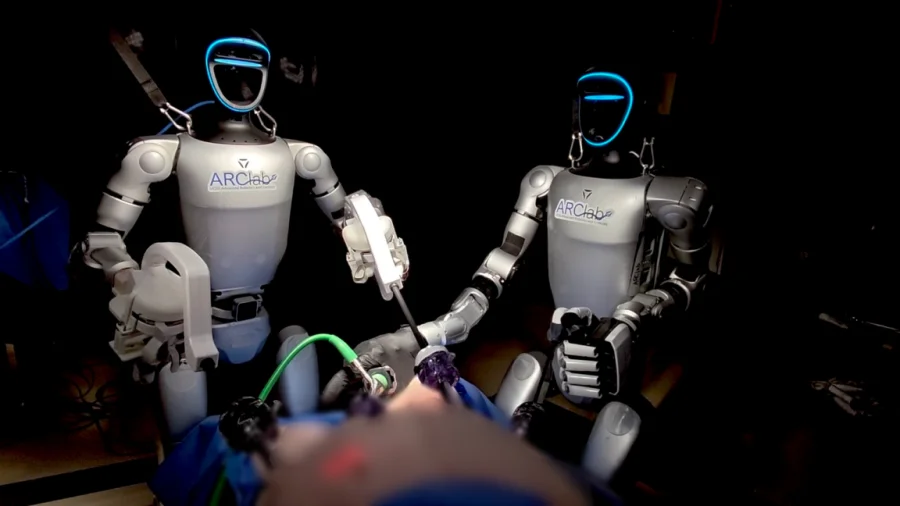
Imagine a surgeon sitting in a control room hundreds of miles away, guiding a humanoid robot's hands to perform delicate surgery on a living patient. That scenario moved closer to reality this month when researchers announced a world-first: humanoid robots, controlled remotely by skilled surgeons, successfully removed gallbladders from live pigs.
What Happened in the World-First Humanoid Robot Surgery
In a preclinical trial published July 15, 2026, in the journal Nature, surgeons at UC San Diego used teleoperated humanoid robots to perform minimally invasive gallbladder removals on live pigs. The robots were not acting autonomously — every movement was directed by a human surgeon using remote controls. The trial demonstrated that general-purpose humanoid robots could be adapted for surgical tasks, potentially offering a cheaper alternative to the specialized robotic systems used in many large hospitals today.
Why This Matters for Patients and Smaller Hospitals
The biggest implication is access. Specialized surgical robots like the da Vinci system cost millions of dollars and require dedicated operating rooms and trained staff. Many smaller hospitals, rural clinics, and facilities in low-resource settings simply cannot afford them. If humanoid robots — which are becoming more common and less expensive — can be repurposed for surgery, it could dramatically lower the barrier to robotic-assisted care. For patients, that could mean less invasive procedures, faster recovery, and access to expert surgeons without traveling to a major medical center.
How the Surgery Worked: Teleoperation, Not Autonomy
This was not a case of robots replacing doctors. Instead, the humanoid robots acted as remote extensions of the surgeon's hands. Using a teleoperation setup, the surgeon controlled the robot's arms and instruments from a separate location. The robots performed laparoscopic gallbladder removal — a common minimally invasive procedure — on the live pigs. The study's authors emphasized that the robots were tools, not independent operators. The key innovation was proving that a general-purpose humanoid platform could achieve the precision needed for surgery, something previously thought to require purpose-built systems.
Who Is Affected: Surgeons, Hospitals, and Future Patients
For surgeons, this technology could expand their reach. A specialist at a university hospital could remotely assist a patient in a rural clinic hundreds of kilometers away. For hospital administrators, the lower cost of humanoid robots — estimated at a fraction of the price of dedicated surgical robots — could make robotic surgery financially viable for more facilities. For patients, the potential benefits include reduced scarring, shorter hospital stays, and lower infection risk, all hallmarks of minimally invasive surgery. However, all of this remains theoretical until human trials confirm safety and effectiveness.
Official Response and Research Team
The study was led by researchers at the University of California San Diego, with the findings published in Nature. The team described the work as a "feasibility study" — a proof of concept that humanoid robots can perform live surgery under human control. In a statement, the researchers noted that the approach "takes a fraction of the cost" of existing robotic systems and could democratize access to advanced surgical care. The paper's authors include engineers, roboticists, and surgeons who collaborated on adapting the humanoid platform for medical use.
What This Breakthrough Really Means
This is not the first time robots have been used in surgery — the da Vinci system has been performing robotic-assisted procedures for decades. But those robots are custom-built, expensive, and fixed in place. Humanoid robots, by contrast, are designed for general tasks and are rapidly becoming cheaper and more capable. The Nature study shows that with the right software and control interface, a humanoid robot can perform delicate surgical maneuvers. The significance lies in the potential for scalability: if humanoid robots can be mass-produced for multiple industries, the medical version could ride that wave of cost reduction.
Confirmed Facts vs What Remains Unclear
Confirmed: The trial involved live pigs, not cadavers or synthetic models. The surgery was gallbladder removal (cholecystectomy). The robots were teleoperated by human surgeons. The results were published in Nature on July 15, 2026. The research was conducted at UC San Diego.
Unclear: How many surgeries were performed and what the success rate was. Whether any complications occurred during or after the procedures. The specific humanoid robot model used. The exact cost comparison with existing surgical robots. Most importantly, when human trials might begin — the researchers have not announced a timeline.
Risks and Balanced View
While promising, the approach faces significant hurdles. Teleoperation introduces latency — any delay between the surgeon's command and the robot's movement could be dangerous in delicate surgery. The humanoid robots used in the trial may lack the fine motor control of purpose-built surgical systems. There are also regulatory questions: how would health authorities like the FDA evaluate a general-purpose robot repurposed for surgery? Critics may argue that the cost savings could come at the expense of precision and safety. The study itself is a preclinical trial, meaning it is far from clinical adoption. Enthusiasts should temper expectations: many promising animal studies never translate to human use.
The Broader Trend: Humanoid Robots Entering Medicine
This trial is part of a wider push to adapt humanoid robots for healthcare. Companies like Tesla, Boston Dynamics, and Figure have been developing general-purpose humanoids for factory work, logistics, and domestic tasks. The medical community is watching closely: if these robots can be trained for surgery, patient care, or hospital logistics, they could reshape healthcare delivery. The Nature study is one of the first rigorous demonstrations of surgical capability in a humanoid platform, but it is unlikely to be the last.
What This Means for You
If you live in a city with a major hospital, you may already have access to robotic surgery. But if you are in a rural area or a developing country, this technology could eventually mean that a surgeon in a distant city can operate on you without you traveling. For now, the impact is limited to research labs. But the direction is clear: humanoid robots, guided by human experts, could become a tool for democratizing surgical care. Patients should watch for human trials in the coming years, and hospital administrators should begin evaluating whether humanoid platforms could fit their future plans.
What Happens Next
The immediate next step is likely more preclinical work to refine the control system, reduce latency, and test on more complex procedures. Human trials would follow, probably starting with simple, low-risk surgeries. Regulatory approval will be a multi-year process. If successful, the first clinical applications could appear within five to ten years. The researchers have not announced a specific timeline, but the publication in Nature signals that the work is being taken seriously by the scientific community.
Our Take
This is a genuine breakthrough, but it is important to separate the achievement from the hype. The researchers did not create autonomous surgical robots — they proved that humanoid robots can be controlled remotely to perform surgery on live animals. That is a meaningful step, but it is not a revolution yet. The real promise is in access and cost. If humanoid robots can bring robotic surgery to the millions of patients who currently lack access, that would be transformative. But the path from a pig in a lab to a patient in a rural clinic is long, expensive, and uncertain. For now, this is a story of what could be — and that is worth paying attention to.
Frequently Asked Questions
Were the robots operating autonomously?
No. The humanoid robots were teleoperated by human surgeons in real time. Every movement was controlled by a surgeon, not by artificial intelligence or pre-programmed instructions.
Why is this different from existing surgical robots like da Vinci?
Existing surgical robots are custom-built, expensive (often millions of dollars), and fixed in place. This study used a general-purpose humanoid robot, which is cheaper and could be mass-produced for multiple uses, potentially making robotic surgery affordable for smaller hospitals.
When will this be available for human patients?
There is no announced timeline. The study is a preclinical trial on pigs. Human trials, regulatory approval, and clinical adoption would take years, likely five to ten years at minimum if all goes well.
What surgery was performed?
The robots performed laparoscopic gallbladder removal (cholecystectomy) on live pigs. This is a common minimally invasive procedure in humans.
Could this replace human surgeons?
No. The technology is designed to extend the reach of human surgeons, not replace them. The robots are tools controlled by skilled doctors. The human surgeon remains essential for decision-making, judgment, and control.