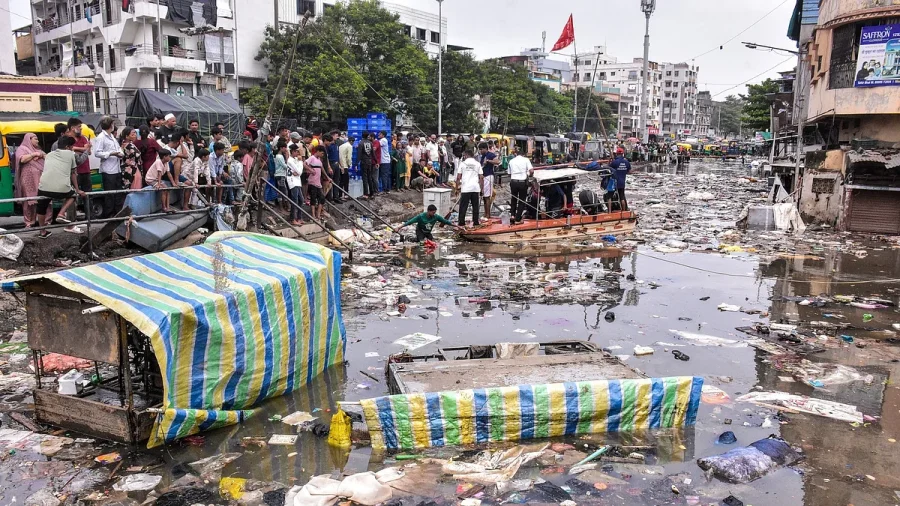
The death toll from rain-related incidents in Gujarat has risen to 23, with Surat among the worst-hit districts after torrential monsoon rain triggered flood-like conditions, forced large-scale evacuations and disrupted normal life across south Gujarat. Surat city, which recorded 358 mm of rainfall in the 24 hours ending Wednesday morning, witnessed some of the heaviest rain in its recent history, inundating residential neighbourhoods, commercial hubs and transport corridors. Officials said more than 3,400 people were rescued and over 3,800 residents from low-lying areas were shifted to safer locations in Surat alone, while across Gujarat a total of 7,522 people were moved to relief centres and 3,711 rescued. The situation in and around Surat remained grim even after rainfall eased, with waterlogging persisting in many areas and authorities monitoring river levels closely.
Why Surat's record rainfall is a crisis for millions
Surat, Gujarat's second-largest city and a major industrial and diamond trading hub, is home to over 6 million people. The 358 mm rainfall in a single day overwhelmed drainage systems, turning streets into rivers and cutting off entire neighbourhoods. For residents, the deluge meant not just waterlogged homes but also disrupted access to food, drinking water, medical supplies and transport. Many families spent hours trapped on upper floors or rooftops, waiting for rescue teams to arrive. The human toll extends beyond the 23 confirmed deaths — thousands have lost belongings, livestock and livelihoods, especially in low-lying and informal settlements that are most vulnerable to flooding.
How the monsoon crisis unfolded in Gujarat
The heavy rainfall that began earlier this week intensified rapidly, particularly in south Gujarat districts including Surat, Navsari, Valsad and Tapi. Surat's 358 mm rainfall broke an 85-year-old record for a single day in July, according to local meteorological data. Rivers and dams in the region swelled, prompting authorities to release water from reservoirs, which worsened flooding in downstream areas. The state government deployed National Disaster Response Force (NDRF) teams, State Disaster Response Force (SDRF) units, and local administration personnel for rescue and relief operations. By Wednesday, the rain had eased but the damage was already extensive.
Who is affected and what it means for ordinary people
The flooding has hit Surat's working-class and middle-class families hardest. Many residents in low-lying areas like Katargam, Varachha, Udhna and Adajan saw water enter their homes, damaging furniture, electronics and essential supplies. Small business owners, street vendors and daily wage workers — already struggling with economic pressures — face additional losses as shops and markets remain closed. Schools and colleges have been shut, and many offices have asked employees to work from home. For thousands of families, the immediate concern is access to clean drinking water and food, as floodwaters have contaminated local water sources. Relief camps set up by the government are providing temporary shelter, but the scale of displacement is significant.
Official response and rescue operations underway
Gujarat Chief Minister Bhupendra Patel reviewed the situation and directed officials to expedite rescue and relief efforts. The state government has announced compensation for families of the deceased and is assessing damage to property and infrastructure. NDRF teams, along with local police and fire brigade personnel, have been conducting boat rescues in submerged areas. Officials said that more than 3,400 people were rescued in Surat alone, and over 7,500 across the state. Medical teams have been deployed to relief camps to prevent waterborne diseases. The India Meteorological Department (IMD) has issued warnings for continued heavy rainfall in parts of Gujarat, though intensity is expected to reduce over the next 48 hours.
What the record rainfall reveals about urban flooding risks
The 358 mm rainfall in Surat is not just a weather event — it is a stark reminder of how rapidly urbanising cities in India are becoming more vulnerable to extreme monsoon events. Surat's drainage infrastructure, designed for lower rainfall intensities, was unable to cope with the unprecedented deluge. Encroachments on natural water channels, rapid construction in floodplains, and inadequate stormwater management systems have compounded the risk. Climate scientists have warned that such extreme rainfall events are becoming more frequent and intense due to climate change, making it essential for cities like Surat to invest in resilient infrastructure, early warning systems and better urban planning.
Confirmed facts vs what remains unclear
What is confirmed: The death toll stands at 23 as of the latest official update. Surat recorded 358 mm rainfall in 24 hours. Over 7,500 people have been evacuated across Gujarat. Rescue operations are ongoing. What remains unclear: The full extent of property damage and economic losses has not yet been assessed. The number of people still stranded in remote or inaccessible areas is not fully known. Whether the death toll will rise further as water recedes and more bodies are recovered is uncertain. Officials have not yet provided a district-wise breakdown of all 23 deaths. Speculation about the exact cause of each death — drowning, electrocution, building collapse — should be treated as unconfirmed until official reports are released.
Risks and concerns as floodwaters recede
Even as rainfall eases, the risk of waterborne diseases such as cholera, typhoid and leptospirosis increases in flood-affected areas. Stagnant water becomes a breeding ground for mosquitoes, raising the threat of dengue and malaria. There are also concerns about structural damage to buildings weakened by prolonged waterlogging. For displaced families, the psychological toll of losing homes and livelihoods can be severe. Critics have pointed to inadequate preparedness and slow response in some areas, though officials maintain that rescue operations were launched promptly. The long-term challenge will be rebuilding lives and infrastructure while addressing the underlying vulnerabilities that made this crisis so severe.
Wider pattern: Extreme monsoon events becoming more common
Surat's record rainfall is part of a broader trend across India, where monsoon patterns are becoming more erratic and extreme. In recent years, cities like Mumbai, Chennai, Bengaluru and Hyderabad have experienced similar flooding events, often exceeding historical records. Climate scientists attribute this to a warming atmosphere that can hold more moisture, leading to heavier downpours. For Gujarat, which has faced both droughts and floods in recent decades, the challenge is to build resilience against both extremes. The Surat floods should serve as a wake-up call for urban planners and policymakers across the country.
What residents and affected people should do now
For those in flood-affected areas, the immediate priority is safety. Avoid walking or driving through floodwaters, which may be contaminated or hide open manholes and debris. Boil drinking water or use purification tablets. If you are in a relief camp, follow instructions from authorities and report any health issues immediately. For those outside affected areas, consider donating to verified relief organisations or contributing to state government relief funds. Stay updated through official sources — district administration social media handles, IMD alerts and local news — rather than relying on unverified social media posts. If you have family members in affected areas, try to establish contact through phone or messaging apps, but be patient as networks may be disrupted.
What happens next: Relief, recovery and monsoon forecast
Over the coming days, the focus will shift from rescue to relief and rehabilitation. Authorities will assess damage to homes, roads, bridges and public infrastructure. Compensation for families of the deceased and those who lost property will be processed. The IMD will continue to monitor rainfall patterns and issue warnings. If heavy rain resumes, the risk of further flooding and landslides in hilly areas remains. The state government is expected to release a detailed damage assessment report in the coming weeks. For Surat, the immediate task is to drain floodwaters, restore essential services and prevent disease outbreaks. The longer-term challenge is to build a city that can withstand the next extreme monsoon — because, as climate scientists warn, there will be a next time.
Our Take
The Gujarat floods are not just a natural disaster — they are a man-made crisis amplified by inadequate urban planning, climate change and insufficient investment in resilient infrastructure. The 23 deaths are a tragedy, but the number could have been higher without the swift rescue operations. The real test for the government and city authorities will be in the weeks and months ahead: ensuring that displaced families are rehabilitated, that compensation reaches those who need it, and that lessons are learned to prevent a repeat. Surat's record rainfall is a warning for every Indian city — the monsoon is changing, and our cities must change with it. This is not a one-off event; it is a pattern that demands urgent action.
Frequently Asked Questions
What is the current death toll in Gujarat floods?
The death toll from rain-related incidents in Gujarat has risen to 23 as of the latest official update. Surat district is among the worst affected.
How much rainfall did Surat receive?
Surat recorded 358 mm of rainfall in the 24 hours ending Wednesday morning, one of the heaviest in its recent history and breaking an 85-year-old record for July.
How many people have been rescued and evacuated?
In Surat alone, over 3,400 people were rescued and more than 3,800 shifted from low-lying areas. Across Gujarat, a total of 7,522 people have been moved to relief centres and 3,711 rescued.
What should people in flood-affected areas do now?
Avoid walking or driving through floodwaters, boil drinking water, follow instructions from authorities, and stay updated through official sources like district administration and IMD alerts.