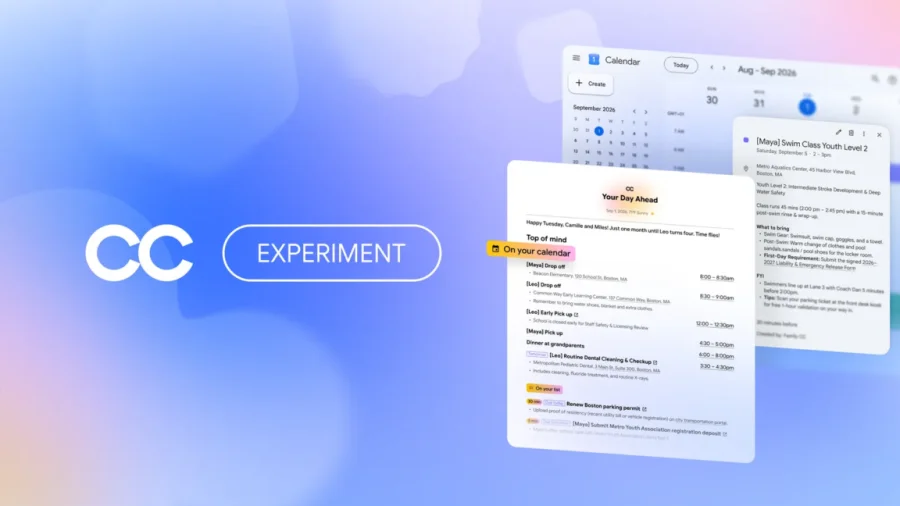
Google's AI models may not be winning every benchmark race right now. But the company holds something its rivals can only rent: years of your data, already sitting inside Gmail, Calendar, Maps, and Search. Its newest experiment, CC, is an attempt to turn that quiet advantage into something a whole household can use.
CC is a Google Labs project — an AI agent designed to be shared by up to six family members, each with their own way of interacting with it, or ignoring it entirely.
What Exactly Is CC, and How Is It Different From Gemini?
CC is not a chatbot you open in a tab. According to Google, it has its own Google account, which means it exists as a separate entity inside the family's digital life rather than being tied to one person's login.
That design choice matters. It lets a parent, a teenager, and a grandparent all talk to the same agent without sharing a single personal account — and without one person's inbox becoming everyone's inbox.
Google says each family member can choose whether to engage with CC at all. That opt-in framing appears deliberate, given how sensitive shared AI access can be inside a home.
The Experiment That Came Before CC
CC is not a sudden idea. It is an evolution of something Google announced in 2025 — an earlier experiment that eventually became Gemini's Daily Brief.
Daily Brief works by churning through data already stored in your Google account to offer daily action items and suggestions. Think reminders, follow-ups, and nudges drawn from what's already in your Gmail or Calendar.
The new CC keeps that same goal but stretches it across a family unit instead of a single user. That is a meaningfully harder problem — because family data is messy, overlapping, and often private in ways individual data is not.
Why Google's Data Advantage Is the Real Story Here
Most AI assistants today start from zero. They know what you tell them, and little else. Google's models start with context — your emails, your commute, your calendar, your search history.
That is the advantage CC is built to exploit. A shared agent that already understands the household's rhythms — school pickups, bill cycles, travel plans — can be genuinely useful in ways a generic chatbot cannot.
It also explains why Google, rather than a startup, is attempting this. Replicating that context would take a competitor years of ecosystem building.
Who This Actually Affects
For now, CC is a Google Labs experiment, which means it is not a product you can simply sign up for and rely on.
But the direction is clear. Families already juggle shared calendars, shared subscriptions, and shared responsibilities across multiple Google accounts. An agent that sits between them could reduce friction — or add a new layer of confusion.
The people most likely to feel the impact first are heavy Google ecosystem users: households already running on Gmail, Google Calendar, and Android devices.
What Google Has Said — and What It Hasn't
Google has confirmed the basics: CC is a Labs experiment, it supports up to six users, and it operates through its own Google account.
What the company has not detailed publicly includes how data is separated between family members, what happens when one member opts out, and whether CC's memory is shared or siloed. Those are the questions that will define whether CC feels helpful or intrusive.
Confirmed Facts vs What Remains Unclear
Confirmed: CC exists as a Google Labs experiment. It is designed for up to six family members. It has its own Google account. It evolved from the 2025 experiment that became Gemini's Daily Brief.
Unclear: The exact privacy architecture, whether family members can see each other's interactions, regional availability, and any commercial timeline. Any claims beyond what Google has stated should be treated as speculation.
Why Google Keeps Betting on Personal Context
Google's broader AI strategy has increasingly leaned on context rather than raw model power. Gemini's integration across Workspace, Android, and Search all point the same direction.
CC extends that logic to the household — the one unit where context is richest and privacy is most complicated. If it works, it becomes very hard to leave. If it misfires, it becomes a cautionary tale about AI that knows too much.
The Risks Google Will Have to Answer For
Shared AI inside a family raises obvious concerns. A teenager's calendar entries, a parent's medical appointments, a grandparent's financial emails — all of it sits inside the same ecosystem CC draws from.
Google's opt-in framing suggests awareness of this. But opt-in alone does not resolve the harder question: what does the agent remember, and who can ask it?
Privacy advocates have consistently argued that convenience-first AI features tend to expand data access faster than users understand. CC will likely face the same scrutiny.
The Bigger Pattern: AI Moves From Personal to Shared
For two years, the AI assistant race has been about individual users. CC signals a shift toward shared agents — for families, teams, and eventually entire organisations.
That shift changes the design problem entirely. Personal assistants optimise for relevance. Shared assistants must optimise for boundaries.
Whoever solves that well could define the next phase of consumer AI.
What Readers Should Do Right Now
There is nothing to sign up for yet. CC remains an experiment, and Google has not announced general availability.
If you are curious, the practical step is to review what data already lives in your Google account — because that is the raw material any future CC-style agent would draw from. Checking your Google privacy settings now is more useful than waiting for a launch.
What Happens Next
Google Labs experiments typically either graduate into products, get folded into existing ones, or quietly disappear. CC's path will depend on how testers respond to the shared-account model.
Watch for two signals: whether Google publishes details on data separation between family members, and whether CC gets tied into Gemini branding. Either would suggest the experiment is heading toward a real launch.
Our Take
CC is a small experiment with a large implication. Google is not trying to build a better chatbot here — it is trying to make its data advantage socially acceptable inside a household.
That is a harder sell than a benchmark win. Families share devices, accounts, and secrets, and an AI agent that sits in the middle of all three will be judged less on intelligence and more on restraint.
If Google gets the boundaries right, CC could become one of the more quietly influential products in its AI lineup. If it doesn't, it will be remembered as the moment the company asked for too much trust, too soon.
Frequently Asked Questions
What is Google CC?
CC is a Google Labs experiment — a shared AI agent designed for families of up to six members. It has its own Google account and builds on the technology behind Gemini's Daily Brief.
How is CC different from Gemini?
Gemini is a personal AI assistant tied to your account. CC is designed to be shared across a family, with each member choosing whether to interact with it.
Is Google CC available to use now?
No. CC is currently an experimental Google Labs project. Google has not announced a public rollout or availability timeline.
Does CC access my personal Google data?
CC is built on the same approach as Gemini's Daily Brief, which draws on data in your Google account. Google has not yet detailed exactly how data is separated between family members.