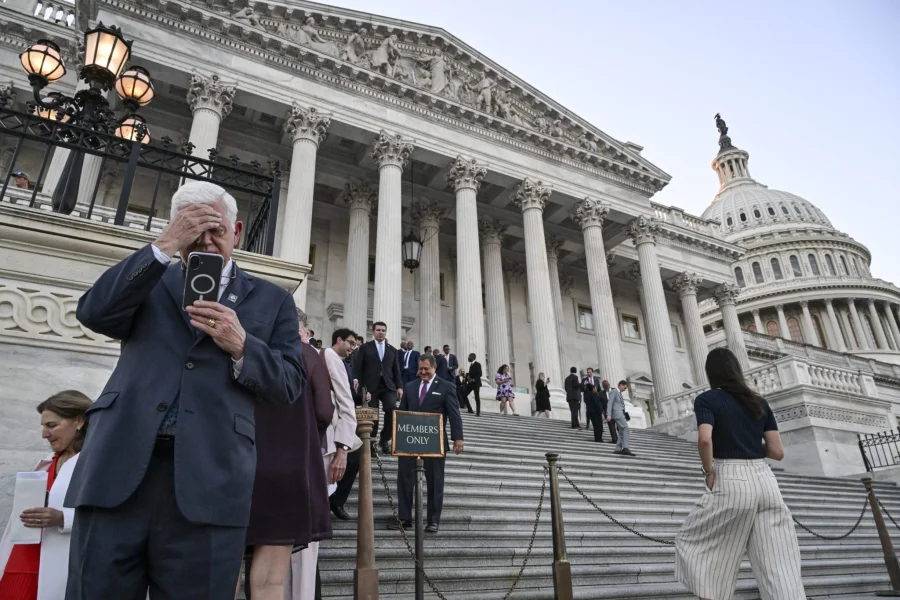
For the thirtieth year in a row, Congress has done what it almost always does: missed its own deadline. The annual appropriations bills that fund the federal government were not passed before the fiscal year began. Again.
It is a failure so routine it barely makes headlines anymore. And that is precisely the problem.
The One Job the Constitution Actually Assigns
Article I of the Constitution gives Congress the power of the purse. Funding the federal government is not a side task — it is the core legislative function. Yet since the end of World War II, Congress has completed this duty on time just four times.
Four times in roughly eighty years. The math is not a partisan talking point. It is a historical record.
Why a Missed Deadline Is Not a Bureaucratic Footnote
When appropriations bills are not passed, the government does not simply pause. It runs on continuing resolutions — short-term patches that keep agencies funded at existing levels, often for weeks or months at a time.
Those patches freeze new programs, delay contracts, and leave federal employees planning their lives around the possibility of a shutdown. National parks, food safety inspections, small business loans, and military readiness all sit in the balance.
Thirty Years of the Same Script
The pattern is not new. It has repeated under Democratic and Republican presidents, under divided government and unified control. The players change. The outcome does not.
Each year, the same sequence unfolds: a deadline approaches, a stopgap is passed, a crisis is narrowly avoided or briefly endured, and the underlying process remains untouched.
Who Actually Pays for This Dysfunction
The people who feel it most are not on Capitol Hill. They are the federal workers who miss paychecks during shutdowns. The families waiting on delayed benefits. The contractors whose projects stall. The taxpayers who fund a government that cannot plan beyond the next sixty days.
Uncertainty has a cost, and it is paid by people who had no vote in the process that created it.
Both Parties Share the Blame
It would be convenient to pin this on one party. The record does not support that. The failure to pass appropriations on time has persisted across administrations of both parties and every configuration of Congress.
That is what makes the dysfunction structural rather than partisan. The incentives reward brinkmanship and punish compromise. The system, as designed and as practiced, produces this result.
What Is Confirmed and What Remains Unclear
Confirmed: Congress has failed to pass all annual appropriations bills on time for thirty consecutive years, and has done so successfully only four times since World War II.
Unclear: Whether any serious reform effort will emerge, and whether the political will exists to change a process that has failed for three decades.
Risks and the Balanced View
Some argue that continuing resolutions, while imperfect, prevent the worst outcomes and allow negotiation to continue. Others counter that stopgap funding is itself the problem — it normalizes failure and removes any pressure to govern.
Both views have merit. What is not in dispute is the record: thirty years of missed deadlines and four on-time completions since 1945.
A Pattern That Extends Beyond Budgets
The appropriations breakdown is a symptom of a broader trend. Congress increasingly struggles to pass major legislation on schedule, relying on last-minute deals and crisis-driven governance.
For a body whose primary constitutional responsibility is funding the government, this is not a minor inefficiency. It is a fundamental failure of function.
What Readers Should Take Away
Watch for continuing resolutions and shutdown threats in the coming months. Understand that these are not anomalies — they are the predictable output of a broken process.
And recognize that the deadline being missed is not a surprise. It is the thirty-year norm.
What Comes Next
Without structural reform, the pattern will repeat. Another fiscal year, another missed deadline, another stopgap measure. The only question is how long the patch holds and who pays the price when it does not.
Our Take
This is not a story about one bad year. It is a story about a system that has stopped working as intended — and a political class that has learned to live with the failure. The four on-time budgets since World War II are not a statistic to gloss over. They are a verdict.
Frequently Asked Questions
How many times has Congress passed all appropriations bills on time since WWII?
Four times. Since the end of World War II, Congress has completed its annual appropriations process before the fiscal year deadline on only four occasions.
What happens when Congress misses the appropriations deadline?
The government operates on continuing resolutions — temporary funding measures that keep agencies running at existing levels. If those expire without a new deal, a government shutdown follows.
Is this a Republican or Democratic problem?
Neither exclusively. The failure to pass appropriations on time has occurred under both parties and every combination of divided and unified government.
Why does Congress keep missing the budget deadline?
Political incentives reward delay and brinkmanship over compromise. The process lacks enforcement mechanisms, and stopgap funding has become an accepted substitute for actual budgeting.