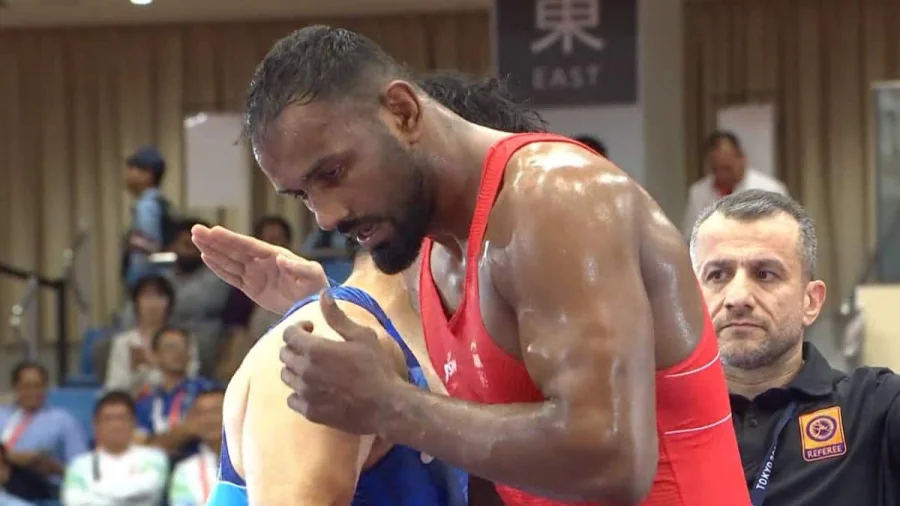
Nitesh Siwach walked off the mat with silver around his neck and a result that matters more than the colour of the medal. In the men's 97kg Greco-Roman final at the Asian Games, he lost 0-4 to Japan's Yuri Nakazato — but in doing so, he became the first Indian to reach this stage of a Greco-Roman final at the Games.
For a country whose wrestling identity is built almost entirely on freestyle, that is not a small thing.
How The Final Unfolded Against Nakazato
Siwach entered the bout with a shot at India's first-ever Asian Games gold in Greco-Roman wrestling. He trailed 0-2 at the halfway mark and could not find a way back into the contest, eventually going down 0-4.
Nakazato controlled the tempo from the opening exchanges. In Greco-Roman, where holds below the waist are not allowed and the emphasis falls on upper-body control, that early lead proved decisive.
Why A Greco-Roman Silver Hits Differently For India
India's wrestling medals — at the Olympics, the World Championships and the Asian Games — have come overwhelmingly from freestyle. Greco-Roman has long been the discipline where Indian wrestlers arrive, compete and exit early.
Siwach's run changes that pattern. A final appearance, even in defeat, signals that the gap is narrowing.
The Road That Led Him To The Title Clash
Siwach's path to the final was built on the kind of grinding, low-scoring bouts that define Greco-Roman wrestling. Each round narrowed the field until only two wrestlers remained — and one of them was Indian.
That he reached the last bout at all is the story here. The final result, while disappointing in the moment, sits on top of a campaign that no previous Indian Greco-Roman wrestler had managed at this level.
What This Means For Indian Wrestling's Next Generation
For young wrestlers training in akharas across Haryana, Punjab and Delhi, Greco-Roman has rarely looked like a viable path to the podium. Siwach's silver offers a different picture.
Coaches and state associations now have a concrete result to point to — proof that the discipline is not a dead end for Indian athletes.
Reading The 0-4 Scoreline Honestly
The margin was clear. Siwach did not lose on a controversial call or a late scramble; Nakazato was the better wrestler on the day and controlled the final.
That honesty matters. A historic silver does not need to be dressed up as a near-miss for gold. It stands on its own.
Confirmed Facts vs What Remains Unclear
Confirmed: Siwach competed in the men's 97kg Greco-Roman final, trailed 0-2 at halfway, and lost 0-4 to Japan's Yuri Nakazato. The result delivered a historic silver for India in the discipline.
Unclear: No official statement from Indian wrestling authorities has been issued at the time of writing. Details of Siwach's full tournament path, opponent-by-opponent, have not been independently verified beyond the final result.
Risks And The Balanced View
A single silver does not transform a discipline's fortunes overnight. India's Greco-Roman pipeline remains thin compared to freestyle, and one podium finish can obscure how much structural work is still needed.
The result should be celebrated — and also read as a starting point, not a conclusion.
The Wider Pattern In Indian Wrestling
Indian wrestling has been broadening its base in recent years, with more athletes competing across weight categories and disciplines at international events. Siwach's run fits that trend.
It also raises a question the sport will now have to answer: can this be repeated, or was it a one-off?
What Readers And Aspiring Wrestlers Should Take Away
For aspiring Greco-Roman wrestlers, the practical message is straightforward — the discipline is no longer a closed door. For fans, the takeaway is to watch the next cycle of Indian Greco-Roman competitors closely.
For selectors and federations, the pressure now is to build on a result that arrived without a deep support system behind it.
Future Outlook
Siwach's silver will likely be referenced for years as the moment Indian Greco-Roman wrestling first reached an Asian Games final. Whether it becomes a turning point or an outlier depends on what follows — in funding, coaching and the next generation of athletes.
Our Take
The gold slipped away, and that will sting. But the more important line in the record books is the one that says an Indian wrestler contested a Greco-Roman final at the Asian Games. That had not happened before. Siwach did not win gold — he did something arguably harder, in a discipline where India had no history to lean on.
Frequently Asked Questions
Did Nitesh Siwach win gold at the Asian Games?
No. Siwach lost the men's 97kg Greco-Roman final 0-4 to Japan's Yuri Nakazato and settled for silver.
Why is Siwach's silver considered historic?
India has traditionally struggled in Greco-Roman wrestling at the Asian Games. Siwach's final appearance and silver mark a first-of-its-kind result for the country in the discipline.
Who defeated Nitesh Siwach in the final?
Japan's Yuri Nakazato, who led 2-0 at the halfway mark and went on to win 4-0.
What does this mean for Indian wrestling going forward?
It gives the Greco-Roman discipline a credible podium reference point for young athletes and coaches. Whether it leads to sustained success will depend on investment and development in the coming years.