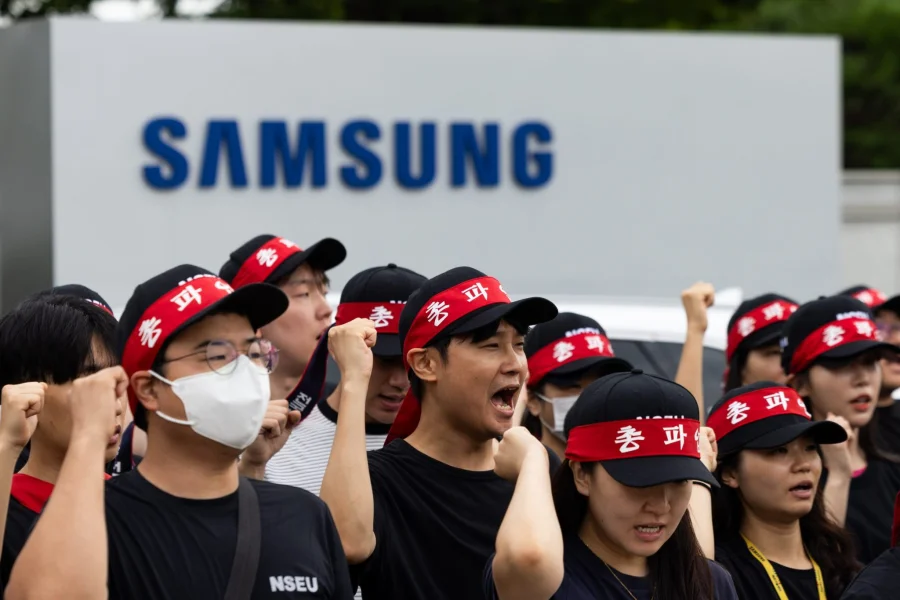
Just as the world’s biggest tech companies are racing to build the next generation of artificial intelligence, a human crisis is brewing at the very heart of the machine. More than 45,000 workers at Samsung’s memory chip plants in South Korea are preparing to walk off the job on May 21 — a strike that could disrupt the production of the one component AI systems simply cannot function without.
This isn’t just a labor dispute. It’s a potential breaking point in the global AI supply chain. And the consequences could ripple far beyond the factory gates.
The Chips That Power AI Are at Risk
When people talk about AI infrastructure, the conversation usually starts and ends with Nvidia’s GPUs. But those powerful processors are useless without the memory chips stacked alongside them. Samsung produces roughly a third of the world’s DRAM — the memory inside virtually every phone, laptop, server, and data center on the planet. Together with its Korean rival SK Hynix, it controls about two-thirds of the global DRAM market.
Even more critically, Samsung is one of only three companies in the world that manufacture high-bandwidth memory (HBM) — the specialized chips that AI systems cannot run without. The other two are SK Hynix and American semiconductor company Micron. If Samsung’s production slows or stops, the entire AI ecosystem feels the pain.
Why This Matters Right Now
The timing could not be worse. The AI boom is in full swing. Data centers are being built at record pace. Nvidia’s next-generation GPUs are already in high demand. And every single one of them requires HBM memory chips that Samsung helps produce.
A prolonged strike could mean:
- Delays in AI infrastructure projects worldwide
- Higher prices for memory chips, raising costs for tech companies
- Increased pressure on SK Hynix and Micron to fill the gap — a near-impossible task
- Slower rollout of AI services that rely on new hardware
For investors, this adds a layer of uncertainty to an already volatile semiconductor market. For consumers, it could mean delayed product launches and higher prices for devices. For the AI industry, it’s a reminder that the most advanced technology still depends on human hands.
How the Strike Threat Unfolded
The labor dispute has been simmering for months. Workers at Samsung’s three fabrication complexes — located in Pyeongtaek, Hwaseong, and Giheung — have been demanding better wages, improved working conditions, and a greater share of the profits from the AI boom that Samsung has helped fuel.
According to reports, the union representing the workers has been in tense negotiations with Samsung management. The company has posted record profits thanks to surging demand for memory chips, but workers say they haven’t seen a fair share of that success. The gap between corporate earnings and worker compensation has become a flashpoint.
The strike threat escalated after talks broke down earlier this month. The union has now set a deadline of May 21 for the walkout, warning that production at the memory chip plants could be severely impacted.
Who Is Affected and What Officials Are Saying
The immediate impact will be felt by Samsung itself. The company’s semiconductor division is its most profitable business, and any disruption could cost billions. But the ripple effects will spread quickly.
Nvidia, which relies on Samsung and SK Hynix for HBM chips, could face supply constraints just as it ramps up production of its next-generation AI GPUs. Other major tech companies — including Google, Amazon, Microsoft, and Meta — that are building massive AI data centers could also see delays.
Samsung officials have expressed concern but have not yet made a public statement on the strike’s potential impact. The union, meanwhile, has said it is prepared to negotiate but will not back down from its demands.
“The workers who built this AI boom deserve a fair share of the profits. We are not asking for anything unreasonable — we are asking for dignity and respect.” — Union representative, as quoted in local reports
What We Know So Far — and What Remains Unclear
What we know:
- 45,000 workers are threatening to strike from May 21
- The strike targets Samsung’s memory chip fabrication plants
- Samsung is a critical supplier of DRAM and HBM chips
- The AI industry is heavily dependent on these chips
What remains unclear:
- How long the strike could last
- Whether Samsung will meet worker demands before the deadline
- How much production capacity will be affected
- Whether SK Hynix and Micron can absorb the shortfall
- The full financial impact on Samsung and the broader tech industry
Risks, Concerns, and the Balanced View
The most immediate risk is a supply crunch for HBM chips. If Samsung’s production drops significantly, AI companies could face a shortage that delays product launches and infrastructure projects. This could slow the pace of AI innovation at a time when competition is fierce.
There is also a financial risk for Samsung. The company’s semiconductor division is its cash cow, and any prolonged disruption could hurt its bottom line and stock price. Investors are already watching nervously.
However, it’s important to keep perspective. Samsung has faced labor disputes before and has managed to resolve them without catastrophic impact. The company also has significant leverage — it is one of the few players in a highly concentrated market. Workers, too, have a lot to lose if the strike drags on and damages the company’s reputation.
Critics of the strike argue that it could backfire, hurting the very workers it aims to help. If Samsung loses market share to SK Hynix or Micron, jobs could be at risk in the long term. But supporters say the strike is necessary to correct years of inequality.
Why Similar Labor Disputes Are Growing in the AI Era
The Samsung strike is not an isolated incident. Across the semiconductor industry, workers are increasingly demanding a larger share of the profits generated by the AI boom. The gap between corporate earnings and worker compensation has widened dramatically, and labor unrest is becoming more common.
In the United States, workers at several chip manufacturing plants have staged protests over wages and working conditions. In Europe, similar tensions are emerging. The AI boom has created enormous wealth, but that wealth has not been evenly distributed.
This trend raises a fundamental question: Can the AI industry sustain its rapid growth if the workers who build its infrastructure feel left behind?
What Investors, Tech Companies, and Consumers Should Know Now
For investors: Keep a close eye on Samsung’s stock and any official statements from the company. The strike could create volatility in the semiconductor sector. Diversifying exposure across SK Hynix and Micron may reduce risk.
For tech companies: Now is the time to diversify supply chains. Relying on just three companies for HBM chips is a vulnerability. Investing in alternative suppliers or in-house production could pay off in the long run.
For consumers: Don’t panic — but be aware that delays in AI hardware could affect product launches. If you’re planning to buy a new device that relies on advanced AI capabilities, you may want to wait and see how this situation develops.
What Could Happen Next
The next few days are critical. If Samsung and the union reach a last-minute agreement, the strike could be averted. If not, the walkout will begin on May 21, and the world will watch to see how long it lasts.
In the best-case scenario, the strike is short and production resumes quickly. In the worst-case scenario, a prolonged disruption could create a global chip shortage that sets the AI industry back by months.
Either way, this strike is a wake-up call. The AI boom is not just about algorithms and GPUs — it’s about people. And those people are demanding to be heard.
Our Take: Why This Story Matters Beyond One Incident
The Samsung strike is a reminder that the most advanced technology in the world still depends on human labor. The chips that power AI are made by people working in clean rooms, wearing protective suits, and operating complex machinery. Their demands for fair treatment are not just a labor issue — they are a supply chain issue, an economic issue, and a moral issue.
If the AI industry wants to sustain its growth, it must find a way to share the wealth more equitably. Otherwise, the very workers who make AI possible may become its biggest bottleneck.
This story is not just about Samsung. It’s about the future of technology and the people who build it.
FAQs
What is the Samsung strike about?
More than 45,000 workers at Samsung’s memory chip plants in South Korea are threatening to strike over demands for better wages, improved working conditions, and a fairer share of profits from the AI boom. The strike is set to begin on May 21, 2026, if negotiations fail.
How could the Samsung strike affect AI development?
Samsung is a critical supplier of DRAM and high-bandwidth memory (HBM) chips, which are essential for AI systems. A prolonged strike could disrupt the supply of these chips, leading to delays in AI infrastructure projects, higher costs, and slower innovation across the industry.
Which companies are most at risk from the Samsung strike?
Nvidia, which relies on Samsung for HBM chips for its AI GPUs, is among the most exposed. Other major tech companies building AI data centers — including Google, Amazon, Microsoft, and Meta — could also face supply constraints. Samsung itself faces significant financial risk.
Can other chipmakers fill the gap if Samsung’s production stops?
Only two other companies — SK Hynix and Micron — manufacture HBM chips. Both are already operating at near-full capacity to meet existing demand. It would be extremely difficult for them to absorb a significant shortfall from Samsung, making a global chip shortage a real possibility.