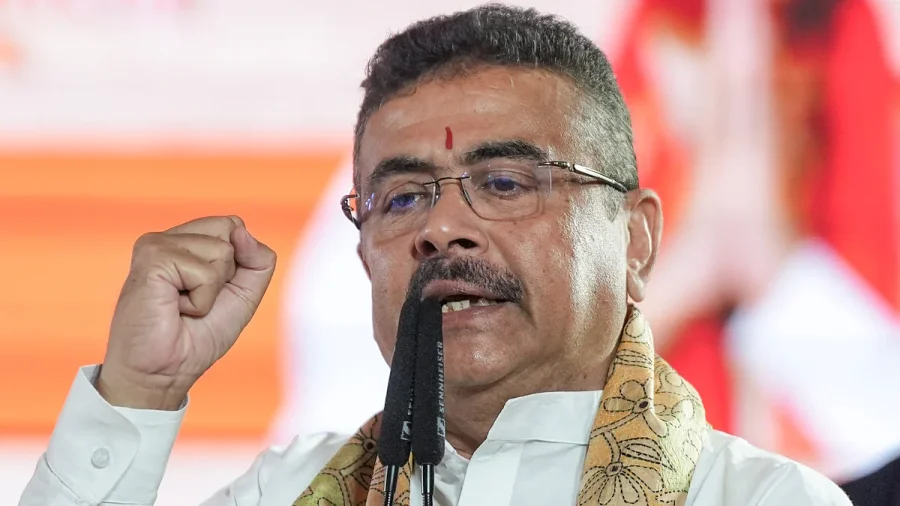
At a Ganesh Puja inauguration in Rajarhat-Gopalpur, east Kolkata, Chief Minister Suvendu Adhikari picked an unlikely target: the books sold at Puja stalls. His claim — that Left Front stalls stocked Karl Marx and Vladimir Lenin but not Swami Vivekananda — landed as a cultural accusation, not a literary one.
Within hours, the CPI(M) had responded, and a dispute about what sits on a festival bookshelf became the latest round in Bengal's long argument over identity and legacy.
What Adhikari Actually Said — And Where He Said It
Speaking on Saturday at the Ganesh Puja inauguration programme, Adhikari accused the Left Front of sidelining Bengal's Sanatan traditions and culture during its 34-year rule.
His specific claim: Left parties traditionally set up book stalls near Puja pandals, where Marxist literature was readily available, while books by Vivekananda, Hindu mystic Baba Lokenath, and publications of the Bharat Sevashram Sangha were allegedly absent.
He added that even after "searching thousands of times," one would not find books on the history of West Bengal's creation or on the two-nation theory at such stalls.
Why a Bookstall Became a Political Stage
In Bengal, the Puja bookstall is not a minor detail. For decades, festival pandals doubled as public reading rooms — places where political parties, cultural organisations, and publishing houses put their intellectual identity on display.
That makes the stall a symbolic space. What is stocked, and what is missing, can be read as a statement about whose ideas a party considers worth circulating.
Adhikari's framing turns that symbolism into an accusation: that the Left's festival presence reflected an ideological filter rather than an open cultural one.
The CPI(M)'s Pushback
The CPI(M) has rejected the Chief Minister's characterisation, hitting back at his remarks. The party's response contests the premise that its Puja stalls excluded Bengal's spiritual and cultural canon.
At the time of writing, the exchange remains a war of statements, with both sides making their case publicly rather than through any formal inquiry or documentation.
Who This Argument Is Really Aimed At
The immediate audience is Bengal's festival-going public — millions who walk through pandals every autumn and stop at stalls out of habit or curiosity.
But the deeper audience is political. Adhikari's remarks speak to voters who see Sanatan traditions as under-represented in Bengal's public culture, and to those who associate the Left's 34-year rule with a particular intellectual orthodoxy.
For the CPI(M), the stakes are its cultural record — the claim that it, too, engaged with Bengal's spiritual and literary inheritance.
Confirmed Facts vs What Remains Unclear
Confirmed: Adhikari made the remarks at a Ganesh Puja inauguration in Rajarhat-Gopalpur on Saturday. He named Marx, Lenin, Vivekananda, Baba Lokenath, and the Bharat Sevashram Sangha in his claim. The CPI(M) has publicly responded.
Unclear: There is no independent, verified inventory of what Left-affiliated Puja book stalls stocked across different years or locations. The claim is a political assertion, not a documented finding. Readers should treat both sides' characterisations as statements of position, not established fact.
The Risks in This Kind of Argument
Cultural claims of this sort are difficult to verify and easy to inflate. A single stall's stock list cannot represent an entire party's 34-year record, and festival stalls vary by organiser, locality, and year.
There is also a risk of flattening Bengal's intellectual history into a binary — Marxist on one side, Sanatan on the other — when the state's reading culture has historically been far more tangled than that.
A Familiar Pattern in Bengal Politics
This is not the first time festival spaces have become political battlegrounds in West Bengal. Puja pandals, their themes, their sponsors, and their cultural messaging have repeatedly drawn political attention.
What is notable here is the vehicle: not a pandal's design or a budget, but a bookstall's shelf. It signals that in Bengal, even the question of which books are sold during Puja can carry electoral weight.
What Readers Should Take From This
For voters and festival-goers, the practical takeaway is simple: treat both claims as political arguments, not settled records. If the cultural record matters to you, look at what stalls actually stock this season rather than relying on either side's description of the past.
For students and readers interested in Bengal's intellectual history, the episode is a reminder that the state's literary and spiritual traditions have rarely belonged to one camp alone.
What Could Happen Next
With the festival calendar ahead, Puja book stalls will be visible again — and both parties have reason to keep the argument alive. Expect the CPI(M) to defend its cultural record, and the Chief Minister's side to repeat the charge.
Whether this remains a rhetorical exchange or prompts any concrete claim about stall inventories is, at this stage, unknown.
Our Take
The story matters less for what was on any particular shelf and more for what it reveals: in West Bengal, culture is not a side issue in politics — it is the main arena. A remark about books at a Puja stall is really a remark about who gets to define Bengal's inheritance.
That is a debate worth having. It is also a debate that deserves evidence, not just assertion — from either side.
Frequently Asked Questions
What did the West Bengal CM say about Puja book stalls?
Suvendu Adhikari claimed that Left Front Puja book stalls stocked works by Karl Marx and Vladimir Lenin but not books by Swami Vivekananda, Baba Lokenath, or Bharat Sevashram Sangha publications, accusing the Left of sidelining Bengal's Sanatan traditions during its 34-year rule.
How did the CPI(M) respond?
The CPI(M) hit back at the Chief Minister's claim, rejecting his characterisation of its Puja book stalls and its cultural record. The exchange remains a public war of statements.
Is there proof that Left Puja stalls excluded Vivekananda's books?
No independent, verified inventory of Left-affiliated Puja book stalls across years has been cited. The claim is a political assertion, and readers should treat it as such rather than as a documented finding.
Why does this argument matter in Bengal politics?
Because Puja pandals and their book stalls are highly visible public spaces in Bengal, and what they stock is read as a statement about cultural and ideological identity — making even a bookshelf a political symbol.