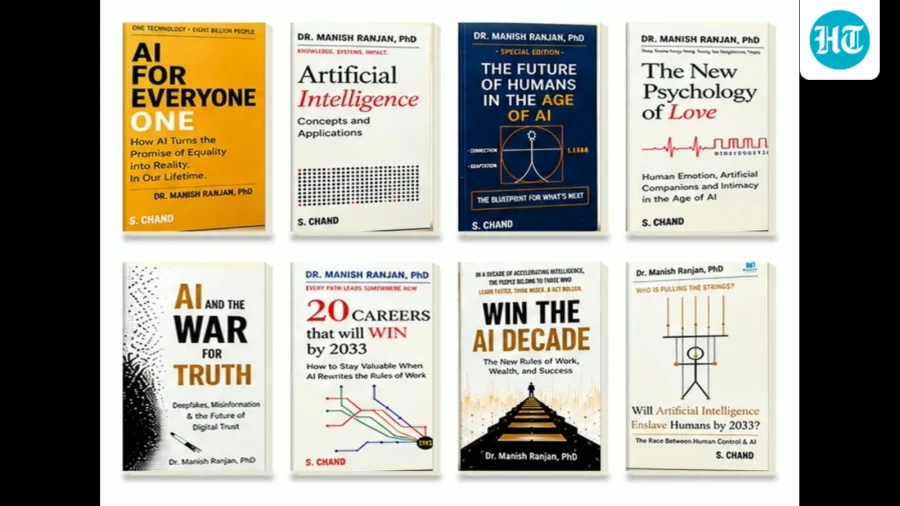
An Indian Administrative Service officer from Jharkhand has done something unusual for a bureaucrat: written not one book, but eight — all on Artificial Intelligence. Manish Ranjan's eight-book series attempts to bridge two worlds that rarely meet on the same page — the fast-moving global AI landscape and India's own governance and opportunity ambitions.
Why an IAS Officer Writing on AI Is Worth Noticing
Civil servants in India are trained to administer — to run districts, implement schemes, manage crises. Writing an eight-volume series on Artificial Intelligence is not part of that job description. That is precisely why it stands out.
It suggests that at least some within the administrative system are thinking about AI not as a distant Silicon Valley phenomenon, but as something that will shape how India is governed, how its citizens access services, and how its workforce competes.
The Gap Between AI Talk and AI Action in India
India talks about AI constantly — in policy circles, in startup boardrooms, in academic conferences. But the translation of that talk into ground-level administrative understanding remains uneven.
A book series written by a serving officer, aimed at connecting global insights with Indian realities, addresses a specific gap: the need for accessible, India-contextual material on AI for people who are not technologists but who make decisions that affect millions.
What the Series Reportedly Covers
According to the original account, the eight-book series blends global AI developments with India's aspirations — particularly around governance transformation and expanding opportunity.
That framing matters. It positions AI not just as a tool for efficiency, but as a lever for equity — a subject that resonates in a country where access to technology, skills, and digital infrastructure varies sharply across regions.
Who This Actually Affects
The immediate audience for such a series would likely include civil servants, policy students, and administrators looking for structured, non-technical explanations of AI.
But the broader implication touches anyone who interacts with government — which, in India, is nearly everyone. If AI is going to be used in welfare delivery, policing, land records, health administration, or education, then the people designing and running those systems need to understand what AI can and cannot do.
No Official Endorsement — and That's Fine
There has been no formal government statement or institutional endorsement of the series. This appears to be a personal intellectual project by a serving officer, not an official policy document.
That distinction is important. It means the books carry the weight of individual expertise and perspective, not the authority of the state. Readers should treat them accordingly — as one informed voice, not a government position.
What We Know vs What Remains Unclear
Confirmed: Manish Ranjan, an IAS officer in the Jharkhand cadre, has authored an eight-book series on Artificial Intelligence. The series reportedly connects global AI insights with India's governance and opportunity goals.
Unclear: Publication details, publisher, release timeline, availability, pricing, and whether the series has been formally launched. No independent reviews or detailed content breakdowns are available at this stage.
Readers should avoid assuming the series has official backing or that it represents a government initiative. It does not, based on available information.
The Bigger Pattern: Bureaucrats as Authors and Thought Leaders
India has a long tradition of civil servants writing — memoirs, policy critiques, fiction, and now, increasingly, technology-focused work. What is changing is the subject matter.
A decade ago, an IAS officer writing about AI would have been an outlier. Today, it reflects a broader recognition that administrative capacity must evolve alongside the technologies being deployed in public systems.
Risks and a Balanced View
Writing about AI is easy. Getting it right is hard. The field moves faster than publishing cycles, and any book series risks becoming outdated quickly.
There is also the question of depth versus breadth. Eight books suggest ambition, but also raise the question of whether each volume offers genuine insight or simply covers ground already well-trodden by global authors.
Without access to the content, these remain open questions — not criticisms, but fair points for any reader to consider.
What Readers and Aspirants Should Take From This
For civil service aspirants and young administrators, the takeaway is straightforward: AI literacy is becoming part of the job, whether or not it is formally in the syllabus.
For policymakers, the signal is that grassroots understanding of AI — not just high-level strategy — will determine how well India implements its digital ambitions.
For general readers, the series may serve as an accessible entry point into AI, written from an Indian administrative perspective rather than a Silicon Valley one.
What Could Happen Next
If the series gains traction, it could feed into training programmes, departmental discussions, or academic curricula. If it does not, it remains a notable individual effort — still worth acknowledging.
Either way, the fact that a serving IAS officer chose AI as his subject says something about where India's administrative imagination is heading.
Our Take
This is not a story about a book launch. It is a story about a shift in how India's civil servants see their own role. Manish Ranjan's eight-book series on AI is significant less for what it contains — which we cannot yet fully assess — and more for what it represents: a recognition that governance in the 2020s requires understanding the technologies reshaping it.
Whether the series becomes a reference or a footnote, the impulse behind it is worth noting. India's administrative future will depend, in part, on how many of its officers think this way.
Frequently Asked Questions
Who is Manish Ranjan?
Manish Ranjan is an Indian Administrative Service (IAS) officer serving in the Jharkhand cadre. He has authored an eight-book series on Artificial Intelligence.
What is the eight-book series about?
The series reportedly focuses on Artificial Intelligence, blending global insights with India's governance and opportunity aspirations. Detailed content breakdowns are not yet publicly available.
Is this an official government publication?
No. Based on available information, this appears to be a personal authorship project by a serving IAS officer, not an official government publication or policy document.
Why is this significant for India?
It reflects growing engagement with AI within India's administrative ranks, signalling that civil servants are increasingly treating AI as a governance and public-policy subject, not just a technological one.
Where can readers find these books?
Publication and availability details have not been confirmed in available sources. Readers should watch for official announcements or publisher listings.