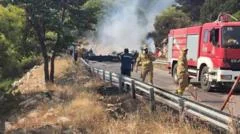
The roar of rotor blades over a Greek wildfire turned to tragedy this week when two firefighting helicopters collided mid-air, killing two crew members and leaving a British pilot among the survivors. The incident, which unfolded during a critical firefighting operation, has sent shockwaves through the close-knit aerial firefighting community and raised urgent questions about the safety of such missions.
What Happened in the Greek Helicopter Crash
Two firefighting helicopters collided while responding to a wildfire in Greece, according to the original report. One Danish national and one Greek national lost their lives in the collision. A British pilot and another Greek crew member survived the incident.
The exact location and time of the crash have not been officially confirmed, and Greek authorities have yet to release a detailed statement on how the collision occurred.
Why This Firefighting Helicopter Collision Matters
This tragedy underscores the extreme risks faced by aerial firefighting crews, who operate in smoke-filled skies, low visibility, and rapidly changing wind conditions. Every summer, Greece deploys helicopters and planes to battle wildfires that threaten homes, forests, and lives. When these aircraft share the same airspace during an emergency, the margin for error is razor-thin.
For the families of the deceased — one in Denmark, one in Greece — the loss is devastating. For the survivors, including the British pilot, the psychological weight of the crash will linger long after the physical injuries heal.
Background: Greece's Wildfire Season and Aerial Response
Greece has faced increasingly severe wildfire seasons in recent years, driven by rising temperatures and prolonged drought. Firefighting helicopters are a vital part of the country's response strategy, often flying multiple sorties a day to drop water on fast-spreading blazes.
While mid-air collisions involving firefighting aircraft are rare, they are not unprecedented. The combination of multiple aircraft operating in the same area, smoke-obscured visibility, and the urgency of the mission creates a high-risk environment. This incident will likely prompt a review of how aerial assets are coordinated during wildfire emergencies.
Human Impact: Who Was Affected by the Helicopter Collision
The two crew members who died were part of an international firefighting effort — one Danish national and one Greek national. Their deaths are a stark reminder that behind every aircraft battling a blaze are trained professionals risking their lives to protect communities they may never meet.
The British pilot who survived, along with the Greek crew member, now faces the difficult road of recovery. Survivors of such incidents often deal with trauma, grief for fallen colleagues, and the challenge of returning to a job that carries inherent danger.
Official Response and Investigation Status
Greek authorities have not yet issued a formal statement regarding the cause of the collision. The original report confirms only the nationalities of those involved and the survival of the British pilot.
An investigation is expected to follow, focusing on how the two helicopters came to occupy the same airspace and whether communication or visibility issues played a role. Until official findings are released, the precise circumstances remain unclear.
Analysis: What This Means for Aerial Firefighting Safety
This incident highlights a growing challenge for countries like Greece that rely heavily on aerial firefighting. As wildfire seasons lengthen and intensify, more aircraft are being deployed simultaneously, increasing the risk of mid-air incidents.
Experts in aviation safety often point to the need for better airspace management, improved communication systems, and enhanced training for pilots operating in smoke and heat. While the full details of this collision are not yet known, the tragedy will likely fuel calls for stricter protocols in wildfire response operations across Europe.
Confirmed Facts vs What Remains Unclear
Confirmed: Two crew members died — one Danish, one Greek. A British pilot and another Greek crew member survived. The incident involved firefighting helicopters in Greece.
Unclear: The exact location and time of the crash. The cause of the collision. Whether weather conditions, mechanical failure, or human error contributed. The identities of the deceased and survivors have not been publicly released.
Wider Pattern: Wildfires and the Rising Cost of Climate Response
Greece is not alone in facing this challenge. Across southern Europe, Australia, and the western United States, firefighting crews are being pushed to their limits as climate change fuels more frequent and intense wildfires. The death of these two crew members is a sobering reminder that the fight against wildfires comes at a human cost.
As nations invest in more aircraft and technology to combat fires, this incident raises a critical question: are we doing enough to protect the people operating that equipment?
What Should Readers Take Away From This Incident
For those following the story, the key takeaway is the human toll behind wildfire response. The two crew members who died were doing a job that most of us would never dare attempt — flying low over burning terrain to save lives and property.
For aviation and emergency response professionals, this incident serves as a reminder of the importance of rigorous safety protocols, clear communication, and continuous training. For the general public, it is a moment to acknowledge the bravery of firefighting crews and the risks they accept every time they take to the skies.
Future Outlook: What Happens Next
In the coming days, Greek authorities are expected to release more details about the collision and the identities of those involved. A formal investigation will likely examine every aspect of the mission, from flight paths to communication logs.
The broader question — how to make aerial firefighting safer in an era of intensifying wildfires — will remain open. This tragedy may well become a catalyst for change, but for now, the focus is on mourning two lives lost and supporting the survivors.
Our Take
This story is not just about a crash — it is about the invisible frontline of climate change. Firefighting crews across the world are being asked to do more, in worse conditions, with ever-increasing frequency. The death of these two crew members is a stark reminder that every wildfire has a human cost, and that the people fighting them deserve not just our gratitude, but our commitment to their safety.
As more details emerge, the focus must remain on the families of the deceased and the survivors, while also pushing for answers that could prevent a similar tragedy in the future.
Frequently Asked Questions
What caused the firefighting helicopter collision in Greece?
The exact cause has not been officially confirmed. Greek authorities are expected to investigate whether visibility issues, communication failures, or other factors contributed to the mid-air collision.
Who died in the Greece helicopter crash?
One Danish national and one Greek national lost their lives in the collision. Their names have not been publicly released.
Did the British pilot survive the helicopter collision?
Yes, a British pilot survived the incident along with another Greek crew member. Their current condition has not been officially reported.
How common are mid-air collisions involving firefighting helicopters?
Mid-air collisions involving firefighting aircraft are rare but have occurred in the past. They typically happen when multiple aircraft operate in the same area under smoke-obscured visibility and high-pressure conditions.
[NEWS_SCHEMA] { "@context": "https://schema.org", "@type": "NewsArticle", "headline": "Two Dead in Greece Firefighting Helicopter Collision — British Pilot Among Survivors", "description": "Two crew members died after firefighting helicopters collided in Greece. A British pilot survived the crash. Here's what we know about the incident.", "image": "", "datePublished": "", "dateModified": "", "author": { "@type": "Person", "name": "Newsroom Desk", "url": "", "sameAs": [] }, "publisher": { "@type": "Organization", "name": "", "logo": { "@type": "ImageObject", "url": "" } }, "mainEntityOfPage": { "@type": "WebPage", "@id": "" }, "articleSection": "World News", "keywords": "Greece helicopter collision, firefighting helicopters collide Greece, Greek helicopter crash, British pilot survives helicopter crash" } [SOURCES] Original Report — Headline and story summary provided