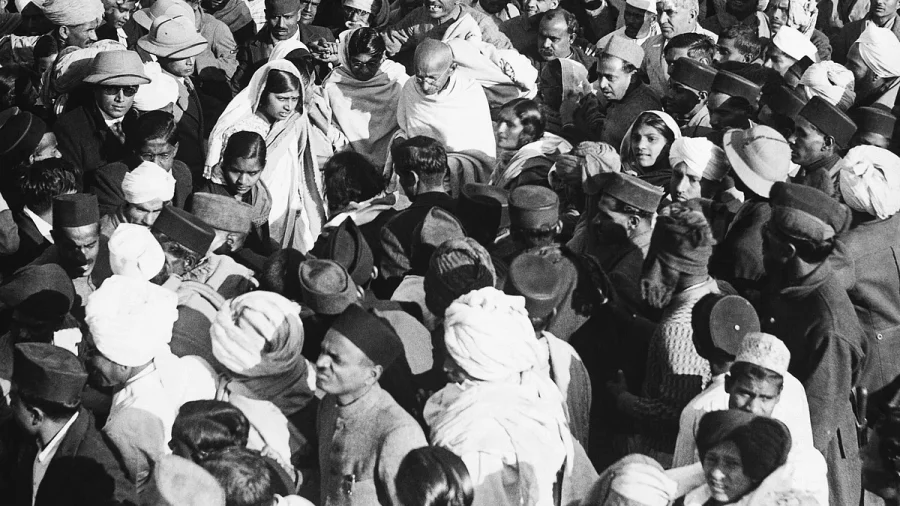
Every year, as 2 October approaches, Gandhi returns to our midst. He appears in official ceremonies, school functions, speeches and the seemingly obligatory advertisements. In that annual ritual, Gandhi is briefly part of public memory, but the Gandhi we remember raises no inconvenient questions.
The Icon We Remember, The Questions We Avoid
Today, when democratic societies are grappling with serious concerns over the centralisation of power, intolerance of dissent, political polarisation, the spread of fear and the growing power of propaganda, it is no longer enough to remember Gandhi as an icon of non-violence.
When power demands nothing but obedience from the citizen, when dissent is regarded with suspicion, when institutions have lost their independence, when one section of society has begun to see another as the enemy, what is the Gandhian way?
Why Gandhi's Method Speaks to Our Moment
Gandhi's approach was not passive. It was a disciplined, active resistance to unjust authority—through non-cooperation, civil disobedience, and the refusal to obey unjust laws. He understood that power, when unchecked, breeds fear. And fear, when normalised, kills democracy.
In our times, the tools of control have changed—from surveillance to media monopolies to algorithmic propaganda—but the underlying challenge remains: how does a citizen resist without becoming what they oppose?
From Ritual to Resistance: The Gandhian Challenge
The annual remembrance of Gandhi often reduces him to a statue, a stamp, a slogan. But the Gandhian way demands more: it asks citizens to question power, to protect dissent, to build bridges across divides, and to refuse complicity in injustice.
That is the uncomfortable question Gandhi raises today. Not whether we remember him, but whether we are willing to practise what he taught.
Confirmed Facts vs What Remains Unclear
Confirmed: Gandhi's philosophy of non-violence and civil disobedience is historically documented. His methods influenced civil rights movements worldwide.
Unclear: How exactly Gandhian principles should be applied to modern digital authoritarianism, surveillance states, or polarised media ecosystems remains a subject of debate among scholars and activists.
Risks and Balanced View
Critics argue that Gandhian non-violence is ineffective against ruthless regimes that do not respect moral appeals. Others contend that his methods require a certain level of democratic space that may not exist in all contexts. These are valid concerns, and the Gandhian way is not a magic formula—it is a demanding discipline.
Wider Trend: The Global Retreat of Dissent
From Hungary to India, from Brazil to the Philippines, democratic institutions are under strain. The pattern is familiar: centralised power, weakened checks, and a public increasingly divided by fear and propaganda. Gandhi's diagnosis of power and fear remains strikingly relevant.
Practical Reader Guidance
What can an ordinary citizen do? Start by asking inconvenient questions. Support independent journalism. Engage across divides. Participate in peaceful dissent where possible. Remember Gandhi not as a distant icon, but as a method.
Future Outlook
As 2 October passes, Gandhi will retreat from public memory until next year. But the challenges he addressed will not. Whether the Gandhian way revives as a living practice or remains a ceremonial relic depends on us.
Our Take
Gandhi's relevance today is not in his image but in his questions. In an age of centralised power and manufactured fear, the Gandhian way is not nostalgia—it is a necessity. Remembering him without practising his courage is the safest way to forget him.
Frequently Asked Questions
What is the Gandhian way?
The Gandhian way refers to Mahatma Gandhi's philosophy of non-violent resistance, civil disobedience, and active dissent against unjust authority. It emphasises truth, fearlessness, and the refusal to obey unjust laws.
Why is Gandhi relevant in fascist times?
Gandhi's methods directly address the core problems of fascist tendencies: centralisation of power, suppression of dissent, propaganda, and polarisation. His approach offers a disciplined way to resist without replicating the oppressor's violence.
How can ordinary citizens apply Gandhian principles today?
By asking inconvenient questions, supporting independent media, engaging in peaceful protest, building bridges across divides, and refusing to normalise fear or injustice.
Is non-violence effective against modern authoritarianism?
Scholars debate this. Non-violence has succeeded in many contexts, but its effectiveness depends on the regime's nature and the presence of democratic space. It is not a guaranteed solution but a moral and strategic framework.