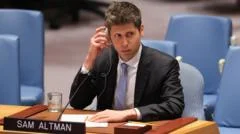
Three of the most powerful names in artificial intelligence — OpenAI's Sam Altman, Anthropic's Dario Amodei, and Hugging Face's Clement Delangue — are now pushing the United Nations to set global standards for evaluating AI risks. It's a rare moment of alignment between companies that compete fiercely in the market but apparently agree on one thing: AI is moving faster than the rules meant to govern it.
What Exactly Are They Asking For?
According to the original report, the three CEOs have called for risk evaluation standards — a shared framework for assessing how dangerous or capable an AI system is before it reaches the public. Altman and Amodei have both previously warned about AI's long-term risks, while Delangue's Hugging Face represents the open-source side of the ecosystem.
The ask is significant because it comes from industry insiders, not regulators. When the people building the technology say they need external guardrails, it carries a different weight than a government warning.
Why This Matters Beyond Silicon Valley
AI governance isn't just a tech story. It affects hiring, healthcare diagnostics, financial lending, education tools, and even how governments deliver services. If global standards emerge, they could determine which AI products reach countries like India — and under what conditions.
For Indian developers, startups, and students entering the AI field, the shape of these rules could influence everything from compliance costs to market access.
How We Got Here
This isn't the first time AI leaders have asked for regulation. Altman testified before the US Senate in 2023, urging lawmakers to license and regulate advanced AI. Amodei has consistently warned about catastrophic risks from frontier models. The European Union passed its AI Act, and India released draft AI governance guidelines.
But a UN-level framework is different — it would require consensus among member states with very different priorities, from the US and EU to China, India, and the Global South.
Who Is Affected — And How
If global AI risk standards take shape, the first to feel it would be AI developers building frontier models. They'd likely face standardized testing, documentation, and disclosure requirements. Next in line: enterprises deploying AI at scale, who may need to prove compliance.
Ordinary users — patients, job seekers, students — may never see the standards directly, but they'd be the ultimate beneficiaries if the rules reduce harm from biased or unsafe AI systems.
What the Companies Are Saying
Altman, Amodei, and Delangue have each publicly backed risk evaluation standards, according to the original report. Their positions reflect a growing view within the industry that voluntary commitments alone aren't enough — and that a patchwork of national rules creates uncertainty for everyone.
No formal joint statement text or UN response has been confirmed at this stage.
The Real Tension Behind the Unity
Here's the nuance: the same companies calling for global standards also compete to release the most capable models first. Critics argue that big labs support regulation partly because compliance costs favor established players over smaller startups and open-source projects.
That tension — between safety rhetoric and competitive incentives — is the subtext of every AI governance conversation, including this one.
Confirmed Facts vs What Remains Unclear
Confirmed: Altman, Amodei, and Delangue have called for AI risk evaluation standards, as reported. All three lead major AI organizations.
Unclear: Whether the UN has formally responded, what specific standards are proposed, whether any member state has endorsed the push, and what timeline — if any — exists.
Anything beyond the public call is speculation at this point.
Why These Three Companies Matter
OpenAI built ChatGPT and set the consumer AI template. Anthropic, founded by former OpenAI researchers, built Claude with a safety-first brand. Hugging Face hosts hundreds of thousands of open models and is the backbone of the open-source AI community.
Together, they represent closed frontier labs, safety-focused labs, and open-source infrastructure — the three pillars of the modern AI ecosystem. When all three agree on something, it's worth paying attention.
Risks and the Balanced View
Global standards sound good in principle, but they raise hard questions. Who writes them? How are they enforced? Do they slow innovation in developing countries? Could they become a tool for geopolitical leverage?
Smaller AI companies and open-source advocates worry that rules designed by the biggest players could entrench their dominance. Governments in the Global South worry about being rule-takers rather than rule-makers.
A Pattern Worth Watching
This push fits a broader trend: AI companies increasingly positioning themselves as partners in regulation rather than targets of it. Google, Microsoft, and Meta have made similar moves. The question is whether this is genuine responsibility or strategic positioning — or both.
What Indian Readers Should Know
India is drafting its own AI governance framework and has a seat at many international tables. If UN-level standards emerge, India would likely be both a participant and an affected market — home to a massive developer base, a growing AI startup ecosystem, and millions of AI users.
For students and professionals in AI, watching these developments isn't optional anymore. Compliance literacy is becoming a career skill.
What Could Happen Next
The realistic path: continued public advocacy, informal consultations, and eventually a UN-led process — if member states agree. That could take years. In the meantime, national regulations will likely move faster than any global framework.
Don't expect binding global AI rules soon. Do expect the conversation to intensify.
Our Take
When rivals like OpenAI and Anthropic agree publicly, it usually means the stakes have grown beyond competition. The push for UN-level AI standards is a signal that the industry itself believes the current patchwork isn't sustainable. Whether that leads to real governance or just more headlines depends on what happens after the call — and that part is still unwritten.
Frequently Asked Questions
What are OpenAI and Anthropic asking the UN to do?
They're calling for global standards on how AI risks are evaluated — essentially a shared framework for testing and assessing AI systems before deployment.
Why does this matter for India?
India is drafting its own AI rules and would be affected by any global standard — both as a market for AI products and as a growing hub for AI development.
Is this a binding agreement?
No. It's a public call from industry leaders. No UN resolution, treaty, or formal commitment has been confirmed.
Could global AI standards slow innovation?
That's the core debate. Supporters say standards build trust and reduce harm. Critics worry they favor big companies and slow smaller players, especially in developing countries.