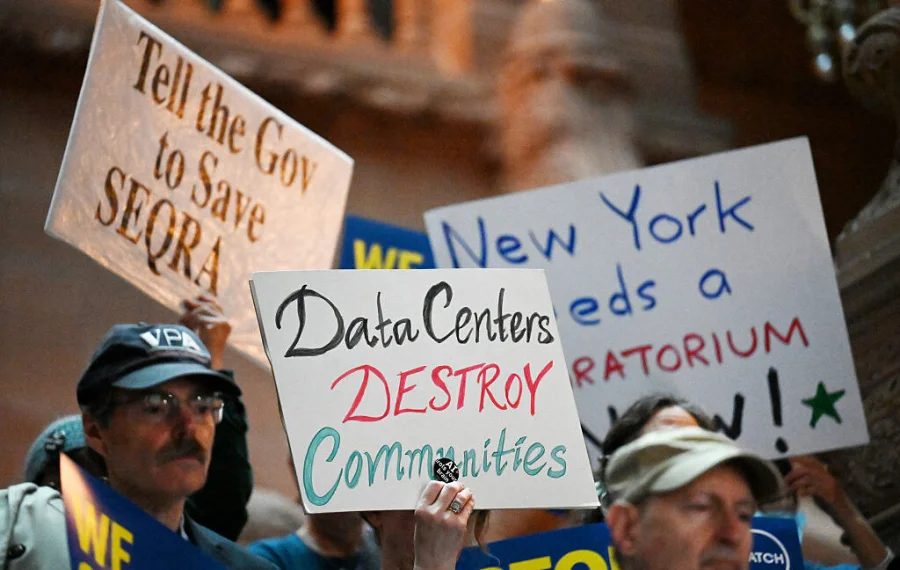
New York has become the first US state to slam the brakes on the AI industry's relentless expansion, with Governor Kathy Hochul announcing a one-year moratorium on the construction of massive new data centers. The decision, reported by Reuters, applies to any facility using 50 megawatts or more of power — effectively freezing the backbone of cloud computing and artificial intelligence development across the state.
Why New York Paused Data Center Construction — The Environmental and Energy Calculus
The moratorium is not a blanket ban on all data centers, but a targeted pause on the largest, most energy-hungry facilities. Officials told Reuters the state needs time to figure out what "consistent standards" for responsible data center development should look like. The move reflects growing public anxiety over the environmental toll of data centers, which consume vast amounts of electricity and water for cooling. Across the US, communities have raised alarms about pollution, rising energy costs, and diminishing water supplies linked to these facilities.
How the AI Industry Is Reacting to the New York Data Center Ban
The AI industry, which depends on hyperscale data centers to train and run large language models, is rattled. New York is a major hub for tech and finance, and the ban could delay or redirect billions of dollars in planned investments. Companies like Google, Microsoft, and Amazon — which operate or plan data centers in the state — now face uncertainty. The moratorium sends a signal that regulatory pushback against AI infrastructure is no longer hypothetical; it is here.
The Timeline: From Growing Concerns to a Statewide Pause
The ban did not emerge in a vacuum. In recent months, local opposition to data center projects has intensified, with residents and environmental groups citing noise, water usage, and strain on local power grids. At the federal level, Senator Bernie Sanders (I-Vt.) and Representative Alexandria Ocasio-Cortez (D-N.Y.) have introduced legislation seeking a possible nationwide construction ban. While Republicans have largely opposed such measures, the New York moratorium marks a significant escalation in the regulatory landscape.
Who Is Affected by the Data Center Moratorium — Real People, Real Consequences
For New York residents, the ban may bring relief to communities worried about rising electricity bills and water shortages. But it also threatens jobs in construction, tech, and related industries. For AI startups and researchers based in New York, the pause could slow innovation and force them to look elsewhere for computing power. The moratorium is a double-edged sword: environmental protection versus economic growth and technological progress.
What Governor Kathy Hochul and Officials Have Said About the Ban
Governor Hochul’s office has framed the moratorium as a necessary step toward responsible development. "We need to ensure that data centers are built in a way that protects our environment, our energy grid, and our communities," a spokesperson told Reuters. The state plans to use the one-year period to consult with experts, industry stakeholders, and the public to draft new regulations. No specific timeline for the new standards has been released.
What This Means for the Future of AI Infrastructure — A Deeper Analysis
The New York ban is more than a local policy; it is a bellwether for the entire AI industry. Data centers are the physical foundation of AI, and any restriction on their construction directly impacts the pace of AI development. The moratorium could set a precedent for other states grappling with similar concerns. If federal legislation gains traction, the entire US data center buildout could face a slowdown. The AI industry, which has grown accustomed to rapid expansion, now faces a new variable: regulatory risk.
Confirmed Facts vs What Remains Unclear About the New York Data Center Ban
Confirmed: The moratorium applies to data centers using 50 megawatts or more; it is a one-year pause; it is the first such state-wide ban in the US; Governor Hochul announced it on Tuesday; the state will develop consistent standards before lifting the ban.
Unclear: Whether existing construction projects are exempt; how the state will define "consistent standards"; whether the ban will be extended beyond one year; the exact economic impact on AI companies and jobs in New York; whether other states will follow.
Why New York’s Data Center Ban Matters Beyond the State — A Wider Trend
The moratorium is part of a broader global conversation about the environmental cost of digital infrastructure. From Ireland to Singapore, governments have imposed restrictions on data center construction due to energy and water concerns. In the US, the debate is intensifying as AI adoption accelerates. The New York ban could catalyze similar actions in other states, creating a patchwork of regulations that complicates national AI strategy.
What Should AI Companies, Investors, and New York Residents Do Now?
For AI companies: Diversify data center locations and engage early with state regulators to shape the new standards. For investors: Factor regulatory risk into valuations of AI infrastructure plays. For New York residents: Participate in public consultations to ensure community concerns are addressed. For policymakers in other states: Watch New York closely — the standards developed here could become a model.
What Could Happen Next — The Future of Data Center Regulation
Over the next year, New York will draft new rules. If they are stringent, other states may adopt similar frameworks. If they are industry-friendly, the ban may be seen as a temporary hiccup. Meanwhile, the federal legislation by Sanders and Ocasio-Cortez could gain momentum, especially if public concern over AI’s environmental footprint grows. The AI industry will likely lobby hard to prevent a nationwide ban, but the New York moratorium has already shifted the conversation.
Our Take
The New York data center ban is a watershed moment for the AI industry. It signals that the era of unchecked infrastructure expansion is over. While the moratorium is temporary, its implications are lasting: AI companies must now account for environmental and social costs in their growth plans. The challenge for policymakers will be to balance innovation with sustainability — a task that will define the next decade of technology regulation.
Frequently Asked Questions
What does the New York data center construction ban mean for AI companies?
AI companies that rely on large data centers in New York face delays in expanding their computing capacity. They may need to shift investments to other states or countries, potentially increasing costs and slowing AI development timelines.
Why did New York impose a moratorium on data centers?
Governor Hochul cited the need to address environmental concerns, including pollution, rising energy costs, and water supply depletion. The state wants to establish consistent standards before allowing further construction of large data centers.
How long will the data center ban last in New York?
The moratorium is in effect for one year. It will be lifted only after the state develops and implements new regulations for responsible data center development.
Could other states follow New York’s lead on data center regulation?
Yes. The New York ban could set a precedent. Other states facing similar environmental and energy concerns may consider their own moratoriums or stricter regulations, especially as public awareness of data center impacts grows.