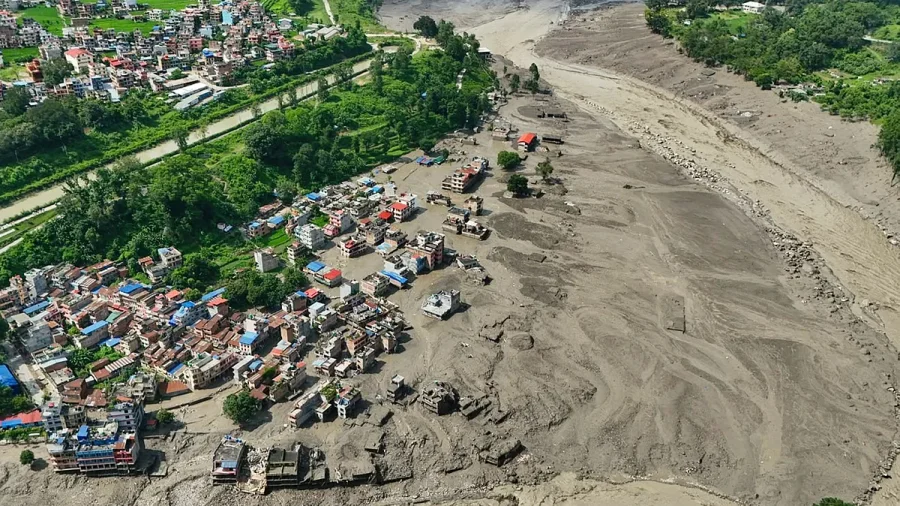
The mountains of northern Nepal turned into a wall of water on Wednesday, and in a matter of hours, hundreds of lives were thrown into uncertainty. At least four people are dead, nearly 400 are missing, and among them are 105 Indian tourists who had travelled thousands of kilometres for a pilgrimage that was supposed to be the journey of a lifetime.
Rasuwa's Raging Waters: What Happened in Nepal's Flood-Hit District
The flash floods struck Rasuwa district with little warning, sweeping through valleys and settlements with devastating force. According to the Nepal Tourism Board, 384 travellers — 291 foreigners and 93 Nepalese nationals — have gone missing in the deluge. The numbers are still fluid, and officials on both sides of the border are bracing for the worst.
The missing include 105 Indian tourists and 37 NRIs, with the remaining travellers hailing from the US, Malaysia, the UK, South Africa, Australia and the Netherlands. For families back home in India, every hour of silence is becoming unbearable.
Why This Flood Hits India's Border Communities and Pilgrims Hard
This is not just a disaster in a neighbouring country — it is a crisis with deep Indian roots. Most of the missing Indians were travelling for the Kailash Manasarovar Yatra in Tibet, a pilgrimage of profound religious significance. The route passes through terrain that is as spiritually revered as it is geographically unforgiving.
For border communities in Uttarakhand and Sikkim, the floods are a stark reminder of their own vulnerability. The high alert along border areas reflects a shared Himalayan reality: rivers do not respect international boundaries, and neither do disasters.
From Crisis to Action: How India Mobilised Relief Within Hours
India's response has been swift and concrete. Under the government's humanitarian assistance initiative, emergency supplies — including medicines and rations — are being loaded onto Indian Air Force aircraft bound for Nepal. The operation signals not just diplomatic goodwill but a practical recognition that the Himalayan neighbourhood stands together in times of catastrophe.
Officials said the relief mission is being coordinated with Nepalese authorities to ensure aid reaches the most affected areas without delay. The focus remains on rescue first, relief second, and recovery thereafter.
The Human Toll: Families Waiting, Pilgrims Unaccounted For
Behind every missing number is a family that has not slept. The 105 Indian tourists were not statistics — they were parents, siblings, and grandparents who had saved up for years to undertake the Kailash Manasarovar Yatra. The 37 NRIs had crossed oceans to reconnect with their spiritual roots.
For their families in India and abroad, the lack of information is its own form of torment. Local authorities in Rasuwa are working with limited resources, and communication lines in the flood-hit region remain patchy.
Official Response: What Nepal and India Have Said So Far
The Nepal Tourism Board has confirmed the scale of the missing — 291 foreigners and 93 Nepalese nationals — but cautioned that the numbers could change as rescue teams reach isolated areas. Indian authorities have acknowledged the situation and are in constant touch with Nepalese counterparts.
According to the original report, India is sending emergency assistance on IAF aircraft, with medicines and rations as the immediate priority. Further details on the scope of the relief package are expected to emerge as the operation unfolds.
Reading the Disaster: Why Flash Floods in the Himalayas Are Becoming More Frequent
This is not an isolated tragedy. The Himalayan region has witnessed a troubling pattern of flash floods in recent years, driven by a combination of glacial melt, erratic rainfall, and fragile mountain geology. Rasuwa's geography — steep slopes, narrow valleys, and fast-flowing rivers — makes it particularly susceptible to sudden deluges.
Climate scientists have long warned that the Hindu Kush Himalayan region is warming faster than the global average. What was once a once-in-a-century event is now becoming a recurring nightmare for mountain communities and the pilgrims who traverse these routes.
Confirmed Facts vs What Remains Unclear in the Nepal Flood Crisis
What is confirmed: At least four deaths, nearly 400 missing, 105 Indian tourists and 37 NRIs among the unaccounted, and India's dispatch of relief supplies via IAF aircraft.
What remains unclear: The exact number of survivors, the condition of those missing, and the full extent of damage to infrastructure in Rasuwa district. Officials have not yet confirmed whether the death toll will rise as rescue operations reach more remote areas.
All figures are based on the Nepal Tourism Board's latest count and may be revised as communication is restored.
India's Humanitarian Reach: Why This Relief Operation Matters Beyond Diplomacy
India's decision to deploy IAF aircraft for relief supplies reflects a broader regional role — one that combines strategic interest with genuine humanitarian concern. For Indian pilgrims who undertake the Kailash Manasarovar Yatra, the assurance that their government will move heaven and earth to bring them home is not a small thing.
The operation also reinforces the practical interdependence of the Himalayan neighbourhood. When disaster strikes one side of the border, the other side feels the tremor.
Risks and the Road Ahead: Challenges in Rescue and Recovery
The rescue operation faces formidable obstacles. Flood-damaged roads, disrupted communication networks, and unpredictable weather are hampering efforts to reach stranded travellers. The terrain that makes the region spiritually significant also makes it operationally difficult.
There are also concerns about the psychological toll on survivors and the families of the missing. The coming days will test the resilience of both Nepalese and Indian authorities as they work against time.
A Pattern of Himalayan Floods: What This Tells Us About the Region's Future
From Uttarakhand's Kedarnath tragedy to repeated deluges in Nepal, the pattern is unmistakable. Mountain regions are becoming more volatile, and the communities that live in and travel through them are paying the price. This flood is not just a news event — it is a warning about the changing character of the Himalayas themselves.
What Pilgrims and Travellers Should Do Now
For those planning Himalayan travel or the Kailash Manasarovar Yatra, the immediate advice is to postpone non-essential journeys until the situation stabilises. Travellers should register with the Indian embassy or consulate in Nepal, maintain updated contact details with family, and follow official advisories from both governments.
Families of missing individuals should stay in touch with the Ministry of External Affairs' emergency helpline and the Indian embassy in Kathmandu for verified updates. Avoid relying on unverified social media posts, which often spread misinformation during crises.
Future Outlook: What Happens Next in the Nepal Flood Relief Effort
The immediate priority is search and rescue. In the coming days, the focus will shift to providing shelter, food, and medical care to survivors, followed by the difficult task of rebuilding damaged infrastructure. The number of missing may rise or fall as communication is restored, and officials have cautioned against premature conclusions.
For India, the operation will likely expand if the scale of the disaster demands it. The government's commitment to the Kailash Manasarovar Yatra route and the safety of Indian pilgrims will remain a key consideration in the days ahead.
Our Take
This disaster is a reminder that the Himalayas, for all their beauty, are among the most dangerous landscapes on Earth. The loss of life and the uncertainty surrounding nearly 400 missing people — including 105 Indians — is a tragedy that transcends borders. India's swift relief response is commendable, but it also underscores a larger truth: the region needs long-term investment in disaster preparedness, early warning systems, and climate resilience. For now, the world watches and hopes for the safe return of those still unaccounted for.
Frequently Asked Questions
How many Indians are missing in the Nepal flash flood?
According to the Nepal Tourism Board, 105 Indian tourists and 37 NRIs are among the nearly 400 people missing after flash floods hit Rasuwa district in northern Nepal.
What is India doing to help Nepal after the flood?
India is sending emergency assistance, including medicines and rations, on Indian Air Force aircraft under the government's humanitarian assistance initiative. Border areas have been placed on high alert.
Why were most missing Indians travelling in the Rasuwa region?
Most of the missing Indians were travelling for the Kailash Manasarovar Yatra in Tibet, a significant Hindu pilgrimage route that passes through the Himalayan region near Rasuwa district.
How can families of missing Indian pilgrims get information?
Families should contact the Ministry of External Affairs' emergency helpline and the Indian embassy in Kathmandu for verified updates. Officials advise against relying on unverified social media information during the ongoing rescue operation.