The hills of Kangpokpi district have turned into a new flashpoint. What began as a targeted ambush has spiralled into a cycle of retaliatory killings, with at least seven civilians dead and dozens of homes reduced to ashes. Manipur's ethnic conflict, long defined by the Meitei-Kuki divide, is now acquiring a dangerous new dimension — one that pulls the Naga community into the crossfire.
A Deadly Week Along the Imphal-Tamenglong Road
The violence unfolded in rapid succession along the Imphal-Tamenglong (IT) Road, a strategic artery connecting the valley to the hill districts. On 27 August, an ambush between Makui Ashang and Thananba Naga villages killed four Naga civilians and left several others injured. Local Naga organisations were quick to attribute the attack to armed Kuki groups.
Four days later, on 31 August, the pattern reversed. Assailants attacked N. Teikhang, a Kuki village along the same stretch of road, killing three Kuki civilians and wounding several more. The tit-for-tat nature of the attacks points to organised retaliation rather than spontaneous mob violence.
Arson and Gunfire: The September 1 Attacks
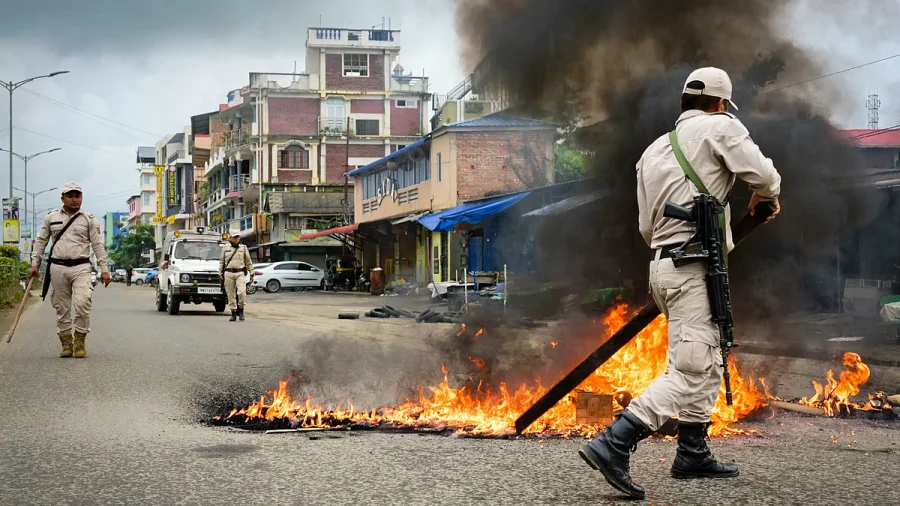
The situation escalated further on 1 September when armed miscreants opened fire and set ablaze around 30 houses across Tapon Khullen, Tapon Khunou and Makui Pipuram. The coordinated nature of the arson suggests a deliberate attempt to displace communities and alter the demographic character of the area.
Villagers along the IT Road now face an impossible choice: stay and risk further attacks, or flee and lose their homes and livelihoods. The psychological toll on these communities cannot be overstated.
Why This Marks a Shift in Manipur's Conflict
Since May 2023, Manipur's violence has been largely framed as a Meitei-Kuki confrontation. The Meitei community, dominant in the Imphal Valley, has been pitted against the Kuki-Zomi tribes of the hills over issues of land, identity and political representation.
The Naga community, by and large, had remained on the periphery of this conflict. That appears to be changing. The fresh clashes along the IT Road suggest that the Naga-Kuki faultline — long dormant — is now being activated, potentially drawing a third major ethnic group into the violence.
Who Is Affected and What Is at Stake
The immediate victims are civilians — farmers, traders and families who have lived alongside each other for generations. The IT Road is not just a highway; it is a lifeline for trade, transport and daily movement between the valley and the hills.
If the violence spreads further, the humanitarian consequences could be severe. Displacement, disruption of supply chains and the collapse of local markets would follow. Schools, health centres and essential services along the route are already under strain.
Official Response and Security Concerns
Security forces have been deployed along the affected stretch, but the terrain poses significant challenges. The IT Road winds through dense forests and steep hills, making ambushes difficult to prevent and even harder to investigate.
Officials have not yet issued a detailed statement on the latest incidents, and the full extent of the damage remains unclear. What is evident is that the state machinery faces a daunting task in restoring confidence among communities that no longer trust each other.
Reading the Pattern: Organised Violence or Local Grievances?
The sequence of attacks — a Naga village targeted, followed by a Kuki village, followed by coordinated arson — suggests a level of organisation that goes beyond spontaneous communal anger. Analysts believe armed groups on both sides may be exploiting local grievances to expand their influence.
However, it is equally possible that the violence is being driven by local land disputes and personal vendettas that have now acquired an ethnic character. Without a thorough investigation, distinguishing between these motivations remains difficult.
Confirmed Facts vs What Remains Unclear
What is confirmed: four Naga civilians were killed on 27 August, three Kuki civilians were killed on 31 August, and around 30 houses were burned on 1 September. Local Naga organisations have blamed armed Kuki groups for the first attack.
What remains unclear: who exactly carried out the attacks on the Kuki village and the arson, whether there is a coordinated strategy behind the violence, and what steps the state government is taking beyond standard security deployment. These questions require official confirmation.
The Fragile Peace Between Naga and Kuki Communities
Historically, Naga and Kuki communities in Manipur have had their share of tensions, particularly over territorial claims in the hill districts. But large-scale violent conflict between them has been relatively rare in recent decades.
The current escalation threatens to undo years of relative coexistence. If the cycle of retaliation continues, it could create a permanent rift between communities that have otherwise found ways to share the same hills.
Risks and Concerns: A Widening War
The most immediate risk is that the violence spreads to other districts where Naga and Kuki populations live in close proximity. Areas like Ukhrul, Senapati and Chandel could see similar flare-ups if the current pattern is not contained.
There is also the risk of the conflict becoming a three-way confrontation. If the Naga community is drawn into active hostilities against the Kukis, the Meitei-Kuki dynamic could shift in unpredictable ways, making any political resolution even more remote.
A Wider Pattern of Ethnic Polarisation
Manipur's troubles are not isolated. Across India's Northeast, ethnic identities are being sharpened by political mobilisation, resource competition and historical grievances. The Manipur conflict is the most violent expression of this broader trend.
The involvement of the Naga community adds another layer of complexity to an already intractable situation. It also raises the stakes for regional stability, as Naga political groups have influence beyond Manipur's borders.
What Residents and Observers Should Watch For
For residents along the IT Road, the immediate priority is safety. Avoiding travel through the affected stretch, staying informed through reliable local sources, and maintaining communication with community networks are practical steps.
For observers and policymakers, the key indicators to watch are: whether security forces can prevent further attacks, whether community leaders on both sides call for restraint, and whether the state government initiates any dialogue to address underlying grievances.
What Happens Next
The coming days will be critical. If the cycle of retaliation is not broken, the IT Road could become a permanent frontline. The state government's response — both in terms of security and political outreach — will determine whether this new faultline hardens or heals.
There is also the question of accountability. The families of the seven civilians killed deserve answers. Who ordered these attacks? What is being done to bring the perpetrators to justice? These are questions that cannot be left unanswered.
Our Take
The Naga-Kuki clashes along the IT Road represent a worrying escalation in Manipur's conflict. The state has struggled to contain the Meitei-Kuki violence for over two years; the prospect of a second front is a grim development.
What makes this particularly dangerous is the speed at which the attacks escalated — from a single ambush to coordinated arson within five days. This suggests either pre-planned operations or a highly volatile local situation where any spark can ignite a firestorm.
The central and state governments must recognise that security deployment alone will not solve this. Without a credible political process that addresses the grievances of all communities — Meitei, Kuki and now Naga — Manipur risks descending into a cycle of violence with no clear end.
Frequently Asked Questions
What triggered the recent Naga-Kuki violence in Manipur?
The immediate trigger was an ambush on 27 August between Makui Ashang and Thananba Naga villages along the Imphal-Tamenglong Road, which killed four Naga civilians. Local Naga organisations blamed armed Kuki groups, leading to retaliatory attacks on Kuki villages.
Where is the violence concentrated?
The epicentre is along the Imphal-Tamenglong (IT) Road in Kangpokpi district, a strategic highway connecting the Imphal Valley to hill districts. Villages including Tapon Khullen, Tapon Khunou and Makui Pipuram have been affected.
How does this differ from the earlier Manipur conflict?
The 2023 violence was primarily between Meitei and Kuki communities. The current clashes involve the Naga community, suggesting an expansion of the conflict beyond the original Meitei-Kuki axis.
What is the current death toll from these incidents?
At least seven civilians have been killed — four Naga civilians on 27 August and three Kuki civilians on 31 August. Several others have been injured, and around 30 houses were burned in the September 1 attacks.