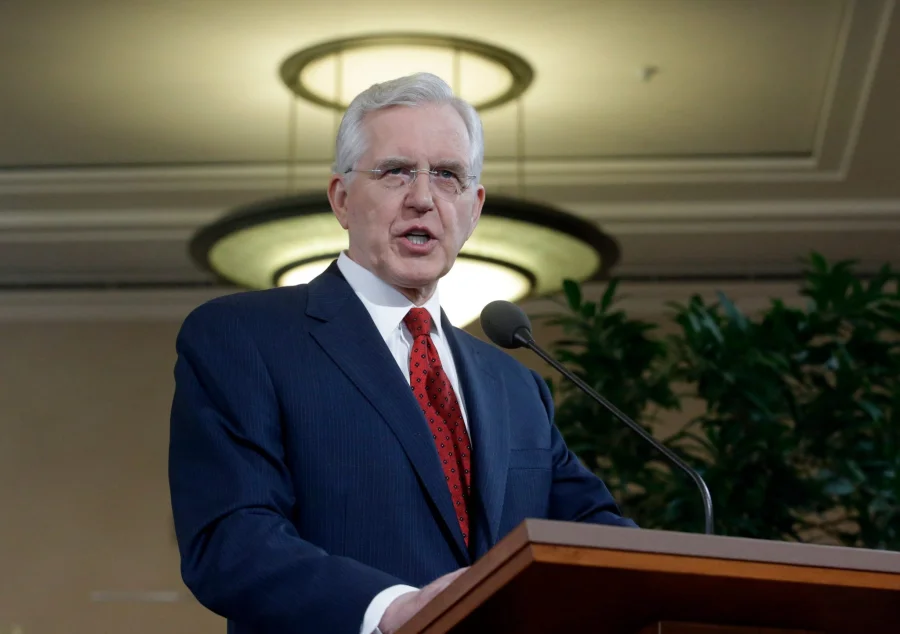
The warning came from the pulpit of one of America's most influential faith communities, and it was aimed squarely at a habit that has quietly moved from casino floors to the palms of teenagers' hands.
D. Todd Christofferson, one of the top three leaders of The Church of Jesus Christ of Latter-day Saints, told a global congregation Saturday that an explosion in gambling — powered by online prediction markets and sports betting — is fostering greed and robbing young people of their time, focus, and relationships.
A moral line drawn against a booming betting culture
"For us as Latter-day Saints, overarching all other concerns is the fact that gambling is morally wrong," Christofferson said at the faith's twice-annual general conference. "Gambling is built on the desire to obtain something for nothing."
His words carried particular weight because they were not aimed at a distant industry. They were aimed at a behaviour that has become frictionless — a few taps on a smartphone, a prediction market wager on an election, a same-game parlay on a basketball matchup.
Why this warning lands harder now than a decade ago
When the church first articulated its opposition to gambling, the primary concern was casinos and lotteries. Today, the landscape is unrecognisable.
Prediction markets — platforms where users wager on the outcome of events ranging from elections to economic data — have grown rapidly in visibility and volume. Sports betting apps are now legal in a majority of US states, and their advertising reaches audiences that include minors.
For parents and faith leaders, the concern is not abstract. Christofferson specifically noted that betting among teenagers and young adults is eating into study time and personal relationships.
What the church leader actually said — and what he didn't
Christofferson's remarks were unequivocal on the moral question. He described gambling as producing "nothing of value" and framed it as a practice that runs counter to the faith's emphasis on work, stewardship, and community.
He also raised a concern that went beyond personal finance: the idea that normalising wagers on unpredictable events — including, he suggested, even the timing of the Second Coming — reflects a broader cultural comfort with speculation over faith.
What the statement did not include was any new disciplinary policy, formal ban, or specific call for legislation. It was a moral and pastoral warning, not a regulatory announcement.
The young people caught in the middle
The church's concern is not without context. Research and reporting in recent years have highlighted rising rates of gambling participation among young adults, often through informal channels like peer-to-peer betting and social media-driven prediction pools.
For Latter-day Saint families, the tension is practical. A teenager with a phone can place a wager in seconds — often without a parent's knowledge and sometimes without fully understanding the financial or emotional risks.
Christofferson's framing suggested the church sees this not just as a financial hazard but as a spiritual and developmental one.
A faith that has long warned against 'something for nothing'
The Latter-day Saints have historically taken a firm stance against gambling, viewing it as incompatible with principles of self-reliance and honest labour. Church-owned media and educational institutions have consistently reinforced that position.
But the rise of prediction markets has created a new category of ambiguity. Some users view them as financial instruments or information markets rather than gambling. Others see them as entertainment. Christofferson's remarks appeared designed to cut through that ambiguity.
Confirmed facts vs. what remains unclear
Confirmed: Christofferson spoke at the general conference. He described gambling as morally wrong and said it produces nothing of value. He specifically mentioned prediction markets and sports betting. He raised concerns about youth participation.
Unclear: Whether the church will introduce new guidance, resources, or disciplinary measures in response. Whether the remarks will be followed by a formal statement or policy document. The exact scope of gambling participation among Latter-day Saint youth has not been publicly quantified by the church.
Risks and the other side of the debate
Not everyone views prediction markets through the same lens. Supporters argue that these platforms can aggregate information, provide hedging tools for businesses, and operate in a space distinct from traditional casino gambling.
Critics of that view — including faith leaders like Christofferson — contend that the distinction is thin and that the social costs, particularly for young people, outweigh any informational benefit.
The debate is likely to intensify as prediction markets expand and as more jurisdictions consider how to regulate them.
A wider pattern: faith institutions vs. the attention economy
Christofferson's warning fits a broader pattern of religious and civic leaders raising alarms about digital products designed to be addictive. From social media to loot boxes in video games to sports betting apps, the common thread is frictionless access and variable-reward mechanics.
For the Latter-day Saints, the concern is not just about money. It is about what occupies the mind and time of a generation that the church sees as its future.
What members and families can take from this
For Latter-day Saint families, the practical takeaway is likely to be a renewed conversation about digital habits. The church's longstanding guidance encourages members to avoid gambling in all forms — a position that now requires vigilance in app stores and group chats, not just casinos.
Parents may find it useful to review what betting-related apps are installed on family devices and to discuss how prediction markets work, including their risks.
What happens next
The general conference address is likely to be cited in future church materials and local leadership discussions. Whether it leads to a more formal campaign or resource for families remains to be seen.
What is clear is that the church has now placed online prediction markets and sports betting squarely within its moral framework — and it has done so at a moment when those products are more accessible to young people than ever before.
Our Take
This is not a story about one faith's internal rules. It is a story about how quickly the boundaries of gambling have shifted — and how institutions that once worried about casinos now find themselves worrying about smartphones.
Christofferson's remarks are a reminder that the debate over prediction markets is not only legal and financial. It is also moral, developmental, and deeply personal for families trying to raise children in an economy designed to be tapped, not trusted.
Frequently Asked Questions
What did the Mormon leader say about gambling?
D. Todd Christofferson said gambling is "morally wrong" and "built on the desire to obtain something for nothing." He warned that online prediction markets and sports betting are fueling greed, especially among young people.
Why did he specifically mention prediction markets?
Prediction markets have grown rapidly and are often viewed as distinct from traditional gambling. Christofferson's remarks appeared aimed at rejecting that distinction and placing them within the same moral category as other forms of betting.
Is the LDS Church changing its policy on gambling?
No new policy was announced. The church has long opposed gambling. The general conference address was a moral and pastoral warning, not a regulatory or disciplinary change.
What should Latter-day Saint families do about betting apps?
The church encourages members to avoid gambling in all forms. Families may want to review device settings, discuss the risks of prediction markets, and reinforce the faith's emphasis on self-reliance and honest work.