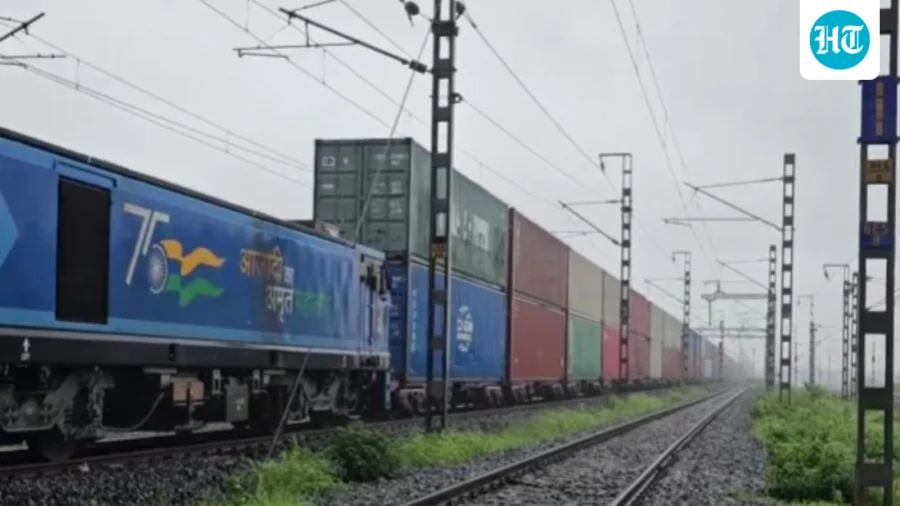
Indian Railways has quietly crossed a freight milestone that could reshape how goods move across the country. For the first time, the national transporter operated a double-stack long-haul container train — a format that stacks containers two high on a single railcar. The achievement is being described as a long-term unlock for higher returns per journey, better transport efficiency, and a meaningful reduction in road congestion.
A first for the network: What exactly was achieved
The operation marks the first time Indian Railways has run a double-stack container train over a long-haul distance. Unlike conventional single-stack services, this format carries significantly more cargo in one trip. Officials said the move is part of a broader push to make rail freight more competitive and cost-effective.
Why this matters for India's freight economy
For businesses, the benefit is straightforward: more goods moved per train means lower logistics costs and faster transit times. For the public, the ripple effect is quieter roads and fewer trucks carrying heavy loads over long distances. The efficiency gain is not just operational — it has direct economic and environmental implications.
How the double-stack model changes the economics
In a single journey, a double-stack train can carry nearly double the volume of a standard service. That translates into higher revenue for Indian Railways without a proportional increase in fuel, crew, or track usage. It is a classic case of doing more with the same infrastructure — a critical advantage on a network that handles immense freight volume daily.
What this means for road traffic and logistics pressure
India's roads carry a disproportionate share of freight, leading to congestion, higher emissions, and wear on highways. By shifting more cargo to rail through double-stack operations, the pressure on road networks could ease meaningfully. For logistics companies, rail becomes a more viable option for long-haul movement, especially on high-density corridors.
Official response and operational context
Railway officials have framed the operation as a strategic step rather than a one-off experiment. The focus now shifts to identifying routes where clearance and infrastructure allow safe double-stack operations. While the announcement is significant, the long-term payoff depends on how quickly the model can be scaled across the network.
What remains unclear about the rollout
What is confirmed is that the first long-haul double-stack service has been operated. What remains unclear is the specific route, the frequency planned, and the timeline for wider deployment. Infrastructure constraints — particularly overhead electrification and tunnel clearances — will determine how many corridors can support this format.
Why Indian Railways is betting on freight modernisation
Freight is the financial backbone of Indian Railways, cross-subsidising passenger services. Every efficiency gain in cargo operations strengthens the network's ability to invest in modernisation. The double-stack milestone fits into a larger strategy of dedicated freight corridors, higher axle loads, and faster transit times — all aimed at making rail the preferred mode for bulk and containerised cargo.
Risks and the road ahead
Scaling double-stack operations is not without challenges. Electrified routes with limited clearance, ageing bridges, and congested sections could slow expansion. There is also the question of terminal infrastructure — not every container depot is equipped to handle double-stack loading and unloading. These are practical hurdles that will shape how quickly the benefit reaches the wider economy.
A wider shift in Indian logistics
The move aligns with a broader national push toward multimodal logistics — where rail, road, and ports work as one connected system. Double-stack trains are already common in countries with mature freight networks. India's first long-haul operation signals that the country is ready to adopt global best practices in rail freight.
What shippers and logistics firms should watch
For businesses that move containerised cargo over long distances, this development is worth tracking closely. If double-stack services expand, rail could become a more attractive option on cost and reliability. Logistics planners should monitor route announcements and terminal upgrades to assess where the new capacity becomes available.
Future outlook: From milestone to mainstream
The first operation is a proof point, not the finish line. The real test lies in how quickly Indian Railways can replicate this on multiple corridors and integrate it into regular freight scheduling. If successful, the double-stack model could become a standard feature of India's rail freight network — and a quiet game-changer for the country's logistics landscape.
Our Take
This is one of those developments that sounds technical but carries real economic weight. Moving more goods per train is not just about railway efficiency — it is about cheaper logistics for businesses, less congestion on highways, and a more sustainable freight system. The milestone deserves attention not because it is flashy, but because it signals a structural improvement in how India moves its economy.
Frequently Asked Questions
What is a double-stack container train?
A double-stack container train carries containers stacked two high on each railcar, allowing nearly double the cargo volume per train compared to single-stack operations.
Why is Indian Railways' first double-stack long-haul train significant?
It is the first long-haul operation of this format in India, unlocking higher revenue per journey, better transport efficiency, and reduced road congestion.
How does double-stack freight benefit the public?
By moving more cargo by rail, it reduces the number of trucks on highways, leading to less congestion, lower emissions, and reduced wear on road infrastructure.
What challenges remain for scaling double-stack trains in India?
Infrastructure constraints such as overhead electrification clearance, bridge strength, and terminal handling capacity will determine how widely the model can be deployed.