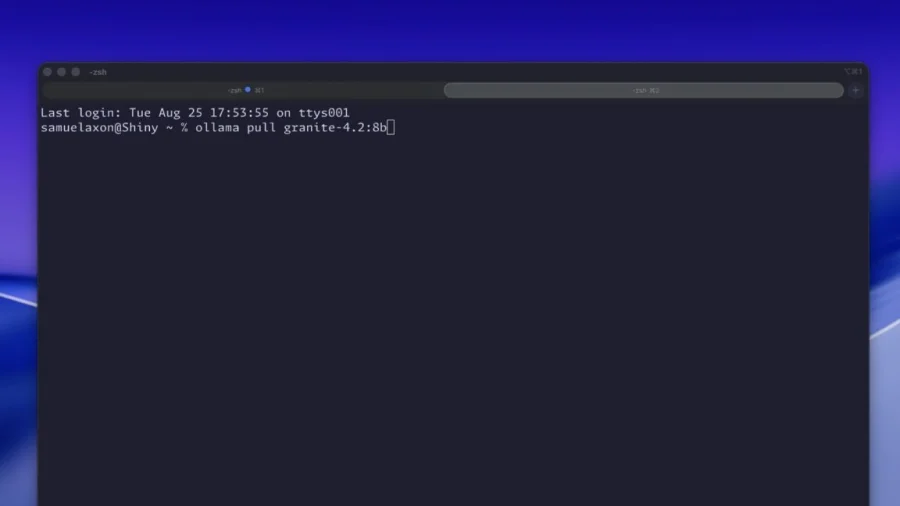
The race to run powerful AI without sending data to the cloud just got a new contender. IBM's latest open-weight models, Granite 4.2, are designed for organizations that want the brains of a large language model without surrendering control of their data.
Granite 4.2: Three Sizes, One Big Context Window
IBM has rolled out Granite 4.2 in three configurations: 3B, 8B, and 30B parameters. All three share a native 128,000-token context window, which means they can process roughly 100 pages of text in a single pass — a critical feature for legal, financial, and research-heavy workloads.
The company continues its decoder-only architecture approach, a design choice that prioritizes efficient text generation and next-token prediction.
Why Self-Hosted AI Is Gaining Momentum
The growing interest in local LLMs stems from a simple tension: cloud-based AI offers power, but it requires sending sensitive data to third-party servers. For banks, hospitals, and government agencies, that trade-off is often unacceptable.
Open-weight models like Granite 4.2 let organizations deploy AI on their own infrastructure, keeping proprietary data within their firewall. This approach also offers cost predictability for high-volume inference workloads.
Agentic Training: The 8B and 30B Advantage
The 8B and 30B variants go a step further with an agentic reinforcement-learning block. This specialized training phase teaches the models to perform actions — not just generate text. They can use a terminal, search the web, and call external tools to complete multi-step tasks.
The 3B model supports tools as well, but without the same depth of agentic training. For lightweight deployments where cost and speed matter more than complex reasoning, the 3B remains a practical option.
What This Means for Enterprise AI Teams
For developers and IT teams, Granite 4.2 offers a middle path between massive frontier models and small task-specific ones. The 30B variant delivers substantial reasoning capability while remaining feasible to run on modest hardware compared to 70B or 400B models.
The 128K context window also reduces the need for complex retrieval-augmented generation pipelines in many use cases, simplifying architecture and lowering latency.
IBM's Position in the Open-Weight Arena
IBM enters a crowded field. Meta's Llama, Mistral, and Alibaba's Qwen all offer competitive open-weight models. IBM's differentiator lies in its enterprise focus — the Granite family is explicitly tuned for business applications like code generation, SQL queries, and document analysis.
The company also provides commercial support and indemnification, which matters for enterprises wary of open-source licensing complexities.
Confirmed Facts vs What Remains Unclear
Verified: Granite 4.2 launches in 3B, 8B, and 30B sizes with a native 128K context window. The 8B and 30B models received agentic reinforcement learning for tool use.
Unclear: IBM has not disclosed specific benchmark scores, training data details, or exact licensing terms for Granite 4.2 in the available information. Performance comparisons against rival models remain unverified.
Risks and Balanced View
Open-weight models carry inherent risks. Self-hosting requires in-house ML expertise for deployment, fine-tuning, and maintenance. Security vulnerabilities in the model or its dependencies could expose enterprise systems.
Critics also note that smaller open models often lag behind frontier models on complex reasoning tasks. Organizations must evaluate whether Granite 4.2's capabilities meet their specific requirements.
The Broader Shift Toward On-Premise AI
Granite 4.2 reflects a wider industry trend. From healthcare to defense, organizations are demanding AI that respects data sovereignty. The open-weight movement is no longer a niche experiment — it is becoming a standard deployment option alongside cloud APIs.
Practical Guidance for Teams Evaluating Granite 4.2
Start with the 3B model for prototyping and simple tasks. Move to the 8B if you need agentic capabilities with moderate compute. Reserve the 30B for complex reasoning workloads where accuracy justifies the hardware investment.
Test the 128K context window with your own documents to verify retrieval quality. And always evaluate on your specific use cases rather than generic benchmarks.
Future Outlook
IBM's continued investment in open-weight models signals confidence in the self-hosted AI market. Future iterations may bring larger parameter counts, multimodal capabilities, or deeper agentic training.
As local LLMs improve, the line between cloud and on-premise AI will blur further. Organizations that build expertise now will be positioned to choose the best deployment model for each workload.
Our Take
Granite 4.2 is a pragmatic release that addresses a real market need: enterprise-grade AI that respects data boundaries. The 128K context window and agentic training bring meaningful upgrades, but the real test will be real-world performance and developer adoption.
IBM's enterprise focus and commercial backing give it an edge in conservative industries. However, the open-weight landscape moves fast, and staying relevant requires continuous innovation.
Frequently Asked Questions
What is IBM Granite 4.2?
IBM Granite 4.2 is a family of open-weight large language models available in 3B, 8B, and 30B parameter sizes. They are designed for download and self-hosting, offering a native 128,000-token context window.
Can Granite 4.2 models use external tools?
Yes. The 8B and 30B variants received agentic reinforcement learning for terminal use, web search, and external tool integration. The 3B model supports tools but without the same specialized training.
Why choose open-weight models like Granite 4.2?
Open-weight models allow organizations to deploy AI on their own infrastructure, keeping sensitive data private and avoiding per-token cloud API costs. They offer control, security, and predictable pricing.
What hardware do I need to run Granite 4.2?
Hardware requirements vary by model size. The 3B model can run on consumer GPUs, while the 30B variant typically requires enterprise-grade GPUs with substantial VRAM. IBM provides deployment guidance for each variant.