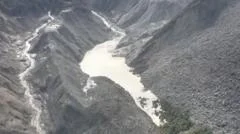
The warning is stark and the timeline is short. China has said there is a 'high risk' that a lake formed by a recent landslide near the Nepal-Tibet border could burst in the coming days, unleashing a second flood on already vulnerable communities. The statement shifts the focus from the initial disaster to a looming, potentially more destructive sequel.
A New Lake, A New Danger
The lake in question is not a natural, longstanding body of water. It was created when a massive landslide blocked a river valley, causing water to pool behind the natural dam of rock and debris. This is a common but highly volatile phenomenon in the Himalayas, where the terrain is young, steep, and prone to seismic activity.
Why a Breach Could Be Catastrophic
Unlike a slow-release dam, a landslide dam is unstable. The water pressure builds rapidly against a poorly consolidated wall of earth. If that wall gives way, it releases a wall of water and debris known as a Glacial Lake Outburst Flood (GLOF) or a Landslide Lake Outburst Flood (LLOF). The sudden surge can travel downstream with little warning, destroying infrastructure and endangering lives.
Timeline of a Rising Threat
The initial landslide occurred recently, creating the lake and the subsequent flood risk. The situation has been developing since then, with water levels rising behind the natural dam. The current warning from China indicates that the situation has reached a critical point where a breach is considered more likely than not.
Who Is in the Path of the Flood?
The immediate risk is to communities living in the river valleys downstream of the lake. This includes areas on the Tibetan side of the border, which are under Chinese jurisdiction, and potentially villages in Nepal, which lie further downstream. These are often remote, mountainous regions where evacuation is difficult and warning times are short.
China's Official Response and Monitoring
Chinese authorities have issued the warning, signaling a high level of concern. The primary response is intensive monitoring of the lake's water level and the structural integrity of the landslide dam. This data is crucial for predicting the exact moment of a potential breach and for triggering any evacuation orders.
Understanding the Science of Landslide Dams
Landslide dams are a known geological hazard. They are formed when a landslide blocks a river, and they can fail in a matter of hours, days, or even years. The key factors are the height of the dam, the volume of water behind it, and the material composition of the dam itself. A dam made of fine silt is far more likely to erode quickly than one made of large boulders.
Confirmed Facts vs. What Remains Unclear
What is confirmed is that China has issued a formal warning about the high risk of a breach. What remains unclear is the exact timeline, the precise volume of water in the lake, and the specific areas that would be most affected. The full extent of the potential impact is still being assessed.
The Broader Pattern of Himalayan Flood Risk
This event is not isolated. It is part of a broader pattern of increasing flood risk in the Himalayan region. Climate change is causing glaciers to melt faster, creating more glacial lakes. Simultaneously, increased seismic activity and extreme weather events are triggering more landslides, which can block rivers and create these dangerous, temporary dams.
What Should People in the Region Do Now?
For those in the potential flood path, the advice is to stay informed through official channels and be prepared to move to higher ground at a moment's notice. Local authorities should be ready to issue evacuation orders and have clear communication plans in place. For the global community, this is a reminder of the need for better early-warning systems in mountainous regions.
Future Outlook: A Waiting Game
The coming days are critical. The situation is a waiting game, with the outcome dependent on the stability of the natural dam and the weather. If the dam holds and the water level recedes, the risk will pass. If it fails, the region will face a second, potentially more severe disaster. The world will be watching for the next official update from China.
Our Take
This warning is a sobering reminder that the aftermath of a natural disaster can be as dangerous as the initial event. The focus now must be on preparedness and rapid response. The 'high risk' warning is not a prediction of inevitability, but it is a clear signal that the margin for error is gone. The priority is to protect human life, and that means taking this threat with the utmost seriousness.
Frequently Asked Questions
What is a landslide lake?
A landslide lake is formed when a landslide blocks a river or stream, causing water to accumulate behind the natural dam of rock and debris.
Why is there a risk of a second flood?
The natural dam is unstable. If it fails, the water held behind it will be released suddenly, causing a flash flood downstream.
Where is the lake located?
The lake is located near the Nepal-Tibet border, in a mountainous region that is prone to landslides.
What is being done to prevent a breach?
Authorities are monitoring the lake's water level and the dam's stability. In some cases, controlled releases or drainage channels are used, but the primary action is to warn and prepare communities for a potential flood.