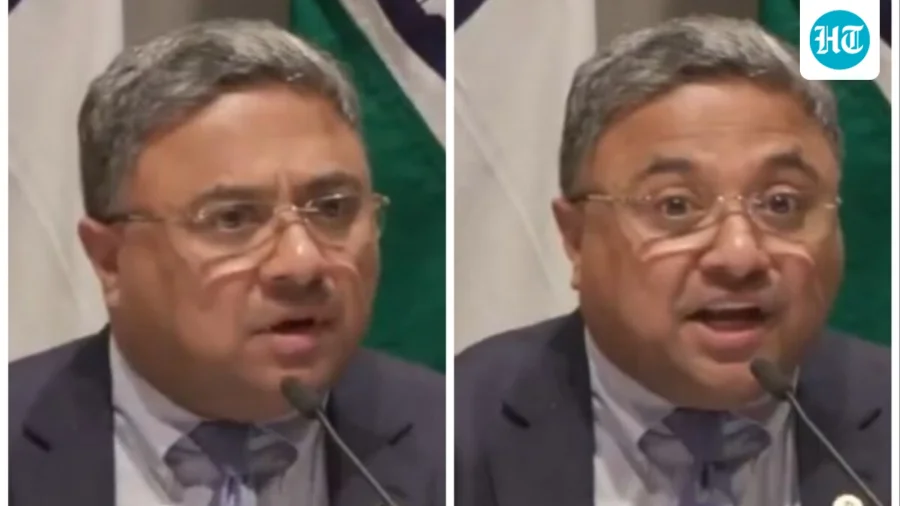
A tense moment unfolded during the India-Norway joint press conference when India's Ministry of External Affairs (MEA) spokesperson Sibi George firmly told a Norwegian journalist to "go to court" after being pressed on whether Prime Minister Narendra Modi had deliberately skipped questions from the press. The exchange, captured on video, has quickly gone viral, sparking debate about media freedom and diplomatic decorum.
What Happened at the India-Norway Joint Press Meet
The incident occurred during a joint press conference between Prime Minister Narendra Modi and Norwegian Prime Minister Jonas Gahr Støre in Norway. A Norwegian journalist questioned why PM Modi had not taken questions from the media, suggesting he had "skipped" them. The journalist's tone implied skepticism about India's commitment to media freedom.
MEA spokesperson Sibi George, visibly unimpressed, responded directly. "If you have any evidence that questions were skipped, you are free to go to court," he said, his voice firm. "India has a robust legal system. If you believe there has been a violation, take it to the court."
Why This Matters Right Now
This exchange is not just a diplomatic spat. It touches on deeper questions about how India is perceived globally, especially regarding media freedom and democratic values. For Indian readers, it raises questions about how the government handles international scrutiny. For global audiences, it highlights the tension between India's civilisational pride and Western expectations of press conduct.
The video has already sparked heated discussions on social media, with some praising George's assertiveness and others criticizing it as defensive. The incident also comes at a time when India is actively positioning itself as a global leader, making such exchanges particularly significant.
How the Exchange Unfolded
The joint press conference was meant to showcase the strengthening ties between India and Norway, covering areas like trade, climate change, and technology. However, the tone shifted when a journalist from a Norwegian outlet asked why PM Modi had not responded to questions from the floor.
"Prime Minister Modi seemed to skip questions from the press," the journalist said. "Is this a reflection of India's attitude towards media freedom?"
Sibi George immediately countered. "India has a long civilisational legacy of debate and discussion. Our media is vibrant and free. If you have a specific complaint, you know where the courts are. We welcome scrutiny, but not baseless allegations."
Who Is Affected and What Officials Are Saying
The exchange has affected multiple stakeholders. For the Norwegian press, it was a moment of frustration. For the Indian government, it was a chance to defend its record. For the public, it has become a flashpoint for debates about nationalism, diplomacy, and press freedom.
Neither PM Modi nor Norwegian PM Støre directly addressed the exchange during the conference. However, sources close to the MEA indicated that the response was intended to be firm but not confrontational. "India does not shy away from questions, but we also do not accept unfounded accusations," an official said.
What We Know So Far — and What Remains Unclear
What we know: The exchange happened during a joint press conference. MEA spokesperson Sibi George told a journalist to "go to court" over allegations that PM Modi skipped questions. The video of the exchange is widely available.
What remains unclear: Whether the journalist's claim was accurate — did PM Modi actually skip questions, or was there a misunderstanding about the format? Also unclear is whether any legal action will be taken, or if the matter will be resolved diplomatically.
Risks, Concerns, and the Balanced View
Critics argue that the MEA's response was overly aggressive and could damage India's image as a democracy that welcomes free press. "Telling a journalist to go to court is not a sign of confidence; it's a sign of defensiveness," one media analyst said.
Supporters, however, see it differently. "India has every right to defend itself against biased reporting. The journalist's question was loaded with assumptions," a political commentator noted.
The balanced view is that while India's media freedom record is robust, such exchanges can create unnecessary friction. Diplomatic press conferences are meant to build bridges, not burn them.
Why Similar Trends or Concerns Are Growing
This incident is part of a broader pattern where Indian officials have increasingly pushed back against Western media narratives. From climate change to human rights, India has adopted a more assertive stance in international forums.
At the same time, Western media outlets have become more critical of India's domestic policies, including media freedom. This creates a cycle of tension that can escalate quickly, as seen in this exchange.
- India's civilisational legacy was a key theme in George's response
- The journalist's question reflected broader Western skepticism about Indian media freedom
- Social media reactions are sharply divided along ideological lines
"India has a long civilisational legacy of debate and discussion. Our media is vibrant and free. If you have a specific complaint, you know where the courts are." — MEA Spokesperson Sibi George
What Readers, Users, or Investors Should Know Now
For readers following India's diplomatic engagements, this incident is a reminder that the government is increasingly willing to confront perceived bias. For journalists, it signals that questioning Indian officials may invite sharp pushback.
For investors and businesses, such exchanges are unlikely to have a direct impact, but they contribute to the overall perception of India's business environment. A reputation for being defensive can affect how international partners view the country.
What Could Happen Next
The Norwegian journalist may choose to take the matter to court, though this seems unlikely given the lack of concrete evidence. More probably, the incident will fade from headlines, but it will remain a reference point for future interactions between Indian officials and Western media.
Diplomatic channels may also work to smooth over the tension, with both sides emphasizing the broader importance of India-Norway relations.
Our Take: Why This Story Matters Beyond One Incident
This exchange is a microcosm of a larger global dynamic: the clash between India's rising assertiveness and Western media's critical lens. While the MEA's response was firm, it also risked alienating a press that could shape global narratives about India.
The real question is whether India can balance its pride with diplomacy. The answer will determine how the world sees India — not just as a rising power, but as a partner in global discourse.
FAQs
What did the MEA spokesperson say to the Norwegian journalist?
MEA spokesperson Sibi George told the journalist to "go to court" if they believed PM Modi had skipped questions, defending India's media freedom and civilisational legacy.
Why did the Norwegian journalist ask about PM Modi skipping questions?
The journalist alleged that PM Modi did not take questions from the press during the joint conference, suggesting a lack of transparency. The MEA countered that the claim was baseless.
Is India's media freedom under threat?
India has a vibrant and diverse media landscape, but international watchdogs have raised concerns about press freedom in recent years. The MEA's response was aimed at defending India's record against what it sees as biased reporting.
What happens next in this diplomatic exchange?
It is unlikely that legal action will be taken. The incident may be resolved through diplomatic channels, with both sides focusing on the broader India-Norway partnership.