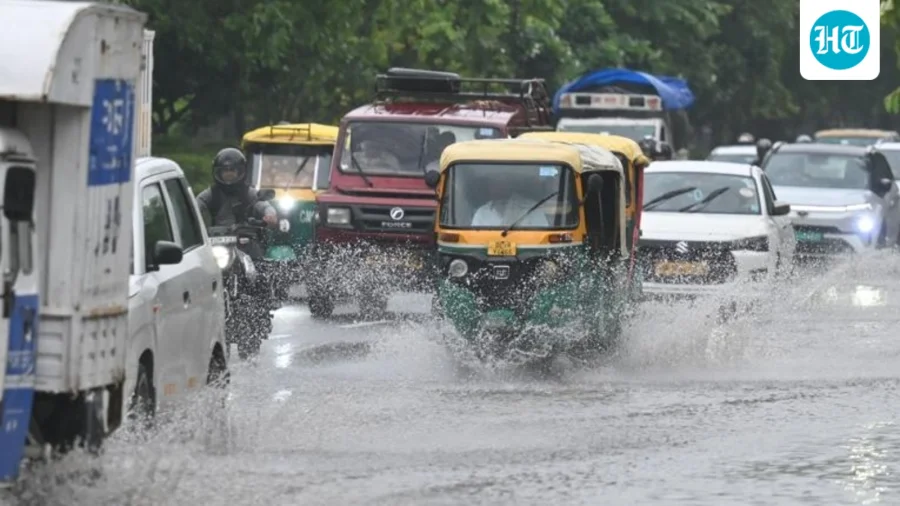
Monday's downpour turned Delhi-NCR's streets into rivers within hours, exposing a bitter truth: the '95% desilted' claim meant little when the rain actually arrived. Commuters waded through knee-deep water, school buses got stranded in Gurugram, and flights had to be diverted — all while officials had assured the city was monsoon-ready.
Monday's Downpour Exposes the Gap Between Claim and Reality
The heavy rainfall that lashed Delhi-NCR on Monday was not an unprecedented weather event — it was a routine monsoon spell. Yet the city's infrastructure buckled almost immediately. Waterlogging was reported across multiple neighbourhoods, with key roads turning into impassable stretches within minutes of the rain intensifying.
What makes this particularly troubling is the timing. Just weeks ago, civic authorities had publicly stated that desilting work was nearly complete, with drains declared '95% desilted'. The claim was meant to reassure residents that the capital was prepared for the monsoon season. Monday's chaos suggests otherwise.
Why This Failure Hits Commuters and Families Hardest
The human cost of this infrastructure failure was visible across the region. In Gurugram, school buses carrying children remained stranded in waterlogged roads, forcing anxious parents to wait for hours without clear information. For daily commuters, the evening rush turned into a nightmare, with traffic jams stretching for kilometres and autorickshaw drivers refusing to ply on submerged routes.
For families, the anxiety goes beyond inconvenience. When school buses are stuck in rising water, when office-goers cannot reach home, and when emergency vehicles cannot pass through flooded streets — the failure of drainage systems becomes a safety issue, not just a civic one.
How the '95% Desilted' Claim Unravelled in Hours
The desilting claim was supposed to be the cornerstone of Delhi's monsoon preparedness. Civic agencies had reported that the bulk of the drainage network had been cleaned, with only minor stretches pending. The message was clear: the city was ready.
Monday's rain told a different story. Drains clogged quickly, water accumulated on roads that were supposed to be clear, and the system that was meant to handle the monsoon failed under a moderate-to-heavy spell. The disconnect between the official narrative and on-ground reality has now become a point of public anger.
Real-Life Disruption: Stranded Buses, Diverted Flights, Endless Traffic
The impact was felt across every mode of transport. At the airport, flights were diverted due to poor visibility and waterlogging on runways, leaving passengers stranded and schedules disrupted. On the roads, school buses in Gurugram became symbols of the crisis — vehicles designed to carry children safely were stuck in water, with no immediate rescue mechanism visible.
For the average resident, the day meant hours lost, plans cancelled, and a growing sense that the city's infrastructure cannot be trusted when it matters most.
What Civic Authorities Are Saying — and What They Aren't
Officials have attributed Monday's waterlogging to the intensity of the rainfall, arguing that even a fully desilted system would struggle with such a sudden downpour. There is some technical merit to this — drainage systems have design limits, and extreme rainfall can overwhelm even well-maintained networks.
However, what remains unexplained is why the same areas flood repeatedly, why desilting work did not translate into visible improvement, and why there was no proactive response — such as deploying pumps or clearing vulnerable spots — before the rain hit. The silence on these questions is telling.
Beyond the Claim: What This Reveals About Urban Preparedness
Monday's flooding is not an isolated incident — it is a pattern. Every year, Delhi-NCR faces the same scenes: waterlogged underpasses, stranded vehicles, and frustrated citizens. The '95% desilted' claim was meant to break this cycle, but it has instead become another example of how official assurances often fail to match ground reality.
The issue is not just about drains. It is about urban planning, maintenance culture, and accountability. A city that cannot manage its monsoon is a city that is not prepared for the larger challenges of climate change, which is expected to bring more intense and unpredictable rainfall.
Confirmed Facts vs What Remains Unclear
What is confirmed: Heavy rain on Monday caused severe waterlogging across Delhi-NCR. School buses were stranded in Gurugram. Flights were diverted. Traffic was severely disrupted.
What remains unclear: The exact percentage of drains that were actually desilted and functional at the time of the rain. Whether the desilting work was completed as claimed or if gaps existed. The specific reasons why the system failed despite the official preparedness claim. These questions require independent verification and a transparent response from civic agencies.
Why Delhi's Drainage System Keeps Failing Despite Promises
The recurring failure points to deeper structural issues. Delhi's drainage network is old, under-capacity for the city's growth, and often choked with solid waste and construction debris. Desilting alone cannot fix a system that is fundamentally overburdened.
Moreover, coordination between multiple agencies — the municipal corporations, the Public Works Department, and the Delhi Development Authority — remains a challenge. Responsibility is fragmented, and when things go wrong, accountability becomes diffuse. Until these structural issues are addressed, desilting claims will remain cosmetic exercises.
Risks and the Need for a Balanced View
It is important to acknowledge that no city can be fully immune to extreme rainfall. Even well-developed cities face waterlogging during intense downpours. The question is not whether flooding will happen, but how quickly the city can respond and how much disruption is acceptable.
Critics, however, argue that Delhi's problem is not just about extreme weather — it is about chronic neglect. The same vulnerable points flood every year, suggesting that lessons are not being learned. Supporters of the civic agencies might point to the scale of the challenge and the difficulty of upgrading a centuries-old network. Both perspectives have merit, but the public's patience is wearing thin.
A Wider Pattern: Indian Cities and the Monsoon Test
Delhi is not alone in this struggle. From Mumbai to Bengaluru, Indian cities face similar monsoon chaos every year. The pattern is consistent: heavy rain, waterlogging, traffic paralysis, and official promises of improvement that fail to materialise.
This is not just a drainage problem — it is a governance problem. It reflects a broader failure to invest in resilient urban infrastructure and to plan for climate change. As extreme weather events become more frequent, the cost of this neglect will only rise.
What Residents and Commuters Should Do Now
For those living in flood-prone areas, practical precautions are essential. Avoid driving through waterlogged roads — it is dangerous and can damage vehicles. Check weather alerts before stepping out, and plan alternate routes. Parents should confirm school transport arrangements during heavy rain and stay in touch with school authorities.
Citizens should also report waterlogging incidents through official channels and demand accountability from local representatives. Public pressure is often the only force that pushes civic agencies to act.
What Happens Next: More Rain, More Questions
With more rainfall predicted in the coming days, the immediate concern is whether the city will face a repeat of Monday's chaos. The authorities have promised to deploy additional pumps and clear vulnerable spots, but similar assurances have been made before.
The larger question — whether Delhi's drainage system can be fundamentally upgraded to handle monsoon rains — remains unanswered. Until that changes, the '95% desilted' claim will ring hollow every time the clouds gather.
Our Take
Monday's flooding is a reminder that infrastructure claims must be measured against real-world performance. The '95% desilted' figure may have been technically accurate, but it failed the only test that matters: did the drains work when the rain came? The answer, witnessed by millions of commuters, was a clear no.
This is not about assigning blame in the heat of the moment. It is about demanding a system that is honest about its limitations and serious about fixing them. Until then, Delhi's monsoon will remain a season of anxiety, not relief.
Frequently Asked Questions
Why did Delhi drains fail despite the '95% desilted' claim?
Despite the official claim that drains were 95% desilted, Monday's heavy rain caused severe waterlogging. This suggests that desilting alone was insufficient, possibly due to system capacity issues, blockages from solid waste, or gaps between the claim and actual on-ground readiness.
What areas were worst affected by Monday's rain in Delhi-NCR?
Severe waterlogging was reported across multiple parts of Delhi and NCR, including Gurugram, where school buses were stranded. Key roads and underpasses saw major traffic jams, and flights were diverted due to waterlogging and poor visibility.
Were school children safe during the Gurugram bus stranding?
Reports indicate that school buses were stranded in waterlogged roads in Gurugram, causing anxiety among parents. There were no immediate reports of injuries, but the incident highlighted safety concerns during heavy rain.
What should commuters do during heavy rain in Delhi-NCR?
Commuters should avoid waterlogged roads, check weather alerts, plan alternate routes, and allow extra travel time. Parents should confirm school transport arrangements and stay in touch with authorities during heavy rain.