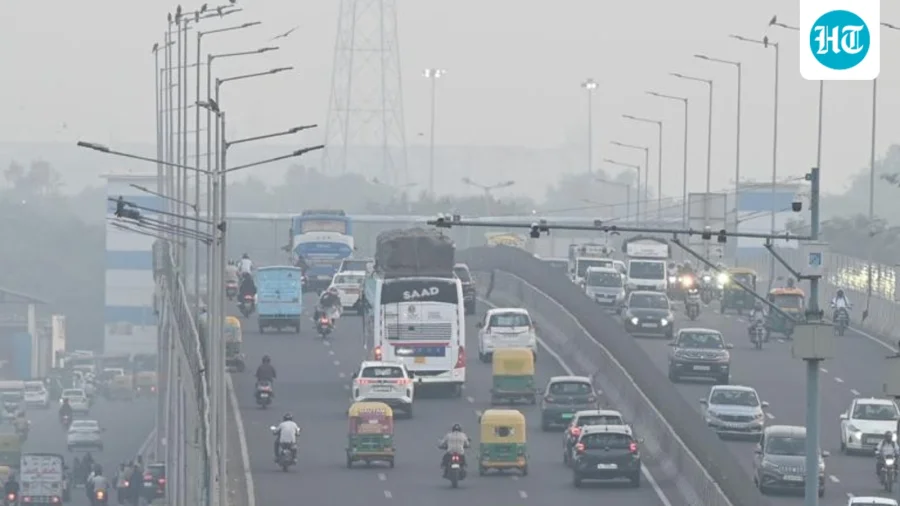
For once, Delhiites stepped outside in September without checking the air first. The city's average Air Quality Index for the month settled at 102 — the lowest September reading in five years, and a number that would have seemed optimistic even two autumns ago.
It is not clean air by any global standard. But in a city where September usually marks the last calm before the winter smog, 102 is a signal worth reading carefully.
Five Septembers, One Slow Downward Line
The comparison is what gives the number its weight. Delhi averaged 105 in September 2025, 105 again in 2024, 108 in 2023 and 104 in 2022. This year's 102 is a modest drop — but it is the first time the month has broken below the 104 mark in this five-year window.
Just as significant is the second half of the story: September 2026 also recorded the highest number of 'moderate' air quality days in the period. That means fewer days tipped into the 'poor' or 'very poor' bands, and more days where the air was merely uncomfortable rather than hazardous.
Why a September Number Matters More Than It Looks
September is not Delhi's worst air month. It is the diagnostic month.
By late October, two forces converge — stubble burning across Punjab and Haryana, and a meteorological phenomenon called temperature inversion, where cooler air traps pollutants close to the ground. Once that happens, the city's air quality is largely dictated by weather, not policy.
September is the last stretch where ground-level action — construction dust control, vehicular emissions, industrial compliance — can still visibly move the needle. A cleaner September suggests some of that groundwork held.
What Likely Drove the Improvement
Based on the pattern of recent years, a combination of factors typically explains a better-than-usual September: favourable wind speeds and rainfall that disperse and wash out particulate matter, reduced construction activity during the monsoon tail, and the effect of graded response action plans that kick in at defined AQI thresholds.
What the data does not yet establish is how much of the gain comes from permanent emission reductions versus a favourable weather month. That distinction matters enormously for how the rest of the year unfolds.
Who Feels This First
The people who benefit most from a moderate September are the ones with the least margin — children with asthma, elderly residents with respiratory conditions, outdoor workers, and households that cannot afford air purifiers.
For them, a month of 'moderate' days is not an abstract statistic. It is fewer inhaler refills, fewer missed school days, and fewer nights spent wheezing.
The Official Position and the Open Question
Air quality management in Delhi operates through a graded framework — restrictions on construction, vehicle movement and industrial activity are triggered as AQI crosses specific thresholds. A September average of 102 sits in the 'moderate' band, below the levels that trigger the harshest measures.
The open question, which no single month can answer, is whether this reflects structural improvement or simply a good weather window. Officials have historically cautioned against reading seasonal gains as proof of long-term progress.
Confirmed Facts vs What Remains Unclear
Confirmed: The September 2026 monthly average AQI was 102. It is the lowest September figure in five years. The month logged the highest number of moderate-category days in the tracked period.
Unclear: How much of the improvement is attributable to policy enforcement versus meteorological conditions. Whether the trend will hold through October and November. Whether emission sources have genuinely declined year-on-year.
Any claim that Delhi's air pollution problem is "solved" would be premature and unsupported by the data.
The Risks That Could Erase This Gain
Three factors could reverse September's progress within weeks.
First, stubble burning. If farm fire counts rise sharply in October, as they have in several past years, the impact on Delhi's air is immediate and severe. Second, weather. A drop in wind speed combined with early winter inversion can trap pollutants regardless of local emission levels. Third, festival season — firecracker use around Diwali has historically caused sharp, short-term AQI spikes.
A clean September buys time. It does not buy immunity.
The Bigger Pattern Across Indian Cities
Delhi's September reading fits a broader, cautious national trend: several Indian cities have recorded marginally better air quality in recent non-winter months, driven by a mix of stricter enforcement, expanded monitoring networks and cleaner fuel norms.
The gains remain fragile and seasonal. India's air quality challenge is structural — tied to transport, industry, waste burning and crop residue — and structural problems do not resolve in a single good month.
What Delhi Residents Should Actually Do Now
Use this window. If you have respiratory conditions, this is the period to build routine, get check-ups done and stock medication before winter demand spikes.
Households considering air purifiers will typically find better prices and availability now than in November. Societies and resident welfare associations can push for dust-control compliance at nearby construction sites while enforcement attention is still high.
Most importantly, treat September's number as a benchmark, not a verdict.
What the Coming Weeks Will Tell Us
The real test arrives in the last week of October and the first half of November. If Delhi's AQI stays in the 'moderate' to 'poor' range longer than usual this year, September's improvement will look like the start of something. If it collapses into 'very poor' and 'severe' by early November, 102 will be remembered as a weather-assisted anomaly.
Either way, the number is now on record — and it sets a standard the city will be measured against next September.
Our Take
A five-year low in September AQI is genuinely good news, and it deserves to be reported as such. But the honest framing is this: Delhi's air quality is improving at the margins while the core problem remains unresolved.
The city has learned to manage September. It has not yet learned to manage November. Until that changes, every clean month is a reprieve, not a cure.
Frequently Asked Questions
What was Delhi's AQI in September 2026?
Delhi's monthly average AQI for September 2026 was 102, which falls in the 'moderate' category. It is the lowest September average recorded in five years.
How does this compare with previous Septembers?
September averages stood at 105 in 2025, 105 in 2024, 108 in 2023 and 104 in 2022. At 102, September 2026 is the cleanest of the five.
Why is September AQI significant for Delhi?
September is the last month before winter pollution peaks. It is the final window where local emission controls — rather than weather — can still influence air quality, making it a useful indicator of ground-level enforcement.
Will Delhi's air quality stay clean through winter?
Not necessarily. October and November typically bring stubble burning, lower wind speeds and temperature inversion, all of which can sharply worsen air quality. September's improvement does not guarantee a cleaner winter.
What does 'moderate' AQI mean?
An AQI between 101 and 200 is classified as 'moderate'. It may cause breathing discomfort for people with asthma, heart conditions, children and the elderly, though it is far less severe than the 'poor', 'very poor' or 'severe' categories.