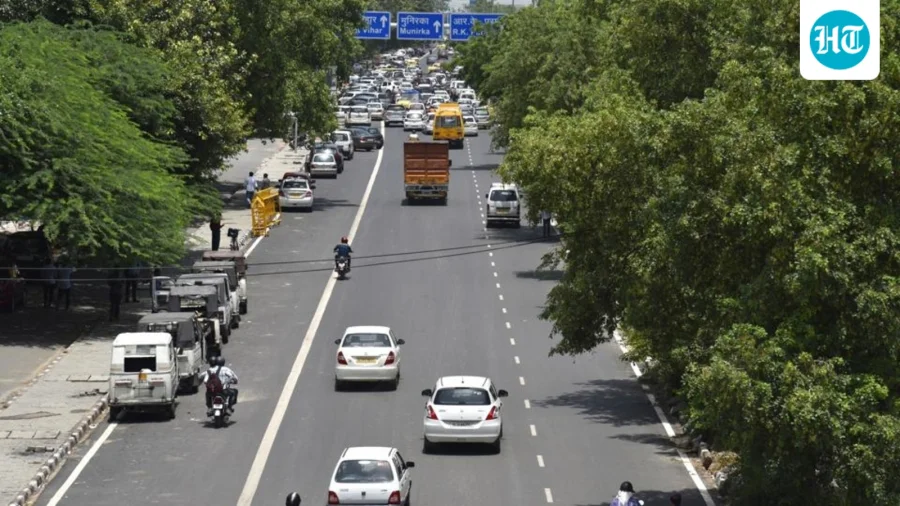
For lakhs of Delhi commuters who spend hours crawling through the Mahipalpur stretch or circling the airport to reach south Delhi, a major relief is finally on the horizon. The Union Cabinet has approved a six-lane, 8.1-km road tunnel that will directly connect the Dwarka Expressway to Nelson Mandela Marg in Vasant Kunj — a project that promises to slash travel time and reshape how people move across southwest Delhi.
What the Cabinet has approved: The tunnel project in detail
The Cabinet has given the green light for the construction of a six-lane road tunnel under National Highway 148AE (NH-148AE). This tunnel will create a direct, uninterrupted link between the Dwarka Expressway — a key corridor for west Delhi and Gurugram-bound traffic — and Nelson Mandela Marg in Vasant Kunj, one of south Delhi's major arterial roads. The project will be executed through the hybrid annuity mode (HAM), a public-private partnership model where the government pays a portion of the construction cost during the building phase and the remainder as annuities over the concession period. The total estimated cost is ₹6,969 crore, and the project is slated for completion in five years.
Why this tunnel matters for Delhi's daily commuters
Currently, anyone travelling from Dwarka, Najafgarh, or the Dwarka Expressway towards Vasant Kunj, Saket, or south Delhi has limited options. The most common route involves navigating the congested Mahipalpur stretch near the airport or taking a longer detour through the Ring Road. Both options are notorious for peak-hour gridlock. This tunnel will provide a direct, signal-free underground passage, bypassing these bottlenecks entirely. For residents of Dwarka and nearby areas who work in south Delhi's commercial hubs, this could mean saving 30 to 45 minutes each way — a significant quality-of-life improvement.
How the project fits into Delhi's evolving road network
The Dwarka Expressway itself is a relatively new addition to Delhi's infrastructure, designed to ease pressure on the Delhi-Gurugram Expressway. However, its utility has been limited by the lack of seamless connectivity into south Delhi. This tunnel effectively completes the missing link, turning the Dwarka Expressway into a truly integrated corridor. The project is part of a larger ₹14,115 crore package of highway projects cleared by the Cabinet for Delhi and Uttar Pradesh, signalling a focused push on urban road infrastructure in the National Capital Region (NCR).
Who benefits most from the new tunnel
The primary beneficiaries will be daily commuters travelling between west Delhi (Dwarka, Janakpuri, Vikaspuri) and south Delhi (Vasant Kunj, Saket, Hauz Khas, Lajpat Nagar). This includes office workers, students, and families who currently endure long commutes. Additionally, the tunnel will benefit commercial traffic moving between industrial areas in west Delhi and markets in the south. For residents of Vasant Kunj, the tunnel could reduce the volume of through traffic on local roads, as vehicles will now have a dedicated underground route. The project also supports the broader goal of reducing vehicular emissions by cutting idling time in traffic jams.
Official response and government's infrastructure push
The Cabinet's approval was announced as part of a broader set of infrastructure decisions. The Ministry of Road Transport and Highways has been pushing for faster execution of urban highway projects under the Bharatmala Pariyojana. The use of the hybrid annuity model (HAM) is a deliberate strategy to attract private investment while keeping the government's upfront financial burden manageable. Officials have indicated that the project will be tendered soon, with construction expected to begin within the current financial year.
What the hybrid annuity model means for the project's execution
Under HAM, the government contributes 40% of the project cost during the construction phase, while the private developer arranges the remaining 60%. After completion, the government pays the developer annuities (annual payments) over a period, typically 15 years, along with interest. This model reduces the immediate fiscal outlay for the government while ensuring that the private partner has a strong incentive to complete the project on time and maintain quality. It has been used successfully for several highway projects in India, though some have faced delays due to land acquisition issues.
Confirmed facts vs what remains unclear
Confirmed: The Cabinet has approved the tunnel. The length is 8.1 km. It will be six lanes. It will connect Dwarka Expressway to Nelson Mandela Marg. The cost is ₹6,969 crore. The timeline is five years. The model is HAM.
Unclear: The exact alignment of the tunnel — which specific points on Dwarka Expressway and Nelson Mandela Marg it will connect — has not been detailed in public statements. Land acquisition requirements and potential displacement, if any, have not been disclosed. The precise timeline for tendering and the start of construction is not yet announced. Traffic diversion plans during construction are also not available.
Risks and balanced view
While the project is a significant step forward, several challenges remain. Land acquisition in Delhi is notoriously complex, especially in areas with dense habitation or environmental clearances. The five-year timeline could be affected by delays in approvals, contractor issues, or unforeseen geological challenges during tunnelling. There is also the question of cost overruns, which have plagued many large infrastructure projects in India. Critics may argue that the focus should be on expanding public transport rather than building more roads for private vehicles. However, the tunnel is designed to complement existing metro and bus networks by improving last-mile connectivity and reducing congestion on surface roads.
Wider trend: India's push for urban tunnel infrastructure
This project is part of a growing trend in Indian cities to use tunnels as a solution for urban congestion. From the Zojila Pass tunnel in Jammu & Kashmir to the under-construction tunnels in Mumbai and Bengaluru, tunnelling technology is being increasingly deployed to bypass bottlenecks. In Delhi, the new Dwarka-Vasant Kunj tunnel follows the success of the recently opened Dwarka Sector 21 to IGI Airport tunnel and the under-construction tunnel connecting the airport to the Delhi-Gurugram Expressway. This reflects a strategic shift towards grade-separated, signal-free corridors within city limits.
Practical guidance for commuters and residents
For now, commuters should continue using existing routes. Once construction begins, there may be temporary disruptions on surface roads near the tunnel alignment. Residents of Vasant Kunj and Dwarka should stay updated through the Ministry of Road Transport and Highways' announcements and local traffic advisories. For those planning property investments in these areas, improved connectivity could enhance real estate values over the medium term. Students and professionals who rely on daily commutes should factor in potential construction-related delays over the next five years, but the long-term benefit will be substantial.
Future outlook: What happens next
The immediate next step is the tendering process, which is expected to be initiated by the National Highways Authority of India (NHAI). Once a developer is selected, detailed design and geotechnical surveys will begin. Construction is likely to start within 12 to 18 months. If the project stays on schedule, the tunnel could be operational by 2030. The success of this project could set a precedent for similar tunnel-based connectivity solutions in other parts of Delhi-NCR, such as connecting the Dwarka Expressway to the Delhi-Meerut Expressway or improving links between Noida and south Delhi.
Our Take
The Cabinet's approval of the Dwarka Expressway-Vasant Kunj tunnel is a welcome move for Delhi's beleaguered commuters. It addresses a genuine connectivity gap that has persisted for years. However, the real test lies in execution. Delhi has seen many ambitious infrastructure projects delayed by bureaucratic hurdles, land disputes, and cost escalations. The use of HAM is a sensible financial model, but it requires robust project monitoring to prevent delays. For the average commuter, this tunnel represents hope — but it will be five years before that hope translates into a smoother ride. The government must ensure that the project is delivered on time and within budget, and that the benefits are not undermined by poor maintenance or inadequate integration with existing road networks.
Frequently Asked Questions
What is the Dwarka Expressway to Vasant Kunj tunnel project?
It is a six-lane, 8.1-km road tunnel approved by the Union Cabinet, connecting the Dwarka Expressway to Nelson Mandela Marg in Vasant Kunj, Delhi. It will be built under NH-148AE at a cost of ₹6,969 crore.
How long will the tunnel construction take?
The project is expected to be completed in five years from the start of construction. Tendering and detailed design work will begin soon.
How will this tunnel benefit daily commuters?
The tunnel will provide a direct, signal-free route between west Delhi (Dwarka) and south Delhi (Vasant Kunj), bypassing congested stretches like Mahipalpur and the airport area. It could save commuters 30 to 45 minutes each way.
What is the hybrid annuity model (HAM) used for this project?
HAM is a public-private partnership model where the government pays 40% of the project cost during construction, and the private developer arranges the rest. After completion, the government pays the developer annual annuities over 15 years. This reduces upfront government spending and shares risk with the private sector.