The question hung heavy in the studio: "How dare he come to Bengal and tell Bengalis how to celebrate Durga Puja?" The anchor's voice carried the collective outrage of millions as she addressed a controversy that has ignited cultural pride across West Bengal. At the centre of the storm is Dhirendra Shastri, the 30-year-old preacher known as Bageshwar Baba, whose reported remarks on food habits during Durga Puja have struck a raw nerve in the state.
The Remark That Lit the Fire: 'Fraud Hindus' and the Food Question
The controversy stems from Bageshwar Baba's reported comments suggesting that Bengalis who consume meat and fish during Durga Puja cannot be considered genuine Hindus. He allegedly labelled such practitioners as 'pakhandi' (fraud) Hindus, a characterisation that many in Bengal view as a direct assault on their cultural and religious identity.
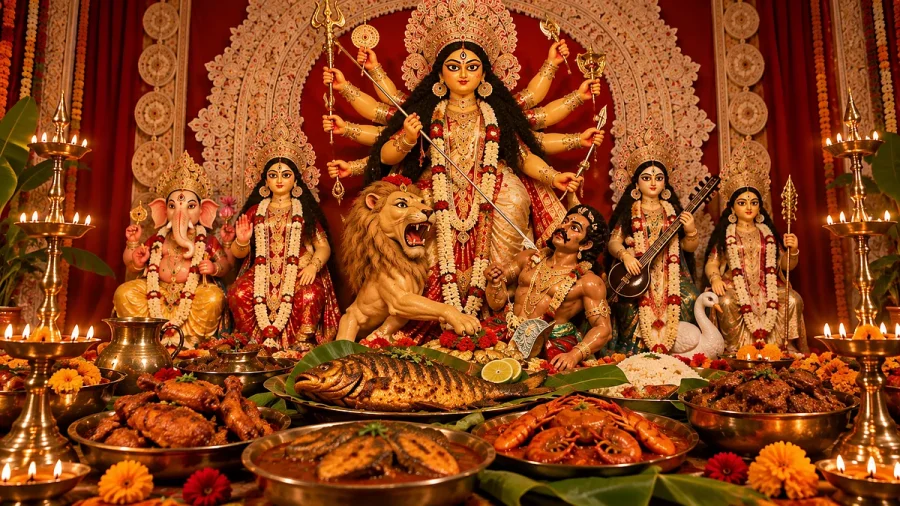
For Bengalis, Durga Puja is not merely a religious event — it is a celebration of life, culture, and community. Food, including traditional fish and meat preparations, is an integral part of the festivities. The preacher's remarks have been perceived as an attempt to impose a north Indian dietary orthodoxy on a culture with its own distinct traditions.
Why Bengal Is Furious: Cultural Autonomy vs Religious Conservatism
The anger in Bengal is not just about food. It is about who gets to define what it means to be Hindu. Bengalis have historically practised a form of Hinduism that embraces Shakti worship with regional customs, where offerings and celebrations differ significantly from the temple traditions of central and north India.
The anchor's pointed questions reflect a deeper sentiment: "Have Bengalis ever told people in other states what to eat and how to observe their festivals?" This rhetorical challenge underscores a growing resentment against what many perceive as cultural policing by preachers from outside the state.
The Prime-Time Confrontation: An Anchor's Demand for Accountability
During the Monday prime-time show on TV Ananda, the Bengali channel of the ABP Group, the celebrated anchor did not hold back. She questioned how Bageshwar Baba has been "allowed to get away" with his remarks. Her demands were specific and legal: Why has no FIR been lodged? Why has there been no arrest?
The on-air confrontation has amplified the issue beyond social media echo chambers, bringing it into mainstream Bengali living rooms. The anchor's framing — that an outsider is dictating terms to Bengalis in their own land — has resonated deeply with viewers across political and social spectrums.
Who Is Bageshwar Baba? The Preacher at the Centre of the Storm
Dhirendra Shastri, popularly known as Bageshwar Baba, is the head priest of the Bageshwar Dham temple in Madhya Pradesh. At just 30 years old, he has built a significant following through his public durbars, where he claims to perform miracles and identify devotees' problems through divine insight.
His rise has been meteoric, attracting large crowds and significant media attention. However, his outspoken style on religious and cultural matters has also made him a polarising figure. This is not the first time his remarks have sparked controversy, but the Bengal backlash represents a significant escalation in regional pushback.
The Legal Question: Can an FIR Be Filed and on What Grounds?
The demand for legal action raises complex questions. For an FIR to be registered, the remarks must potentially violate specific provisions of the law, such as those relating to promoting enmity between different groups on grounds of religion (Section 153A of the IPC) or deliberate and malicious acts intended to outrage religious feelings (Section 295A).
Legal experts note that while hate speech provisions exist, applying them to religious sermons is often legally contentious. The question of whether Bageshwar Baba's remarks constitute a punishable offence or merely offensive speech would ultimately be a matter for the courts to decide if a case is registered.
Confirmed Facts vs What Remains Unclear
What is confirmed is that a significant controversy has erupted, with a leading Bengali news anchor publicly demanding legal action. The reported remarks about 'pakhandi Hindus' are attributed to Bageshwar Baba, though the exact context and full transcript of his statements have not been independently verified in this report.
What remains unclear is whether any formal complaint has been filed with the police, whether the preacher's camp has responded to the backlash, and whether political parties in Bengal will convert this cultural anger into a formal demand for action. The absence of an official statement from Bageshwar Baba or his representatives leaves a significant gap in the narrative.
Why This Preacher's Words Carry Weight: The Business of Faith
Bageshwar Baba's influence cannot be dismissed as marginal. His Bageshwar Dham temple has become a major pilgrimage site, attracting devotees from across the country. His public durbars draw massive crowds, and his speeches are widely shared on digital platforms.
This reach gives his words significant cultural power. When a figure with this level of following makes remarks about another region's religious practices, it can shape perceptions and reinforce stereotypes. The backlash in Bengal is, in part, a recognition of this influence and a refusal to let it go unchallenged.
The Risks of the Controversy: Polarisation and Political Exploitation
While the anger in Bengal is genuine, there are risks that the controversy could deepen religious polarisation. Framing the debate purely as a clash between vegetarian and non-vegetarian Hindus risks oversimplifying a complex cultural landscape. Many Hindus across India are non-vegetarian, and dietary practices vary widely by region, community, and personal choice.
There is also the risk of political exploitation. In a state where religious identity and cultural pride are politically sensitive, both the ruling party and the opposition may seek to leverage this controversy for electoral advantage. Such politicisation could further entrench divisions rather than foster understanding.
A Wider Pattern: The Growing Clash Over Who Defines Hinduism
This controversy is not an isolated incident. Across India, there have been increasing tensions over who has the authority to define authentic Hindu practice. From debates over temple entry to questions of dietary rules, a visible struggle is underway between reformist, regional, and conservative interpretations of the faith.
Bengal's response to Bageshwar Baba represents a significant assertion of regional autonomy within the broader Hindu fold. It challenges the notion that a single, homogenised version of Hinduism — often associated with the Hindi heartland — should be the benchmark for authenticity.
What Should Bengalis and Observers Do Now?
For those angered by the remarks, the immediate recourse is to channel outrage through legitimate democratic means. This could include filing formal complaints with the police if they believe a legal offence has been committed, raising the issue through elected representatives, and engaging in public discourse that asserts Bengal's cultural identity without resorting to counter-polarisation.
For observers outside Bengal, this controversy offers an opportunity to understand the diversity of Hindu practice across India. Recognising that regional traditions carry their own legitimacy is essential to appreciating the faith's complexity. The debate should ideally centre on mutual respect rather than one-upmanship over who is a 'better' Hindu.
What Happens Next: Possible Trajectories of the Row
The immediate future of this controversy depends on several factors. If a formal complaint is filed and an FIR is registered, the matter could move into the legal domain, potentially leading to a summons for Bageshwar Baba. Alternatively, the preacher's camp might issue a clarification or apology to defuse the tension.
Political reactions will also shape the trajectory. If major political figures in Bengal take up the cause, the controversy could gain national attention and force a response from authorities in Madhya Pradesh. Without such escalation, the row may gradually fade from prime-time news, though the underlying cultural tensions are likely to persist.
Our Take
This controversy is fundamentally about respect — respect for regional cultures, for diverse interpretations of faith, and for the autonomy of communities to celebrate their traditions without external judgement. Bageshwar Baba's reported remarks, whether born of ignorance or intent, have touched a nerve because they question the very legitimacy of Bengali Hindu practice.
The anchor's demand for an FIR reflects a broader frustration with what many see as a pattern of preachers making inflammatory remarks without facing consequences. Whether legal action is the right remedy is debatable, but the underlying demand for accountability is understandable. In a pluralistic democracy, the freedom to preach must be balanced against the responsibility not to demean the faith practices of others. Bengal's response is a reminder that cultural pride remains a powerful force in Indian public life.
Frequently Asked Questions
What did Bageshwar Baba say about Bengalis and Durga Puja?
Bageshwar Baba, also known as Dhirendra Shastri, reportedly made remarks suggesting that Bengalis who consume meat and fish during Durga Puja are 'pakhandi' (fraud) Hindus. The exact context and full transcript of his statements have not been independently verified, but the reported comments have sparked widespread anger in West Bengal.
Why are Bengalis angry at Bageshwar Baba's remarks?
Bengalis view the remarks as an attack on their cultural and religious identity. Durga Puja is Bengal's biggest festival, and food, including fish and meat, is an integral part of the celebration. Many see the preacher's comments as an attempt by an outsider to impose a different dietary orthodoxy on a culture with its own distinct traditions.
Has any FIR been filed against Bageshwar Baba?
As of the latest reports, there is no confirmed information about an FIR being filed against Bageshwar Baba. A leading Bengali news anchor has publicly demanded legal action, questioning why no FIR has been lodged and no arrest made, but no official confirmation of legal proceedings is available.
Who is Bageshwar Baba and why does his opinion matter?
Bageshwar Baba is the head priest of the Bageshwar Dham temple in Madhya Pradesh. At 30 years old, he has gained a significant following through his public durbars and claimed miracles. His large audience gives his words considerable influence, which is why his reported remarks have triggered such a strong reaction in Bengal.