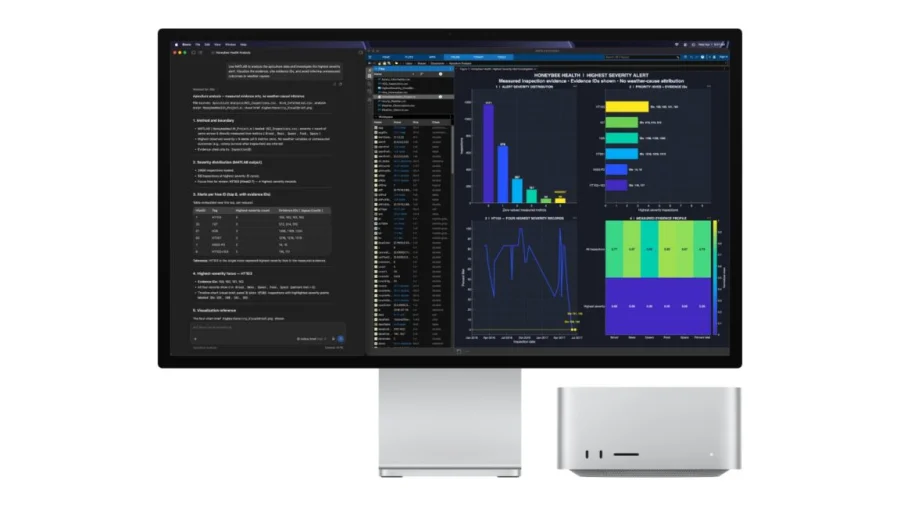
For years, serious AI development meant renting cloud servers and praying your internet connection held up. Apple just made a compelling argument that the future of AI work might sit quietly on your desk.
Two Desktops, One Clear AI Mission
The Mac mini and Mac Studio have always served different audiences—one for compact setups, the other for heavy lifting. But today, they share a defining purpose: local AI development.
Apple's announcement positions both machines as tools for AI inference and software development, capitalizing on the unified memory architecture that lets the CPU and GPU access the same pool of high-speed memory. For AI workloads, that means larger models can run without the bottleneck of copying data between separate memory banks.
Why Local AI Development Is Suddenly a Big Deal
Cloud-based AI development comes with hidden costs: latency, data privacy concerns, and recurring fees that scale with usage. Running models locally eliminates those trade-offs.
For Indian developers, startups, and researchers, this matters even more. Cloud GPU costs in India can be prohibitive, and data localization rules are tightening. A desktop that can handle serious AI workloads locally isn't just convenient—it's a strategic advantage.
The Chips Behind the Leap: M6 and M5 Ultra
The M6 is Apple's first 2nm chip in the M-series for Macs. The move to 2nm means more transistors packed into the same space, delivering better performance per watt—critical for sustained AI workloads that would otherwise throttle or drain power.
The M5 Ultra, meanwhile, is described as the most powerful chip in Apple's lineup for most things, with a specific emphasis on AI workloads. This is the chip that developers will likely gravitate toward for training and running larger models locally.
Who Benefits Most From These New Macs
Independent AI developers who currently rent cloud GPUs will feel the impact first. Instead of paying hourly rates for remote compute, they can iterate faster on their own hardware.
Research labs and university departments—especially those with limited cloud budgets—could also find these machines attractive. And for teams working with sensitive data, keeping everything on-device removes a major compliance headache.
Apple's Positioning: A Quiet Bet on On-Device AI
Apple has been steadily pushing AI features onto its devices rather than relying solely on cloud services. These new desktops are the most explicit signal yet that the company sees local AI as a core use case, not a side feature.
By pairing the unified memory architecture with faster CPUs and GPUs, Apple is betting that developers will choose the convenience and privacy of local development over the flexibility of the cloud.
What This Means for the AI Development Landscape
If these machines deliver on their promise, the economics of AI development could shift. A developer who owns a powerful Mac Studio might no longer need a cloud budget for experimentation and prototyping.
That doesn't mean cloud computing disappears—far from it. Large-scale training will still require data centers. But the barrier to entry for serious AI work just got lower for individuals and small teams.
Confirmed Facts vs What Remains Unclear
Confirmed: Apple announced new Mac mini and Mac Studio models, the M6 chip (first 2nm in M-series for Macs), and the M5 Ultra chip (most powerful in lineup, especially for AI workloads). Both desktops are positioned for local AI inference and development.
Unclear: Specific performance benchmarks, pricing, availability in India, and how these chips compare to Nvidia or AMD alternatives in real-world AI tasks. Apple has not yet disclosed full technical specifications.
Apple's Moat: Why the Unified Memory Architecture Matters
Apple's advantage isn't just raw chip speed—it's the unified memory architecture. In traditional PCs, the CPU and GPU have separate memory pools, forcing data to travel between them. Apple's design lets both processors access the same memory directly.
For AI workloads, this is transformative. Large language models can reside entirely in memory, eliminating the transfer bottleneck that slows down other systems. This is why Apple's chips have become popular among AI developers despite Nvidia's dominance in data centers.
Risks and Balanced View
Not everything is straightforward. Apple's desktop lineup is premium-priced, and the M5 Ultra will likely command a significant premium. For developers on tight budgets, a cloud GPU rental might still be more cost-effective for occasional heavy workloads.
There's also the question of software compatibility. While Apple's ecosystem has strong AI frameworks, some tools and libraries are still optimized for Nvidia's CUDA platform. Developers may face friction when porting workflows.
The Broader Shift: AI Moving From Cloud to Edge
Apple's announcement fits a wider industry trend. From smartphones to laptops, companies are pushing AI capabilities onto devices. The reasons are consistent: privacy, latency, and cost.
As on-device AI hardware improves, the balance between cloud and local computing will keep shifting. Apple's new desktops are a clear bet that for many developers, local is the future.
What Developers Should Do Now
If you're an AI developer considering these machines, start by evaluating your actual workload. Do you need to train large models from scratch, or are you mostly fine-tuning and running inference? The M5 Ultra is aimed at the former; the Mac mini with M6 might be enough for the latter.
Also, check software compatibility before committing. Most major AI frameworks support Apple Silicon, but niche tools may not. And if you're in India, factor in import duties and availability timelines, which often lag behind US launches.
What Happens Next
Expect detailed benchmarks from independent reviewers in the coming weeks. Those tests will reveal how the M6 and M5 Ultra actually perform on real AI workloads—not just Apple's marketing claims.
If the performance matches expectations, these desktops could become standard equipment for AI developers who value privacy and speed. If not, the cloud will remain the default choice.
Our Take
Apple's move is more than a hardware refresh—it's a statement about where AI development is heading. By making local AI development a headline feature, Apple is telling developers that the future isn't just in the cloud; it's on your desk.
The real test will be execution. If the M6 and M5 Ultra deliver on their AI promises, Apple could reshape how a generation of developers builds AI applications. If they fall short, this will be remembered as a well-marketed but underwhelming update.
Frequently Asked Questions
What makes the new Mac mini and Mac Studio good for AI development?
Both desktops use Apple's unified memory architecture, which lets the CPU and GPU access the same high-speed memory. This is ideal for AI workloads because large models can run entirely in memory without data transfer bottlenecks.
What is the Apple M6 chip?
The M6 is Apple's first 2nm chip in the M-series for Macs. The smaller manufacturing process allows more transistors, delivering better performance and power efficiency—important for sustained AI workloads.
How does the M5 Ultra compare to other Apple chips?
Apple describes the M5 Ultra as the most powerful chip in its lineup for most tasks, with a specific emphasis on AI workloads. It's designed for heavy compute tasks like training and running large AI models locally.
Should I buy a new Mac for AI development or use cloud GPUs?
It depends on your workload. If you need to train large models regularly, a Mac with M5 Ultra could save cloud costs over time. For occasional heavy workloads, cloud GPUs might still be more cost-effective. Consider your budget, software compatibility, and data privacy needs before deciding.