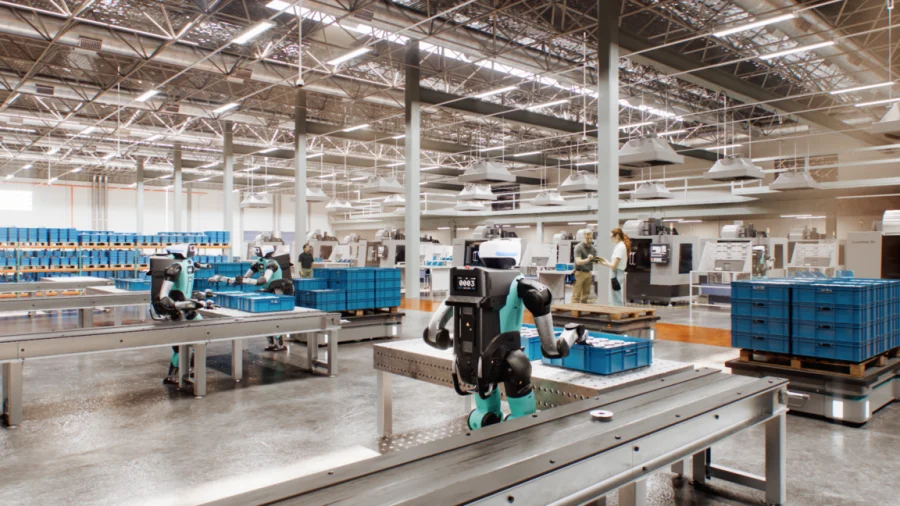
The next generation of warehouse robots may not need cages. Agility Robotics has introduced Digit 5, a humanoid robot built to work safely in the same space as people — and when a human gets too close, it can simply stop, step aside, or squat down until the person passes.
It is a small behavioural detail with large industrial consequences. For years, the biggest obstacle to putting humanoid robots on factory and warehouse floors has not been whether they can lift boxes or walk. It has been whether they can be trusted not to hurt the people standing next to them.
What Digit 5 Actually Does When a Human Approaches
According to Agility Robotics, Digit 5 is its first humanoid robot engineered specifically to work safely near humans without risking harm to flesh-and-blood coworkers. The robot's behaviour changes with distance.
When it detects a person at a distance, it can autonomously take precautions — moving to avoid the person or standing still so they can pass without getting closer. If someone enters close proximity, Digit 5 can choose to squat and assume a seated position, reducing its height and physical footprint.
The company describes this as a "complex safe motion system" that can take a variety of different mitigations depending on exactly what is happening around the robot.
Why Removing the Safety Cage Changes the Economics
Traditional industrial robots are powerful, fast, and dangerous. The standard solution has been physical separation: fences, light curtains, and isolated robot work cells that keep humans and machines apart.
That separation is expensive. It consumes floor space, complicates workflow, and limits where a robot can be deployed. A humanoid that can safely share an aisle with a worker removes a major piece of that overhead — and potentially opens up warehouses and automotive factories that previously could not justify the installation.
For Agility, the commercial logic is straightforward: the fewer barriers a customer has to build, the easier the robot is to sell.
How the Industry Got Here
Humanoid robotics has moved quickly from demonstration videos to commercial pilots. The early focus was on capability — can the robot walk, balance, and manipulate objects? The harder problem, and the one that determines whether these machines ever scale, is safety in unpredictable human environments.
Agility Robotics has positioned Digit as a logistics-focused humanoid rather than a general-purpose spectacle. Digit 5's safety behaviour reflects that positioning: the robot is being designed around the constraints of real facilities, not around a stage.
Who This Affects on the Factory Floor
The people most directly affected are warehouse and manufacturing workers who would share space with these machines. A robot that stops and squats is a meaningfully different proposition from one that requires a locked cage — it changes the daily experience of working near automation.
It also matters for the companies evaluating deployment. Safety incidents are the fastest way to stall an automation programme, both through regulatory scrutiny and through workforce resistance. A robot designed to yield to humans is easier to introduce to a sceptical floor.
What Agility Has Said — and What It Has Not
Agility Robotics has described the safe motion system and the range of mitigations Digit 5 can perform. That is the company's own account of its product.
What the announcement does not establish is independent verification. Safety claims in industrial robotics are typically validated through formal standards, third-party assessment, and documented incident data over time. None of that was detailed in the source material for this story.
Reading the Safety Claim Carefully
There is an important distinction between a robot that behaves safely and a robot that is certified safe. Digit 5's stop-move-squat repertoire is a design approach — a set of intended behaviours. Whether those behaviours hold up across thousands of hours, in cluttered aisles, with distracted workers, is an empirical question.
The squatting behaviour is particularly interesting. It is a conservative response: rather than trying to navigate around a person, the robot reduces its own presence. That suggests a design philosophy built around deference rather than assertiveness, which is likely the right instinct for early commercial deployment.
Confirmed Facts vs What Remains Unclear
Confirmed: Agility Robotics has debuted Digit 5. The robot is designed to work safely near humans. It can detect people, move away or stand still, and squat into a seated position at close proximity. The company describes a complex safe motion system with multiple mitigations.
Unclear: Independent safety certification, specific detection ranges, response times, pricing, deployment timelines, and named customer commitments were not established in the available material. Any figures circulating beyond the company's description should be treated as unverified.
Where Agility's Advantage Could Come From
Agility Robotics is not the only company building humanoid robots, and raw capability is becoming less differentiating. The harder advantages to replicate are deployment experience, safety engineering, and relationships with the logistics operators who actually run warehouses.
If Digit 5's safety behaviour genuinely reduces the infrastructure a customer must install, that is a distribution advantage as much as a technical one. It lowers the cost of the first deployment — which is where most automation programmes succeed or die.
The Risks in the Safety-First Pitch
Safety claims carry asymmetric risk. A single serious incident involving a humanoid working near humans would damage the entire category, not just one company. Regulators in the US and Europe are still developing frameworks for humanoid and mobile robots in shared spaces, and those frameworks may impose requirements stricter than any single vendor's design.
There is also a workforce dimension. Robots designed to work alongside people rather than behind fences are, by definition, robots designed to occupy roles that people currently hold. The safety feature that makes deployment easier also makes displacement more plausible.
The Broader Shift: From Cages to Coexistence
Digit 5 fits a wider pattern in robotics: the move away from segregated automation toward machines that operate in human-designed environments. This is the same logic behind autonomous mobile robots in warehouses and collaborative robot arms on assembly lines.
Humanoids are the hardest version of this problem because they are mobile, tall, and heavy. Solving coexistence for a bipedal robot is a stronger claim than solving it for a wheeled cart — and if it works, it sets a template the rest of the industry will follow.
What This Means for Workers, Operators, and Investors
For warehouse and factory workers, the practical question is not whether the robot can squat, but what the robot's arrival means for staffing, training, and day-to-day safety on the floor. Those answers will come from individual employers, not from product announcements.
For operators evaluating automation, the relevant test is whether Digit 5 reduces total installation cost and complexity. Ask for safety documentation, incident data, and references from live deployments rather than demonstration footage.
For investors and analysts, the signal to watch is certification and customer disclosure — not capability demos. Safety validation is the gate that determines whether humanoid robotics becomes a scaled industry or remains a pilot programme.
What Happens Next
The near-term milestones to watch are formal safety assessment, named deployment partners, and any published performance data from real facilities. Until those appear, Digit 5's stop-and-squat behaviour remains a well-designed intention rather than a proven safety record.
If Agility can demonstrate the system reliably in live warehouses, the barrier-free humanoid becomes a realistic procurement option — and the competitive pressure on the rest of the industry increases sharply.
Our Take
The most consequential thing about Digit 5 is not that it can squat. It is that Agility Robotics has chosen to compete on safety rather than spectacle, at a moment when the humanoid industry is crowded with impressive videos and thin deployment records.
Safety is a slow, unglamorous, documentation-heavy advantage — which is precisely why it is defensible. If Agility gets it right, the reward is access to the ordinary warehouses and factories that make up the actual market. If it gets it wrong, or if regulators move faster than the company expects, the same feature becomes the story's liability.
Either way, the era of the fenced-off robot is starting to look dated.
Frequently Asked Questions
What is Agility Robotics' Digit 5?
Digit 5 is a humanoid robot from Agility Robotics designed to work safely near human workers. It is the company's first humanoid engineered to operate without physical separation barriers, using a safe motion system that adjusts its behaviour based on how close people are.
How does Digit 5 avoid harming human coworkers?
When it detects a person at a distance, Digit 5 can move to avoid them or stand still so they can pass. If a person comes very close, the robot can squat into a seated position to reduce its height and footprint. Agility describes this as a complex safe motion system with multiple possible mitigations.
Why does it matter that Digit 5 doesn't need a safety cage?
Isolated robot work cells with fences and barriers are expensive, consume floor space, and limit where robots can be deployed. A humanoid that can safely share space with people could open up warehouses and automotive factories that previously could not accommodate automation.
Is Digit 5's safety system independently certified?
That has not been established in the available information. Agility Robotics has described the robot's safety behaviour, but independent certification, third-party assessment, and live deployment data were not detailed. Safety claims of this kind are typically validated over time through formal standards and real-world performance.
[NEWS_SCHEMA]{"@context":"https://schema.org","@type":"NewsArticle","headline":"Agility's Digit 5 Humanoid Robot Can Stop and Squat to Avoid Harming Human Coworkers","description":"Agility Robotics' new Digit 5 humanoid robot detects nearby workers and stops, moves aside, or squats to avoid harm — potentially removing safety barriers in warehouses.","image":"","datePublished":"","dateModified":"","author":{"@type":"Person","name":"","url":"","sameAs":[]},"publisher":{"@type":"Organization","name":"","logo":{"@type":"ImageObject","url":""}},"mainEntityOfPage":{"@type":"WebPage","@id":""},"articleSection":"Technology","keywords":"Agility Robotics Digit 5 humanoid robot, Digit 5 safety features, humanoid robot warehouse safety, robots working alongside humans, safe motion system"}[/NEWS_SCHEMA] [SOURCES] No high-confidence external sources were available for this story. Content is based solely on the provided headline and original story description of Agility Robotics' Digit 5 announcement. Independent verification of safety claims, certification status, and deployment details was not possible from the available material. [/SOURCES]