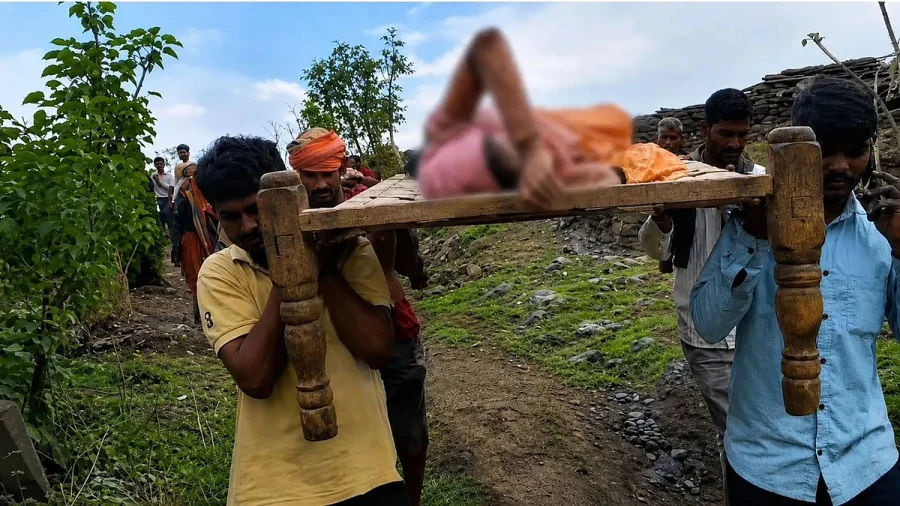
In a moment that has shaken the conscience of the nation, a 35-year-old woman in Madhya Pradesh's Chhindwara district gave birth not in a hospital bed, not in an ambulance, but on a wooden cot — mid-river — as villagers carried her across a rain-swollen stream because no ambulance could reach her home. The video, which surfaced on Sunday, is not just a viral clip. It is a raw, unscripted testimony to the gap between India's healthcare ambitions and the reality of its most remote villages.
How a Routine Labour Turned Into a River Crossing Emergency
Savita Vishwakarma, wife of Shankar Vishwakarma, went into labour on Wednesday evening in Lohri Mohalla of Hathoda Hiri village in Amarwala block. Her family immediately contacted the 108 ambulance service. But the vehicle could not reach her. The reason: a rain-fed river had severed the only approach road, cutting off around 20 families from the outside world during the monsoon. With no bridge, no boat, and no alternative route, the villagers did what they have done for generations — they improvised. They placed Savita on a cot and began the treacherous crossing.
Why This Village Gets Cut Off Every Monsoon
Hathoda Hiri is not an exception. It is a pattern repeated across thousands of villages in central India. Every year, when the monsoon swells the seasonal rivers, communities in the Amarwala block of Chhindwara district are left stranded. The only road becomes impassable. Emergency services, designed for connected areas, become theoretical. For the 20 families in Lohri Mohalla, the river is not a scenic backdrop — it is a barrier that separates them from hospitals, schools, and markets for months. This incident is not an anomaly; it is a predictable consequence of infrastructure neglect.
The Viral Video That Forced the Nation to Look
The video, which spread rapidly on social media from Sunday, shows a group of men wading through waist-deep water, carefully balancing the cot on which Savita lies. The image is stark: a woman in labour, exposed to the elements, dependent entirely on the strength and care of her neighbours. The clip has been shared thousands of times, with many expressing outrage at the failure of the state to provide basic emergency access. But for the residents of Hathoda Hiri, this is not a shocking exception — it is the reality of their lives.
What Happened After the Birth
According to family members, Savita gave birth on the cot itself, mid-crossing. The newborn survived. After reaching the other side, she was taken to a community health centre for further care. Both mother and child are reported to be stable. But the question remains: what if the birth had complications? What if the river was higher? The incident could have easily turned into a tragedy. That it did not is a matter of luck, not planning.
No Official Statement Yet From District Authorities
As of now, the Chhindwara district administration has not issued a formal response to the incident or the ambulance failure. The viral video has put pressure on local officials, but no review or action has been announced. The 108 ambulance service, which is supposed to be a lifeline for rural emergencies, has not explained why no alternative arrangement was made — such as a boat or a four-wheel-drive vehicle — for a known monsoon-isolated area. The silence from authorities is itself a statement.
What This Reveals About Rural Emergency Healthcare in India
This incident is not isolated. In July 2021, a pregnant woman in Madhya Pradesh's Sidhi district gave birth in an ambulance parked on a road because the vehicle could not reach her village. In Betul district, villagers have been seen carrying pregnant women on cots across rivers for years. The pattern is clear: India's emergency healthcare system, despite ambitious schemes like 108 ambulances and Janani Suraksha Yojana, fails when the last mile is a river. The problem is not just roads — it is the absence of a system that accounts for seasonal isolation.
Confirmed Facts vs What Remains Unclear
What is confirmed: Savita Vishwakarma gave birth on a cot while being carried across a river in Chhindwara district. The 108 ambulance could not reach her village due to a rain-swollen river. The video was recorded and shared on Sunday. Mother and child are stable. What remains unclear: whether the ambulance service was notified of the village's isolation beforehand, whether any alternative transport was arranged, and what action, if any, the district administration will take. No official statement has been released.
Why This Village's Isolation Is a Systemic Failure
Hathoda Hiri is not a newly settled area. The fact that around 20 families are cut off every monsoon is a known issue. Yet no permanent bridge, no boat service, and no emergency protocol has been put in place. The 108 ambulance service, while valuable, is designed for road-accessible areas. In villages like this, it becomes a symbol of promise rather than delivery. The system assumes connectivity. When that assumption fails, women like Savita pay the price.
Risks and the Unanswered Questions
The most immediate risk is that this incident will be forgotten after the viral video fades. Without official accountability, the same scenario will repeat next monsoon. There are also concerns about the safety of the newborn, who was delivered in unsterile conditions mid-river. While the child survived, the lack of medical supervision during birth increases risks of infection and complications. Critics have also pointed out that the video, while raising awareness, could lead to tokenism — a temporary bridge built for optics rather than a systemic solution.
The Broader Pattern: Monsoon Isolation Across Rural India
Chhindwara is not alone. Every year, news reports emerge from Madhya Pradesh, Maharashtra, Odisha, Jharkhand, and Bihar of pregnant women being carried across rivers, giving birth on roadsides, or dying because ambulances could not reach them. The problem is structural: India has thousands of villages that become islands during the monsoon. The solution requires not just more ambulances, but all-weather roads, boat services, and community-based emergency protocols for the months when roads are impassable.
What Should Be Done Now
For residents of similar villages, the immediate need is to identify alternative emergency contacts — local boat owners, four-wheeler drivers, or community health workers who can be reached when the 108 service fails. For district administrations, the lesson is clear: every monsoon-isolated village should have a pre-identified emergency transport plan, including boats or tractors, and a list of pregnant women due to deliver during the rainy season. For policymakers, this incident is a reminder that healthcare access cannot be measured by the number of ambulances alone — it must account for the last mile, even if that mile is a river.
Future Outlook: Will Anything Change?
The viral nature of this video may force the Chhindwara administration to act — at least temporarily. A bridge may be promised, a boat may be arranged. But without sustained pressure and systemic reform, the pattern will repeat. The real test will come next monsoon, when the river rises again. If the same village is still cut off, then the video will have been just another moment of outrage, not a catalyst for change. The future depends on whether the state treats this as a failure to be fixed or an exception to be forgotten.
Our Take
This is not a story of heroic villagers saving a woman in distress — though they did. It is a story of a system that has normalised the unacceptable. A woman giving birth on a cot in a river is not a miracle; it is a failure of planning, infrastructure, and political will. The video is powerful because it shows what should never have to happen. But the real measure of our society is not how we react to the video — it is whether we ensure that no woman ever has to give birth mid-river again. Until that changes, every monsoon will bring the same headlines, the same outrage, and the same silence.
Frequently Asked Questions
Where did the woman give birth on a cot across a river?
The incident occurred in Lohri Mohalla of Hathoda Hiri village in Amarwala block, Chhindwara district, Madhya Pradesh. The woman was being carried across a rain-fed river that had cut off the village from the main road.
Why couldn't the ambulance reach the pregnant woman?
The 108 ambulance could not reach the village because the only approach road was submerged by a rain-swollen river. Around 20 families in the area are cut off during the monsoon every year due to the lack of an all-weather bridge.
Is the mother and baby safe after the river birth?
Yes, both the mother, Savita Vishwakarma, and her newborn are reported to be stable. She was taken to a community health centre after crossing the river. The baby survived the delivery on the cot.
What action has the government taken after the viral video?
As of now, no official statement or action has been announced by the Chhindwara district administration. The viral video has drawn widespread attention, but no formal review or accountability measures have been confirmed.