Congress workers marching to Kolkata Police headquarters at Lalbazar found their path blocked on Wednesday, 5 August, as heavy barricades brought the 'Lalbazar Chalo' Satyagraha rally to a halt roughly a kilometre from its destination. The party alleges attacks on its workers and leaders, accusing the police of failing to act against political violence.
Congress leaders lead Satyagraha march from College Street
The rally was led by AICC in-charge Prakash Joshi and West Bengal Congress president Subhankar Sarkar. It began at Calcutta University on College Street, with demonstrators intending to reach Lalbazar to press their demands against alleged political violence and police inaction.
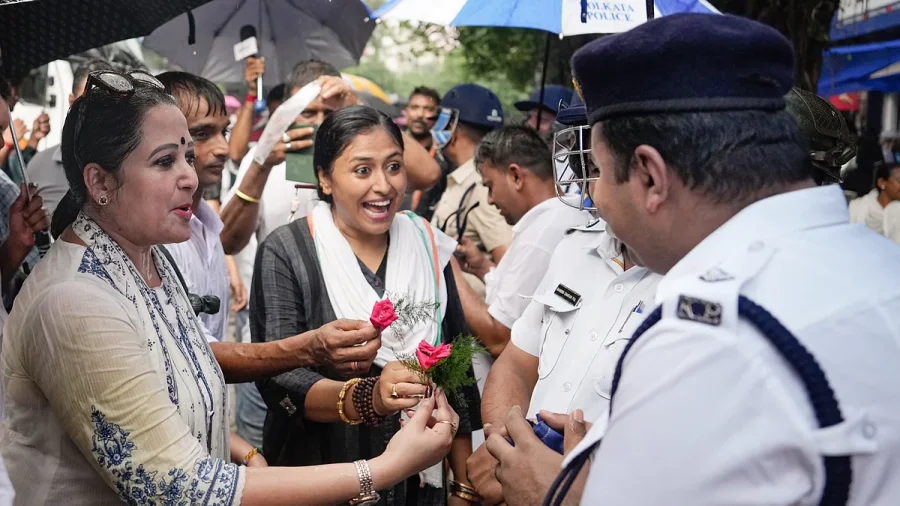
In a Gandhian-style gesture, Congress workers offered flowers and sweets to police personnel stationed at the barricades. Slogans were raised against police cases filed against student protesters and hawkers, with the party demanding that peaceful protests and democratic movements be allowed without intimidation.
Why the march was stopped and what it signals
The decision to halt the march a kilometre short of Lalbazar raises questions about the administration's approach to political demonstrations in West Bengal. Congress leaders argue that blocking a peaceful Satyagraha march contradicts democratic norms, while police maintained heavy security arrangements in central Kolkata.
For ordinary citizens, the incident highlights the growing friction between political parties and law enforcement in the state. The sight of protesters offering flowers to police — a deliberate contrast to confrontational politics — underscores the symbolic nature of this protest.
Background: Allegations of political violence in West Bengal
The Congress march comes amid recurring allegations of political violence in West Bengal. Party leaders have repeatedly claimed that their workers face attacks, and that complaints to police have not resulted in action. Wednesday's march was intended to draw attention to these grievances directly at the police headquarters.
The inclusion of student protesters and hawkers in the party's slogans suggests a broader coalition of grievances, linking political violence concerns with police cases against other groups.
How the protest unfolded on the ground
Eyewitness accounts describe a tense but peaceful scene as marchers approached the barricades. Congress workers, rather than attempting to break through, engaged in symbolic acts of goodwill — offering flowers and sweets to police personnel. This approach appears designed to highlight what the party describes as disproportionate police response to peaceful protest.
The marchers also raised slogans against police cases filed against student protesters and hawkers, broadening the scope of their demands beyond political violence.
Congress leadership's position on police inaction
Prakash Joshi and Subhankar Sarkar have been vocal about their allegations that police have failed to act against political violence targeting Congress workers. By leading the march personally, both leaders signalled that this issue remains a priority for the party's state unit.
The party's demand is clear: peaceful protests and democratic movements must be allowed to proceed without intimidation or obstruction.
What the barricades mean for democratic protest in Kolkata
The heavy barricading of central Kolkata raises broader questions about the space available for political protest in the city. While security concerns are often cited, critics argue that blocking marches prevents legitimate democratic expression. The Congress' choice of a Satyagraha-style protest — rooted in Gandhian tradition — adds historical weight to the confrontation.
Confirmed facts versus what remains unclear
Confirmed: The Congress march began at Calcutta University, was led by Prakash Joshi and Subhankar Sarkar, and was stopped by police barricades about a kilometre from Lalbazar. Workers offered flowers and sweets to police and raised slogans against cases against students and hawkers.
Unclear: The specific incidents of political violence alleged by Congress have not been independently verified in this report. The police's official rationale for the barricades has not been detailed. Whether further protests are planned remains unknown.
Risks and balanced view
While Congress alleges police inaction, authorities may argue that barricades were necessary to prevent disruption in central Kolkata. The party's decision to include student and hawker cases in its slogans suggests a wider political strategy beyond the immediate issue of political violence.
Critics may question whether the march was intended as a genuine protest or a symbolic political statement. Supporters, however, see it as a legitimate exercise of democratic rights in the face of alleged state indifference.
Wider pattern: Political protests and police response in West Bengal
This incident fits a broader pattern of political tensions in West Bengal, where opposition parties frequently allege violence and police bias. The Congress' use of Gandhian protest methods reflects an attempt to frame its struggle in moral terms, appealing to public sympathy rather than confrontation.
What protesters and citizens should know now
For those following the situation, the key takeaway is that the Congress has signalled its intent to continue pressing its demands. Citizens should watch for official police statements regarding the barricades and any further protest announcements from the party.
For those who support peaceful protest, the incident serves as a reminder of the ongoing tension between security measures and democratic expression in Indian cities.
Future outlook: Will the Congress press forward?
Given the party's stated commitment to peaceful protest, further marches or demonstrations are possible. The response of Kolkata Police to future protests will be closely watched. Whether the administration engages with Congress' demands or maintains its current stance remains to be seen.
Our Take
This protest, though halted, achieved its symbolic purpose. The image of Congress workers offering flowers to police at a barricade is a powerful contrast to the violence both sides accuse each other of. The deeper issue — whether political violence is being adequately addressed in West Bengal — remains unresolved. The barricades stopped the march, but they did not stop the questions.
Frequently Asked Questions
Why was the Congress march to Lalbazar halted?
The march was stopped by heavy barricades erected by Kolkata Police in central Kolkata, about a kilometre from the police headquarters at Lalbazar.
Who led the Congress Satyagraha march?
The march was led by AICC in-charge Prakash Joshi and West Bengal Congress president Subhankar Sarkar.
What were the protesters demanding?
Congress workers were protesting alleged political violence against party workers and accusing police of inaction. They also raised slogans against police cases filed against student protesters and hawkers.
How did Congress workers respond to the barricades?
In a Gandhian-style gesture, they offered flowers and sweets to police personnel while raising slogans, rather than attempting to break through the barricades.