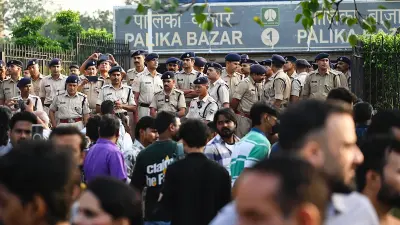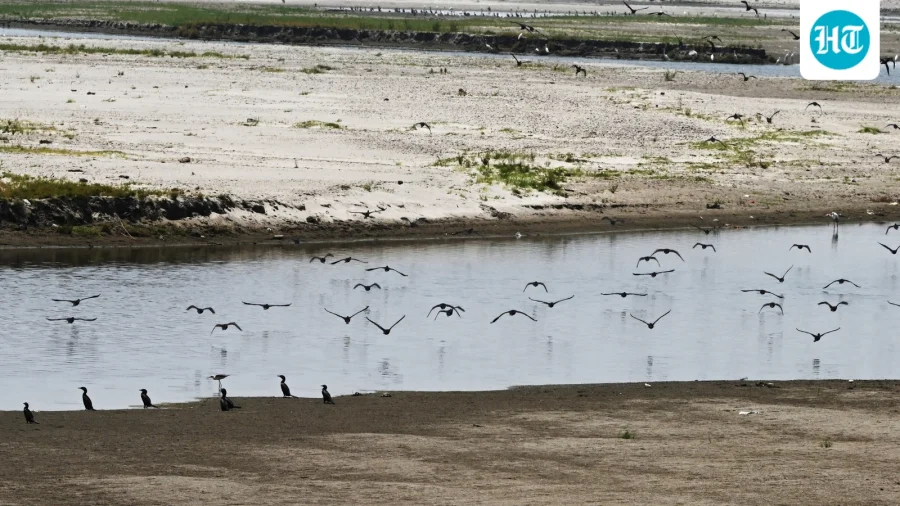
Every summer, the same story unfolds in Delhi. Water supply dwindles, taps run dry, and residents queue for hours with buckets and jerrycans. The official explanation is familiar: extreme summer heat causes evaporation, reducing the water that reaches homes. But this explanation, while true, masks a deeper, more stubborn chokepoint that has kept Delhi's water crisis cyclical for decades.
The evaporation problem — and what it really reveals
Officials like Delhi Jal Board's Gupta have pointed out that extreme summer temperatures cause some of the distributed water to evaporate before it reaches consumers. This is a real phenomenon — in a city where summer temperatures regularly cross 45°C, evaporation losses from open canals and ageing pipes can be significant. But this is not the root cause. It is a symptom of a system that relies on surface water transported over long distances, much of it in open channels, and a distribution network that loses up to 30% of water to leaks and theft.
The real chokepoint: a demand-supply gap that never closes
Delhi's water demand is estimated at around 1,200 million gallons per day (MGD), but the city's supply hovers around 900–950 MGD. That gap — roughly 250 MGD — is the structural chokepoint. It is not a new problem. It has existed for years, widening as the city's population grows and as groundwater levels deplete. The Yamuna, which supplies over 60% of Delhi's water, is heavily polluted and its flow is increasingly unreliable. The city's own groundwater is over-extracted and contaminated in many areas.
Why the same crisis returns every year
The crisis is not a one-off event. It is a predictable annual cycle. Every summer, the combination of higher demand (for drinking, cooling, and washing) and reduced supply (due to lower river flows and evaporation) creates a shortfall. But the underlying infrastructure — the treatment plants, the pipelines, the storage reservoirs — has not been upgraded to match the city's growth. The result is a system that is always on the edge, and every summer pushes it over.
Who bears the brunt
The impact is not uniform. Wealthier neighbourhoods with borewells and storage tanks cope better. But in unauthorised colonies, slums, and low-income areas, residents — especially women and children — spend hours each day fetching water. The crisis deepens existing inequalities. For these communities, the water crisis is not an annual inconvenience; it is a daily struggle that defines their lives.
What the authorities say — and what they don't
Delhi Jal Board officials have acknowledged the evaporation issue and have deployed additional tankers to affected areas. But they have not addressed the fundamental question: why has the supply system not been expanded to meet demand? The answer lies in a combination of political inertia, funding constraints, and the sheer complexity of upgrading a water network in a densely populated city. The Yamuna's pollution, caused by untreated sewage and industrial waste, further complicates the situation, as it reduces the usable water available for treatment.
The deeper analysis: a system designed for a different city
Delhi's water infrastructure was largely built in the 1970s and 1980s, when the city's population was a fraction of what it is today. The system was designed to supply water from the Yamuna and a few other sources, with limited storage. Today, the city has over 20 million residents, and the demand has outstripped the original design capacity. The system has been patched and expanded, but not fundamentally redesigned. This is the chokepoint that keeps returning.
Confirmed facts vs what remains unclear
Confirmed: Delhi's water supply is consistently below demand. The Yamuna is heavily polluted. Evaporation losses are real in summer. The crisis disproportionately affects low-income areas. Unclear: The exact percentage of water lost to evaporation versus leaks. The timeline for any major infrastructure upgrade. The long-term viability of groundwater extraction as a stopgap.
Risks and balanced view
Some argue that the crisis is exaggerated and that Delhi's water supply is actually better than many other Indian cities. Others point out that the real problem is not supply but distribution — that if water were better managed and priced, the crisis could be mitigated. There is also the risk of over-reliance on expensive solutions like desalination or inter-basin water transfers, which could create new dependencies. The balanced view is that the crisis is real, but it is not unsolvable — it requires political will, investment, and a shift in how water is valued.
The wider pattern: a national water crisis
Delhi is not alone. Across India, cities like Bengaluru, Chennai, and Hyderabad face similar water crises, driven by the same combination of population growth, climate change, and ageing infrastructure. The pattern is clear: India's urban water systems were built for a different era, and they are struggling to keep up. The Delhi crisis is a microcosm of a national challenge.
What residents can do now
For those living in Delhi, practical steps include: storing water in advance during summer, using water-saving devices, reporting leaks to the Delhi Jal Board, and supporting local rainwater harvesting initiatives. For those in affected areas, knowing the schedule of water tankers and forming community groups to manage distribution can help. But these are stopgap measures. The real solution lies in systemic change.
What happens next
Without major investment in water recycling, rainwater harvesting, and alternative sources like treated wastewater, the crisis will worsen. Climate change is expected to make summers hotter and rainfall more erratic, further straining the system. The Delhi Jal Board has announced plans to upgrade treatment plants and reduce leaks, but these are long-term projects. In the short term, the same chokepoint will likely return next summer.
Our Take
Delhi's water crisis is not a natural disaster. It is a man-made problem, rooted in decades of underinvestment and a failure to adapt infrastructure to a growing city. The heat is a trigger, not the cause. Until the city addresses the structural gap between demand and supply, the crisis will keep returning — every summer, like clockwork. The real question is not whether the water will run out, but whether the political and administrative system will finally act before it does.
Frequently Asked Questions
Why does Delhi face a water shortage every summer?
Delhi's water shortage is caused by a combination of high summer temperatures causing evaporation, a supply system that cannot meet the city's growing demand, and an ageing infrastructure with significant leaks. The gap between demand (around 1,200 MGD) and supply (around 900–950 MGD) is the core structural issue.
Is the Yamuna the main source of water for Delhi?
Yes, the Yamuna River supplies over 60% of Delhi's water. However, the river is heavily polluted with untreated sewage and industrial waste, which reduces the amount of water that can be treated and used for drinking.
Who is most affected by the water crisis in Delhi?
Low-income communities, residents of unauthorised colonies, and slums are most affected. They often have limited access to borewells or storage tanks and rely on municipal tankers, which are irregular and insufficient.
What can be done to solve Delhi's water crisis?
Long-term solutions include upgrading the water distribution network to reduce leaks, investing in water recycling and rainwater harvesting, reducing pollution in the Yamuna, and exploring alternative sources like treated wastewater. Short-term measures include better management of water tankers and community-level water storage.