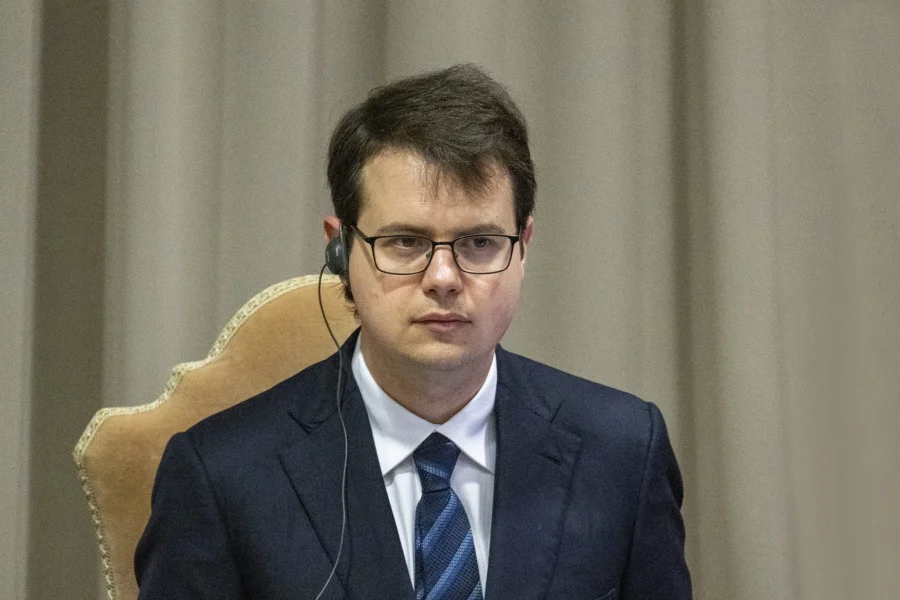
It was an image that seemed almost designed to make the world stop and stare. Inside the Vatican’s Apostolic Palace, Pope Leo XIV — the newly elected leader of the Catholic Church — sat beside a man who openly declares himself an atheist. That man was Chris Olah, the billionaire cofounder of Anthropic, one of the most valuable artificial intelligence companies on the planet. And the message he delivered was as startling as his presence: the tech industry cannot be trusted to govern itself.
Olah was invited to speak during the presentation of the Pope’s first encyclical — a formal papal letter — which focuses on the dangers of artificial intelligence. For a self-described atheist to be chosen to sit beside the Pope and address the world on such a weighty topic is extraordinary. But what Olah said inside those ancient walls has sent ripples far beyond the Vatican.
An Unlikely Messenger at the Heart of the Catholic Church
Chris Olah is not a name most people know. But inside the world of AI safety research, he is a towering figure. As the cofounder and interpretability research lead at Anthropic — the company behind the Claude AI model — Olah has spent years trying to understand how AI systems actually think and make decisions. His field, called interpretability, is about peering inside the black box of neural networks to see what is really happening.
When he stood up to speak at the Vatican last week, Olah acknowledged the strangeness of the moment. “I want to begin with something that may sound strange coming from the co-founder of an AI company,” he said, according to prepared remarks. He then proceeded to deliver a message that many in Silicon Valley did not want to hear.
Why This Matters Right Now
This is not just a story about one man or one speech. It is about a growing global reckoning with artificial intelligence. Governments, religious institutions, civil society groups, and ordinary citizens are all waking up to the fact that AI is evolving faster than any regulatory framework can contain. The Pope choosing to make AI the subject of his first encyclical signals that the Catholic Church sees this as a moral and existential issue. And the fact that he chose an atheist AI researcher to sit beside him suggests that the Church is willing to listen to voices from outside its own walls.
For readers in India, where AI adoption is accelerating rapidly across sectors from education to healthcare to finance, the Vatican’s intervention and Olah’s warning carry direct relevance. The question of who governs AI — and whether tech companies can be trusted to do it themselves — is not a distant debate. It is unfolding right now.
How the Vatican Invitation Came About
The details of how Olah came to be seated beside the Pope remain somewhat unclear. But the invitation itself is a reflection of Pope Leo XIV’s approach to his papacy. Unlike his predecessor, who was known for a more traditionalist stance, Pope Leo has signaled a willingness to engage with the modern world on its own terms — including the world of technology.
Anthropic, founded in 2021 by former OpenAI researchers including Olah, has positioned itself as the “safety-first” AI company. Its mission statement emphasizes responsible AI development, and Olah’s own work on interpretability is central to that mission. The Vatican, in seeking a credible voice from inside the AI industry who would not simply defend the status quo, found a natural partner in Olah.
What Olah Told the Vatican — and the World
In his speech, Olah did not mince words. He argued that the AI industry is under immense pressure — from profit motives, from geopolitical competition, and from the sheer speed of technological advancement. In such an environment, he said, companies cannot be relied upon to police themselves.
“My hope is we can balance humanity and advancement in technology,” Olah said, according to reports. He called for AI development to be guided by voices beyond Big Tech — including governments, civil society, and religious institutions. It was a remarkable admission from a man who helped build one of the most powerful AI companies in existence.
Olah’s presence at the Vatican was not just symbolic. It represented a growing recognition that the AI debate cannot be left to technologists alone. The Pope’s encyclical, and Olah’s speech, together form a powerful argument for a new kind of governance — one that includes moral, ethical, and spiritual dimensions alongside technical expertise.
What We Know So Far — and What Remains Unclear
What is confirmed: Chris Olah, cofounder of Anthropic, spoke at the Vatican during the presentation of Pope Leo XIV’s first encyclical on AI. He acknowledged his unusual position as an atheist speaking in a religious setting. He called for broader governance of AI beyond the tech industry.
What remains unclear: The full text of Olah’s speech has not been publicly released in its entirety. The exact nature of his private conversations with the Pope is unknown. Whether this signals a deeper collaboration between the Vatican and Anthropic is also not confirmed.
Risks, Concerns, and the Balanced View
Olah’s message is powerful, but it is not without its critics. Some in the AI industry argue that self-regulation is working, and that government intervention could slow innovation. Others point out that Anthropic itself is a for-profit company with billions in funding — and that its “safety-first” branding is also a competitive advantage in the marketplace.
There is also the question of whether religious institutions should have a seat at the table in AI governance. Critics argue that the Catholic Church’s positions on issues like contraception and abortion could influence AI policy in ways that are not universally accepted. Supporters counter that moral and ethical guidance is exactly what is missing from the current debate.
Olah’s own position is also worth examining. As a billionaire cofounder, he represents the very industry he is warning about. His call for outside governance could be seen as genuine concern — or as a strategic move to shape regulation in ways that benefit Anthropic.
Why the Tech Industry’s Self-Governance Model Is Under Scrutiny
The debate over AI self-governance is not new, but it has intensified dramatically in recent months. High-profile incidents — from AI-generated misinformation to concerns about job displacement to fears about autonomous systems — have eroded public trust in the industry’s ability to manage itself.
Olah’s Vatican speech is part of a broader pattern. Other AI leaders, including OpenAI’s Sam Altman and Google’s Demis Hassabis, have also called for regulation. But Olah’s message was different because of where it was delivered. The Vatican is not a tech conference. It is an institution that has shaped moral discourse for two millennia. By choosing to speak there, Olah elevated the conversation beyond Silicon Valley.
- Anthropic has raised over $7 billion in funding, including major investments from Google and Amazon.
- The company’s Claude AI model is considered one of the most advanced and safety-focused in the industry.
- Olah’s interpretability research has been published in top scientific journals and is widely respected.
“I want to begin with something that may sound strange coming from the co-founder of an AI company.” — Chris Olah, at the Vatican
What Readers, Users, and Investors Should Know Now
For anyone using AI tools — whether ChatGPT, Claude, or Google Gemini — Olah’s warning is a reminder that the technology is not neutral. It is shaped by the values and incentives of the companies that build it. Users should be aware that AI systems can reflect biases, make mistakes, and be used in ways that their creators did not intend.
For investors, the Vatican moment is a signal that regulatory risk is real. Governments around the world are moving toward stricter AI oversight. Companies that are seen as responsible and transparent may benefit, while those that resist regulation could face backlash.
For policymakers, Olah’s message is clear: do not leave AI governance to the tech industry. The Vatican’s involvement suggests that even the oldest institutions in the world recognize the urgency of this moment.
What Could Happen Next
The Vatican’s engagement with AI is unlikely to end with one encyclical. Pope Leo XIV has signaled that this is a priority for his papacy. There could be further dialogues, working groups, or even formal Vatican positions on AI ethics.
Anthropic, meanwhile, continues to push its safety-first narrative. Olah’s Vatican appearance will likely be used to reinforce the company’s brand as the responsible alternative in the AI industry. But the pressure to compete with OpenAI, Google, and others means that Anthropic will face constant tension between its safety mission and its business goals.
The broader trend is clear: AI governance is moving from the boardroom to the public square. The Vatican’s entry into this debate is a sign that the conversation is becoming more inclusive — and more urgent.
Our Take: Why This Story Matters Beyond One Incident
The image of an atheist AI billionaire sitting beside the Pope is more than a curiosity. It is a symbol of the strange new world we are entering. The old divisions — between science and religion, between technology and morality — are breaking down. The questions raised by AI are so profound that they demand answers from every quarter.
Chris Olah may not believe in God. But he clearly believes that the tech industry needs a moral compass. And he chose to make that argument in the one place on Earth that has been offering moral guidance for two thousand years. That is not irony. It is recognition that the AI revolution is too important to be left to the technologists alone.
FAQs
Who is Chris Olah and why was he at the Vatican?
Chris Olah is the cofounder and interpretability research lead at Anthropic, the AI company behind the Claude model. He was invited by Pope Leo XIV to speak during the presentation of the Pope’s first encyclical on the dangers of artificial intelligence. Olah is a self-declared atheist, making his presence beside the Pope symbolically significant.
What did Chris Olah say about AI governance at the Vatican?
Olah warned that the AI industry cannot govern itself due to pressures from profit motives and geopolitical competition. He called for AI development to be guided by voices beyond Big Tech, including governments, civil society, and religious institutions. He acknowledged that his message might sound strange coming from an AI company cofounder.
Why did the Pope choose an atheist AI researcher for this event?
Pope Leo XIV has signaled a willingness to engage with the modern world on its own terms. By inviting Olah, the Pope demonstrated that the Catholic Church is open to hearing from credible voices inside the AI industry — even those who do not share its religious beliefs. The choice reflects a pragmatic approach to addressing AI’s moral and ethical challenges.
What is Anthropic and why is its safety focus important?
Anthropic is an AI company founded in 2021 by former OpenAI researchers, including Chris Olah. It has positioned itself as a safety-first alternative to competitors like OpenAI and Google. The company’s focus on interpretability — understanding how AI models make decisions — is central to its mission of building responsible AI. Anthropic has raised over $7 billion in funding.