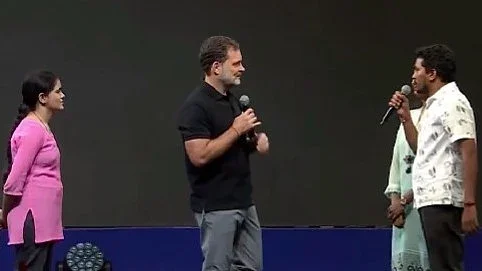
Rahul Gandhi walked into a hall full of students in Indore on Saturday and told them something that sounded less like a campaign line and more like a warning: the people in power are afraid of you. Not because of your numbers, he said, but because of your questions.
"Students are a threat to the system because students ask questions," the Congress leader said at the 'Chhatron Ki Goonj' programme, according to the original report of the event.
What Rahul Gandhi Actually Said in Indore
Speaking to the gathering, Gandhi framed students not as beneficiaries waiting for policy but as a pressure point the establishment would rather avoid. He alleged that the system "hates students" and "loves blind followers" — a line that drew the sharpest contrast of the day.
He also claimed that institutions across the country had been captured by the system, and that this capture is why questioning authority has become uncomfortable for those who hold power.
Why a Speech About Students Lands Differently Right Now
Students are not a niche audience in Indian politics. They are first-time voters, campus organisers, and the loudest voices on issues from exam delays to unemployment. A leader telling them their questions are a threat is a direct appeal to that energy.
It also flips a familiar script. Politicians usually ask students for votes. Gandhi, in Indore, asked them to keep interrogating the system instead.
How the Congress Leader Built His Argument
The core of Gandhi's message rested on a simple claim: institutions that should be neutral have instead been absorbed by the political establishment. If that is true, he argued, then anyone who asks uncomfortable questions — especially young people with nothing to lose — becomes a problem.
He positioned students as India's future and said they should be encouraged to question institutions rather than accept decisions quietly.
Who This Message Is Aimed At
The audience in Indore was not accidental. Madhya Pradesh has a large student population, and campus sentiment has become a live political variable in recent years. Gandhi's remarks appear designed to travel beyond the hall — to WhatsApp groups, college corridors, and short-video feeds.
For students who feel unheard on jobs, fees, and exam systems, the framing offers recognition. For critics, it will read as another instance of the opposition casting institutions as captured.
What the Other Side Has Said — and What It Hasn't
At the time of writing, there was no official response from the government or from the institutions referenced in Gandhi's remarks. No clarification or rebuttal had been reported.
That silence matters. In political cycles, an unanswered allegation often becomes the next round of debate rather than the end of it.
Reading the Line Between Rhetoric and Record
Gandhi's claim that the system "fears" students is a political characterisation, not a documented finding. It is his interpretation of how power responds to dissent.
What is verifiable is narrower and clearer: he said it, at a public event, in front of students, and he tied it to a broader allegation that institutions have been captured.
Confirmed Facts vs What Remains Unclear
Confirmed: Gandhi spoke at the 'Chhatron Ki Goonj' programme in Indore on Saturday. He said students are a threat to the system because they ask questions. He alleged the system hates students and loves blind followers. He said students are India's future and should question institutions.
Unclear: Which specific institutions he was referring to. Whether the government or any institution will respond formally. Whether the remarks will translate into any organisational follow-up by Congress.
The Political Calculation Behind the Message
Youth outreach has become a crowded space. Every major party now runs student wings, campus campaigns, and digital pushes aimed at first-time voters. Gandhi's Indore line gives Congress a sharper emotional hook than a policy document would.
It also carries risk. Framing institutions as captured invites the counter-argument that the opposition is undermining trust in them — a charge that has been traded between parties for years.
A Pattern, Not a One-Off
This is not the first time Gandhi has built a public message around questioning authority. His recent political communication has repeatedly returned to the idea that institutions need to be held accountable, and that young people are the ones who can do it.
The Indore speech fits that pattern — and it is aimed at an audience that will carry the message into campuses long after the event ends.
What Students Should Take From This
Political speeches are not policy. Gandhi's remarks are a call to engage, not a roadmap. Students who want to act on them have practical routes: campus unions, student elections, public consultations, RTI requests, and structured dialogue with institutional leadership.
Questioning authority is legal and legitimate. Doing it with evidence, organisation, and follow-through is what turns a slogan into change.
What Could Happen Next
Expect the remarks to be clipped, shared, and contested. Congress is likely to repeat the framing in other student-facing events. The government or the institutions named may respond, or may let the comment pass.
Either way, the line — "students are a threat to the system because students ask questions" — is built to outlive the event that produced it.
Our Take
Gandhi's Indore speech is less about students than about the relationship between power and scrutiny. By casting students as the system's biggest fear, he is making a bet that young voters want to be seen as interrogators, not beneficiaries.
Whether that bet pays off depends on whether the message is matched by action — and whether students, who are used to being addressed during elections and ignored between them, decide this time is different.
Frequently Asked Questions
What did Rahul Gandhi say in Indore?
At the 'Chhatron Ki Goonj' programme in Indore, Rahul Gandhi said students are a threat to the system because they ask questions. He alleged the system "hates students" and "loves blind followers," and claimed institutions across the country have been captured.
When and where did Rahul Gandhi make these remarks?
He made the remarks on Saturday while addressing the 'Chhatron Ki Goonj' programme in Indore, Madhya Pradesh.
Did the government or any institution respond to Rahul Gandhi's allegations?
No official response from the government or the institutions referenced in his remarks was available at the time of writing.
Why are Rahul Gandhi's Indore remarks significant?
The remarks sharpen Congress's outreach to students and first-time voters, and frame questioning authority as a political act. They are likely to be widely shared and contested in the coming days.
[NEWS_SCHEMA] {"@context":"https://schema.org","@type":"NewsArticle","headline":"Rahul Gandhi in Indore Says the System Fears Students — And That Fear Is the Point","description":"Rahul Gandhi said in Indore that the system fears students because they ask questions, alleging institutions have been captured and now \"love blind followers.\"","image":"","datePublished":"","dateModified":"","author":{"@type":"Person","name":"Newsroom Desk","url":"","sameAs":[]},"publisher":{"@type":"Organization","name":"","logo":{"@type":"ImageObject","url":""}},"mainEntityOfPage":{"@type":"WebPage","@id":""},"articleSection":"India Politics","keywords":"Rahul Gandhi Indore students, Chhatron Ki Goonj, Rahul Gandhi Indore speech, Congress students, Rahul Gandhi system remarks"} [SOURCES] Original story report — 'System fears students because they ask questions: Rahul Gandhi in Indore' (as provided). No additional high-confidence sources were available at the time of writing.