Rahul Gandhi's message from Indore was short, but it landed like a challenge: a system, he said, is afraid of students who ask questions. Within hours, Madhya Pradesh Chief Minister Mohan Yadav had responded — not by disputing the sentiment, but by questioning the substance behind it.
What Rahul Gandhi Said in Indore — And Why It Struck a Nerve
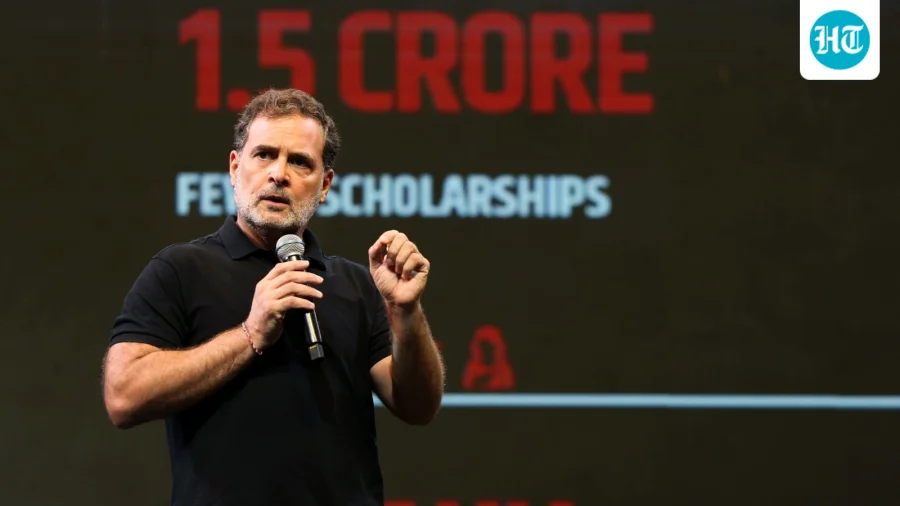
Speaking at a public event in Indore, the Congress leader framed questioning as the core of learning. His line — that the "system is afraid of students who ask questions" — was directed at the broader environment in which Indian students study, speak, and organise.
The phrasing was deliberate. It positioned students not as beneficiaries of the system but as its most important critics. That framing is what gave the remark its political charge.
Mohan Yadav's Counter: 'Show the Facts and Data'
Chief Minister Mohan Yadav did not let the comment pass. In his response, he said Rahul Gandhi should have presented facts and data while speaking about education and children.
It was a pointed rebuttal — not a denial of the concern, but a demand for evidence. By shifting the ground from sentiment to statistics, Yadav attempted to reframe the debate around the state's record rather than the Congress leader's rhetoric.
Why This Exchange Matters Beyond Indore
Education has become one of the most contested terrains in Indian politics. Every claim about students — their freedom, their curriculum, their future — is now also a claim about governance.
When a national opposition leader speaks about students in a state ruled by the BJP, and the Chief Minister responds within the same news cycle, the story is no longer local. It becomes a template for how both sides will argue about education in the months ahead.
How the Story Developed
The sequence was straightforward: Rahul Gandhi spoke in Indore, made the remark about students and questioning, and the Chief Minister issued a public response. Both statements are on record.
No further escalation — no formal complaint, no official inquiry, no follow-up event — has been reported at the time of writing. The exchange currently exists as a political argument, not a legal or administrative one.
Who This Actually Affects
For students in Madhya Pradesh and across India, the practical question is not who won the exchange. It is whether the environment in which they study, question, and organise is becoming more open or more cautious.
For parents and teachers, the debate touches on something more immediate: whether asking difficult questions in a classroom is treated as a virtue or a risk. That is the question neither statement fully answers.
What Each Side Is Really Saying
Rahul Gandhi's remark is a claim about culture — that the system's instinct is to discourage dissent rather than engage with it. It is a critique of atmosphere, not of any single policy.
Mohan Yadav's response is a claim about accountability — that sweeping statements about education should be backed by verifiable numbers. It is a critique of rhetoric, not of the underlying concern.
Both framings are politically useful. Neither, on its own, settles the question of what students actually experience.
Confirmed Facts vs What Remains Unclear
Confirmed: Rahul Gandhi made the remark in Indore. Mohan Yadav publicly responded, asking for facts and data on education and children. Both statements are attributed and on record.
Unclear: The specific context within Gandhi's speech that prompted the line, the exact data Yadav was referring to, and whether either side plans a formal follow-up. Any interpretation beyond the statements themselves remains speculation.
Risks and the Balanced View
The risk in exchanges like this is that education — a subject that demands patience and detail — gets reduced to a slogan war. Students become a backdrop for political positioning rather than the centre of the conversation.
There is also a counter-risk: that demands for "facts and data" become a way of avoiding the harder question of whether students feel free to speak. Numbers can measure enrolment and outcomes; they cannot easily measure fear or hesitation.
A fair reading is that both men are speaking to different audiences — one to those who feel unheard, the other to those who want proof. The student is caught between the two.
The Wider Pattern
This is not an isolated exchange. Across India, education has become a proxy for larger arguments about freedom of expression, institutional autonomy, and the role of the state in shaping young minds.
Whenever a national leader speaks about students, and a state leader responds, the pattern repeats: sentiment versus statistics, atmosphere versus achievement. The Indore exchange fits neatly into that template.
What Readers Should Take Away
For students and parents, the useful move is to separate the political noise from the practical question: what is actually happening in classrooms, and what can be done about it locally.
For observers of politics, the takeaway is simpler. When both sides argue about education, the argument is rarely only about education. It is about who gets to define the story of India's young people.
What Could Happen Next
Further statements from either side are likely, particularly if the remark gains traction in national media. The Congress may use it to press its broader critique; the BJP may use it to highlight the state's education record.
What is less certain is whether the exchange produces any concrete outcome — a policy debate, a legislative discussion, or a sustained public conversation about students. On current evidence, it remains a political moment, not yet a policy one.
Our Take
The Indore exchange is a small but telling example of how India debates education. One side speaks in the language of freedom; the other in the language of evidence. Both are legitimate. Neither is complete.
What matters is whether the argument eventually returns to the people it claims to be about — the students. If it does not, the exchange will be remembered as another headline, not a turning point.
Frequently Asked Questions
What exactly did Rahul Gandhi say in Indore?
He said the "system is afraid of students who ask questions," framing questioning as central to education and criticising the environment in which students study and speak.
How did Mohan Yadav respond?
The Madhya Pradesh Chief Minister said Rahul Gandhi should have presented facts and data while speaking about education and children, shifting the debate from sentiment to evidence.
Is this a legal or administrative matter?
No. It is a political exchange between two leaders. No formal complaint, inquiry, or official action has been reported.
Why is this story significant?
It reflects a wider pattern in Indian politics where education becomes a proxy for debates about freedom of expression, governance, and the state's role in shaping young minds.