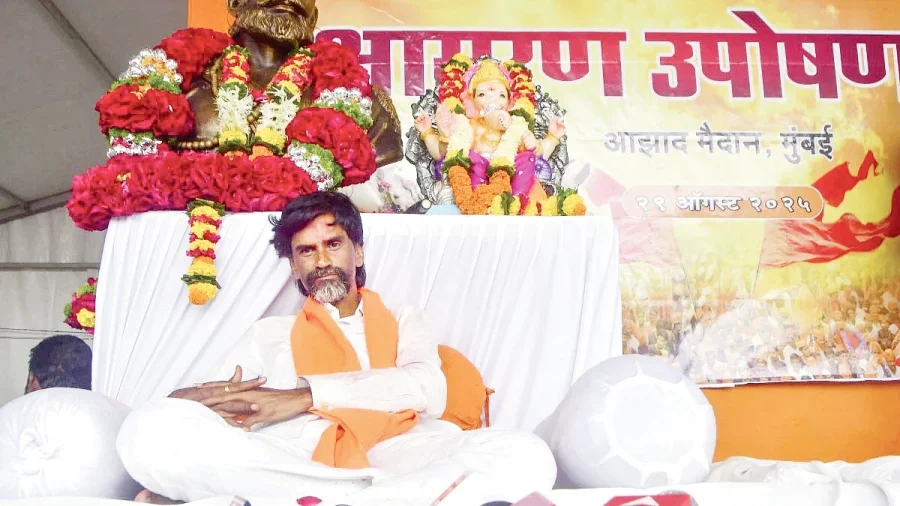
For the Devendra Fadnavis government, the arithmetic was uncomfortable. Manoj Jarange-Patil was fasting again in Jalna, and he had made clear he intended to bring his Maratha quota agitation to Mumbai — right in the middle of Ganeshotsav.
That single sentence explains why the state's political temperature rose even before the first aarti was performed.
A fast in Jalna, a march toward Mumbai
Jarange began what is being described as his 12th Maratha-quota fast since 2014 — cumulatively over a hundred days of protest — at Antarwali Sarati in Jalna district, in the Marathwada region.
After roughly two weeks at the site, he set out on a march to Mumbai, where he planned to resume the protest. The location was the point. Not a village ground, not a district collectorate — Mumbai, at festival peak.
Why Ganeshotsav made the government nervous
Mumbai in Ganeshotsav is a city operating at maximum load. Processions, mandals, crowds and traffic converge, and policing the city becomes a daily balancing act even without a political agitation in the middle of it.
Add the retreating monsoon, which has a habit of delivering heavy, disruptive rain in exactly this window, and the state's anxiety becomes easier to understand. A protest that would be manageable in February is a different problem in September.
What the Maratha quota demand actually is
The core demand is reservation for the Maratha community in education and government jobs — a question that has moved through Maharashtra's courts, streets and assembly for years without a settled answer.
Jarange's method has been sustained, repetitive fasting, which is precisely what makes it politically difficult to ignore. A fast is not a rally. It cannot be dispersed, only answered or endured.
The UCC thread running alongside
The headline framing of this moment also points to the Uniform Civil Code, which has re-entered Maharashtra's political conversation. The two issues — Maratha reservation and the UCC — are not the same demand, but they occupy the same political space.
Both force the state government to take positions that will please one constituency and unsettle another. Both are being watched closely by communities that have learned to read political silence as a signal.
What is confirmed, and what is not
Confirmed: Jarange's fast at Antarwali Sarati, the cumulative count of his protests since 2014, his stated plan to resume in Mumbai, and the government's concern about the timing.
Unclear: The precise terms of any understanding between Jarange and the state, whether the Mumbai leg of the protest proceeded as planned, and what specific assurances, if any, were offered. Any claim beyond this should be treated as speculation until officially confirmed.
The political cost of a festival confrontation
For the Fadnavis government, the risk was never only law and order. It was optics. Dispersing a fasting Maratha leader during a religious festival is a visual that travels fast and lasts longer than any press note.
Equally, allowing an indefinite protest in the middle of Mumbai's biggest festival invites criticism from residents and from the opposition. There was no clean option — only the least damaging one.
Why this keeps returning
Maratha reservation has now outlasted multiple governments, multiple commissions and multiple rounds of litigation. Each time it appears settled, it returns — because the underlying demand has not been met in a form that satisfies both the community and the courts.
That is the pattern worth noting. This is not a new crisis. It is an old one, rescheduled.
What readers in Maharashtra should watch
Watch the location, not the rhetoric. Where a protest is held tells you more about its leverage than what is said at it. A fast in Jalna is a moral appeal; a fast in Mumbai is a deadline.
Also watch the state's language. Any shift from "examining" to "committed" — or the reverse — is the real signal on where the quota question is heading.
What could happen next
The immediate question is whether the Mumbai phase of the agitation proceeds, is deferred, or is negotiated down. Beyond that, the Maratha quota file returns to the same unresolved place it has occupied for a decade.
And the UCC debate, now running parallel, gives the government a second front it cannot easily close.
Our Take
This story is less about one fast and more about a government being asked to solve, under festival-season pressure, a question it has not solved in ten years. Jarange's leverage comes not from numbers on the street but from timing — and he has learned to use it.
The UCC's return to the same political frame suggests Maharashtra is entering a phase where two difficult, emotionally charged questions will compete for the same limited political room. Neither will be resolved quickly. Both will shape the state's next election arithmetic.
Frequently Asked Questions
Who is Manoj Jarange-Patil?
He is a Maratha community leader from Jalna district in Maharashtra's Marathwada region, known for leading sustained hunger strikes demanding reservation for the Maratha community in education and government jobs.
Why did he plan to protest in Mumbai during Ganeshotsav?
Mumbai during Ganeshotsav draws maximum public and media attention. Holding the protest there would have increased pressure on the state government, which is why the timing and location were politically significant.
What is the Maratha quota demand?
The demand is for reservation for the Maratha community in education and government employment. It has been the subject of repeated agitations, committee reports and court proceedings in Maharashtra over several years.
How does the UCC connect to this story?
The Uniform Civil Code has re-entered Maharashtra's political debate at the same time, adding a second contentious issue to the state's agenda. The two are separate demands but compete for the same political attention and carry similar risks for the government.